Skip to content
  • Home
  • About Me
  • Where I’ve Been
  • Destinations
    • Africa
      • Algeria
      • Benin
      • Botswana
      • Burkina Faso
      • Côte d’Ivoire
      • Democratic Republic of the Congo
      • Djibouti
      • Egypt
      • Eritrea
      • Ethiopia
      • Ghana
      • Mauritania
      • Morocco
      • Rwanda
      • Senegal
      • South Sudan
      • Sudan
      • Togo
      • Tunisia
      • Uganda
      • Zambia
      • Zimbabwe
    • Asia
      • Azerbaijan
      • Bangladesh
      • Brunei Darussalam
      • Cambodia
      • China
      • Cyprus
      • Georgia (the country)
      • Hong Kong
      • India
      • Indonesia
      • Iraq
      • Japan
      • Jordan
      • Kazakhstan
      • Kuwait
      • Kyrgyzstan
      • Laos
      • Mongolia
      • Myanmar (Burma)
      • Malaysia
      • Nepal
      • Oman
      • Pakistan
      • Philippines
      • Qatar
      • Saudi Arabia
      • Singapore
      • South Korea
      • Taiwan
      • Thailand
      • Turkey
      • United Arab Emirates
      • Uzbekistan
      • Vietnam
      • Yemen
    • Europe
      • Albania
      • Andorra
      • Belarus
      • Belgium
      • Bosnia and Herzegovina
      • Bulgaria
      • Croatia
      • Denmark
      • England
      • Estonia
      • Finland
      • France
      • Germany
      • Greece
      • Iceland
      • Ireland
      • Italy
      • Latvia
      • Liechtenstein
      • Lithuania
      • Luxembourg
      • Malta
      • Moldova
      • Monaco
      • Montenegro
      • Netherlands
      • North Macedonia
      • Norway
      • Poland
      • Portugal
      • Romania
      • Russia
      • San Marino
      • Scotland
      • Serbia
      • Slovenia
      • Spain
      • Sweden
      • Switzerland
      • Ukraine
      • United Kingdom
      • Vatican City
    • North America
      • Belize
      • Canada
      • Cuba
      • El Salvador
      • Guatemala
      • Mexico
      • Nicaragua
      • Panama
      • USA
    • South America
      • Argentina
      • Brazil
      • Colombia
      • Ecuador
      • Paraguay
      • Peru
      • Uruguay
      • Venezuela
  • Contact
Menu

Wandering North

Chronicling my travel adventures since 2007

  • Home
  • About Me
  • Where I’ve Been
  • Destinations
    • Africa
      • Algeria
      • Benin
      • Botswana
      • Burkina Faso
      • Côte d’Ivoire
      • Democratic Republic of the Congo
      • Djibouti
      • Egypt
      • Eritrea
      • Ethiopia
      • Ghana
      • Mauritania
      • Morocco
      • Rwanda
      • Senegal
      • South Sudan
      • Sudan
      • Togo
      • Tunisia
      • Uganda
      • Zambia
      • Zimbabwe
    • Asia
      • Azerbaijan
      • Bangladesh
      • Brunei Darussalam
      • Cambodia
      • China
      • Cyprus
      • Georgia (the country)
      • Hong Kong
      • India
      • Indonesia
      • Iraq
      • Japan
      • Jordan
      • Kazakhstan
      • Kuwait
      • Kyrgyzstan
      • Laos
      • Mongolia
      • Myanmar (Burma)
      • Malaysia
      • Nepal
      • Oman
      • Pakistan
      • Philippines
      • Qatar
      • Saudi Arabia
      • Singapore
      • South Korea
      • Taiwan
      • Thailand
      • Turkey
      • United Arab Emirates
      • Uzbekistan
      • Vietnam
      • Yemen
    • Europe
      • Albania
      • Andorra
      • Belarus
      • Belgium
      • Bosnia and Herzegovina
      • Bulgaria
      • Croatia
      • Denmark
      • England
      • Estonia
      • Finland
      • France
      • Germany
      • Greece
      • Iceland
      • Ireland
      • Italy
      • Latvia
      • Liechtenstein
      • Lithuania
      • Luxembourg
      • Malta
      • Moldova
      • Monaco
      • Montenegro
      • Netherlands
      • North Macedonia
      • Norway
      • Poland
      • Portugal
      • Romania
      • Russia
      • San Marino
      • Scotland
      • Serbia
      • Slovenia
      • Spain
      • Sweden
      • Switzerland
      • Ukraine
      • United Kingdom
      • Vatican City
    • North America
      • Belize
      • Canada
      • Cuba
      • El Salvador
      • Guatemala
      • Mexico
      • Nicaragua
      • Panama
      • USA
    • South America
      • Argentina
      • Brazil
      • Colombia
      • Ecuador
      • Paraguay
      • Peru
      • Uruguay
      • Venezuela
  • Contact

Tag: temple

Posted inAsia Asian capital trip 2023 Brunei Darussalam

Brunei Darussalam

I flew from Manila to Bandar Seri Begawan, Brunei. It was one of those places I knew little about but decided to go to because I was in the area, so to speak. I would be there for about 36 hours, which was just right, I think, for a visit to the capital. Since Brunei is a bit lesser known, here are some fast facts…

Fast Facts

Brunei Darussalam (Or just ‘Brunei’, if you’re cool) is a teeny tiny country on the island of Borneo (surrounded by Malaysia) in South East Asia.  It is a bit bigger than Luxembourg, but smaller than Rwanda.  Most of it is rain forest. About 500,000 people live there. It was controlled by the British until 1984 when it gained true independence. It is a Muslim country. The capital is Bandar Seri Begawan, which is where I was visiting.

flag of Brunei

I feel like the things that Brunei is most famous for its (1) being wealthy [oil]; and (2) the Sultan. The Sultan of Brunei, Sultan Haji Hassanal Bolkiah Mu’izzaddin Waddaulah ibni Al-Marhum Sultan Haji Omar ‘Ali Saifuddien Sa’adul Khairi Waddien (or Hassanal Bolkiah ibni Omar Ali Saifuddien III for short), is currently the longest serving monarch in the world.  He has been on the throne since October 1967. (When he assumed leadership, Sergeant Pepper’s Lonely Hearts Club Band was a brand new album.) The first time I heard of him was in the 1990s when a lawsuit was filed in the US alleging that he invited beauty pageant winners to Brunei and then kept them as sex slaves.  (The lawsuit was dismissed because he’s the Sultan.) Here’s what seems to be verifiable about him: He loves excess and pomp and circumstance (a visit to the museum is a must do – the palanquin alone is worth a glimpse because of its scale). In the 2010s he adopted Sharia law into the penal code. Although he ultimately rolled back things like death by stoning and amputation, it’s still pretty strict. It’s illegal not to attend Friday prayers if you are Muslim and alcohol is banned.

Back to the travel report…

I arrived in Brunei at about midnight. The border crossing was easy and I went to take a taxi to my hotel. The thing that proved problematic was paying for the taxi. There was no public transportation at this time of night so the taxi was my only option. The issue was, I didn’t have any local currency (Brunei Dollars) and all of the currency exchange facilities at the airport were closed. I tried the two ATMs at the airport and neither of them worked with either of my two cards. Fortunately, I had a stash of US dollars on me and so I approached two of the taxi drivers that were hanging around out front of the airport (the only two taxi drivers that I found) and I negotiated a ride to my hotel. It was a little bit frustrating because I didn’t have small enough bills and so I ultimately ended up overpaying I think for the taxi ride. So my advice is when arriving at the Brunei airport late at night, make sure you have cash in small denominations (and in perfect condition – the taxi drivers would not even accept bills with creases).

I arrived at my hotel the Qing Yun Resthouse Bandar, which is perfectly located right across from the waterfront in a very central location and it’s also extremely affordable. It was brand new and spotlessly clean however my room didn’t have any windows, which was less than ideal. Whatever, I would only be there one day.

windowless room at Qing Yun Resthouse Bandar

The man working at the hotel (the only person I saw at the hotel) also didn’t speak English. Brunei is one of these places where English is not widely spoken and I had (admittedly) made little to no effort to learn any Malay, so communication sometimes was a challenge, but again I relied on my excellent charades and awkward smiling.

The Terrestrial Sights

My initial impression of the capital was that it was not that impressive. It just looked sort of ordinary. That initial impression was softened as I saw ‘the sights’ and explored a bit more.

On my way in from the airport I had passed a couple of incredible looking mosques by the side of the highway I never did make it back to them. I tried to snap a couple of pictures from the taxi window and failed miserably but even in the blurry captures you can still get a sense of the grandeur of them.

Life moves pretty fast in Brunei…

My first stop was the big Omar Ali Saifuddien Mosque. The Omar Ali Saifuddien Mosque is definitely the most recognizable site from Brunei, and rightly so. It’s spectacular. It looks like something out of a fairy tale; huge, white, golden gleaming, and sitting in the middle of a pond; every angle of it is astonishing. It’s not astonishingly old, however; It was built in the 1950s.

Omar Ali Saifuddien Mosque

I walked around it and attempted to snap a couple of selfies and then eventually went inside for a look at the interior which was lovely. The men outside who were working on the grounds were very friendly everyone wanted to know where I was from and to chat as best we could.

Omar Ali Saifuddien Mosque interior

The thing that was a little bit disappointing about Brunei was that when I arrived it was cloudy and raining, which I figured would spoil my photos. How wrong I was! My favourite photo of the big mosque ended up being the one with the stormiest looking skies. The clouds lifted and the sun came out later and I went back to take more photos, but I didn’t think those had the same atmosphere.

stormy skies
sunny skies

I went to the Royal Regalia Museum. There is more than one museum, but I only went to the one. It’s worth going to learn about the history of Brunei and the Sultan and look at the artifacts and riches of the Sultan and his family.

Royal Regalia Museum

The Aquatic Sights

Beyond that, and without leaving the general downtown area of the capital, there isn’t much else to do in Brunei itself – on land. There are however some excellent excursions that can be made on the water. From the waterfront there are boats floating around and as I walked along the waterfront several of them would slow down and call out to me to see if I wanted a ride. One man who spoke a little English engaged in conversation with me and I told him I was interested in seeing the floating village and the mangrove forests and he agreed to take me out. I forget the exact price, but it was quite cheap.

We went out for about an hour or so, first through the water village of Kampong Ayer. It’s a small village located on the water (houses on stilts and floating structures) just off the shore from the capital of Brunei. About 10,000 people live here. Apparently, it has been a village for centuries, although at this point the houses all look quite new.

Kampong Ayer
Kampong Ayer

We sailed around the village looking at the different houses. We didn’t stop anywhere to visit anyone, although I understand that is possible.

boating in Brunei

From there we went into the mangrove forests past thick walls of green trees. Going this way was quite interesting, and it gave us a view of the Sultan’s palace rising above the treetops, shining white.

One of the great things about going into the mangrove forests in Brunei is that if you’re very lucky you’ll see the proboscis monkeys, otherwise known as the ‘big nosed monkeys’. It was pretty extraordinary: we didn’t have to go very far before we saw them up in the trees; maybe about four or five of them. They were sitting and hanging out and sort of jumping from tree branch to tree branch, and I could definitely see their noses which were in fact, well, kind of like penises or potatoes, and very large. I tried to get some photos but they were all useless. This is the best one:

proboscis monkey

The only other wildlife that we saw on this trip was an alligator who had drowned and was floating belly up in the river and was quite bloated. I’m not going to post that picture because it’s very gross.

The under-looked thing about taking a boat out in Brunei is that if your boat captain is cool (and mine was), you can smoke on the boat. In addition to alcohol being banned in Brunei, smoking is pretty much banned. It’s not illegal to smoke, but the smoking restrictions are so severe that I couldn’t find a place enjoy a cigar. You can’t smoke inside or on sidewalks or on patios or balconies or in parks or on paths… And I was told that you will be found and you will be fined. As far as I understand it, the best place is to get a smoking hotel room, and those do exist; but I didn’t have one of those, so I was delighted to get to smoke on the boat, even if it was just cigarillos and not a full cigar.

I’m on a boat

Back on Land

After my boat adventure, I had lunch at a little cafe near my hotel which was quite nice, and I chatted with the owner as I was the only person there. We talked for about an hour, and he gave me his feelings about living in Brunei, which seemed to be lukewarm at best.

I spent the next couple of hours just walking around the city.

I visited a picturesque Chinese temple: Teng Yun temple.

It was at this point that I felt like I had really done everything I wanted to do in Bandar Seri Begawan, and I was satisfied that my flight was leaving that night. I had dinner at a local restaurant, Curry and rice that I think cost me about $2.00. It was delicious.

dinner

And that was my trip to Brunei. A lot of people had said that it wasn’t worth going to, but I don’t agree. I think every place is interesting and every place is worth visiting – some places for a short time and some for a longer time. I feel like I did Brunei justice. I wouldn’t go back, but I’m glad that I went.

I slept for a short time in my hotel room waking up at an ungodly hour to catch a flight to my next destination: Kuala Lumpur.

Read More about Brunei Darussalam
Posted on 8 March 23
0
Posted inAfrica Sudan Sudan-South Sudan trip 2022

Day trip to Naqa and Musawwarat es-Sufra

My next day trip from Khartoum (after visiting the Meroë pyramids) was to go to Naqa and Musawwarat es-Sufra.  As I talked about in the Meroë post, it would be super easy to get to Meroë on your own, but not so with Naqa and Musawwarat es-Sufra.  They are about 30km off the main road and 20km apart, so even if you got yourself to the right spot along the road, you would have to walk quite far into the desert.  So I think it would only be realistic if you brought lots of water and were ok with camping out as needed.  This did not appeal to me, so I got a driver for the day (a nice man named Osman) from my hotel (the aforementioned and incomparable Acropole).

We drove north from Khartoum, stopping for coffee at a roadside shack for some excellent Sudanese spiced coffee. We drove into the desert, stopping at all of the road checks, where my permit to leave the city (the Acropole took care of this), my visa, and my visa registration were all checked repeatedly.

roadside cafe north of Khartoum

We also stopped so that Osman could show me a camel, tied by a rope to a wooden lever, whose job it was to walk in circles.  As he circled, a mortar in the centre would crush sesame seeds into oil and paste.  A camel-powered tahini machine, basically. I did feel bad for the camel, but who really likes their jobs anyway? It was interesting and I met the owner of the operation who had armfuls of cash.  (this may be more a refection of mass inflation than his wealth.)

Sesame grinding camel

Our next stop was Naqa.  But we didn’t go straight to the temple. We had a job to do.  Part of the reason I decided to do this in the way I did was because not only did I want to see these historic sites, but the Acropole – home to so many archaeologists and arranger of all the logistics – needed to deliver food and supplies to a team of archaeologists working at Naqa.  I leapt at the chance to transport the goods.  I had already met and lunched with some archaeologists in Khartoum, but there were ones at work, living in the desert.  I was pretty sure I would become their new best friend as they regaled me with tales of their Indiana Jones lifestyles.  It wasn’t quite like that, but it was very cool.

me at the Naqa archaeologist camp. I am a little too excited

Naqa

First, a bit about the site of Naqa.  Naqa (ٱلـنَّـقْـعَـة) is an ancient city from the Kushitic Kingdom of Meroë.  Although it was, at one time, a huge city, it is now a few temples – but there are archaeologists there excavating and finding new treasures and structures in the shifting sands.  The temples that are there have been listed as UNESCO sites and date to between about 400 years BC to about 400 years AD.  The lost sites were discovered in the early 1800s and since the 1990s they have been excavated on an ongoing basis by a primarily German team.  I met two members of that team including a German woman named Carol who said she has been in Sudan working on excavating these sites since the 1970s.  They were friendly and gave me a small book about the sites, but it was pretty clear they wanted to work and not visit with me, so on I went.

Of the restored temples at Naqa is the Temple of Amun founded by King Natakamani (this the header image for this post), the Temple of Apedemak (aka the Lion Temple), named for a lion-headed god worshipped by the Nubians, and the Roman Kiosk.  They are incredible.  And, again, like the pyramids at Meroë, there was no one else around (except the archaeologists).

Rams at the entrance to the Temple of Amun

Temple of Amun

Views of the Temple of Amun

me at the sarcophagus in the Temple of Amun

Temple of Apedemak (aka the Lion Temple)

The Temple of Apedemak aka The Lion Temple

me at The Temple of Apedemak
me with Osman, a happy guy

The Roman Kiosk

The Roman Kiosk

The Roman Kiosk

Nearby was a well, surrounded by people traveling with donkeys, filling up containers with water.  These are people living in the desert in a nomadic, traditional way and this is their source for water.  Once they retrieved it, they disappeared into the landscape.  I observed from a distance.  I didn’t want to be an annoying tourist with a camera in their faces while they pulled water up from a well.

scenes from a well

Musawwarat es-Sufra

From Naqa we drove to Musawwarat es-Sufra (المصورات الصفراء), a temple complex dating to the 3rd C BC. It had two main sites, the Lion Temple (very well preserved) and the Great Enclosure (this has many impressive elements, but you do have use your imagination a bit to see it as it was).  Both were impressive though.

The Lion Temple

The Lion Temple

The Lion Temple and me

The Great Enclosure

Returning to Khartoum

From there we drove back to Khartoum, giving a ride to two men on foot in the middle of the desert back to the main road. 

desert scenes

By the time we got back to Khartoum it was dark and the traffic was terrible.  There were protests happening in the city (people against the shared military regime and seeking a democratic government) so the bridges were mostly closed.  There wasn’t much to look at – darkness in the desert is just black – but it was pleasant to feel the warm night air and reflect on the incredible antiquities I had seen.  It is amazing to think that there is more there to find.

I returned to the hotel and had a cigar on the patio, chatting with whomever was around (at this point, even though it had only been about 5 days, I was feeling like family).  Another great day in Sudan. The next day (my final one) would be a wander around Tutti Island and a visit to a Sufi ceremony.

me at The Temple of Apedemak
Read More about Day trip to Naqa and Musawwarat es-Sufra
Posted on 18 November 22
0
Posted inAround the World 2022 Asia Singapore

Singapore day 2: Mostly Museums

Singapore. Day two. I probably didn’t need to set my alarm for 5am, but I did. I wanted to make the most of the day. Leaving my hostel, I set out to get a coffee and a bite to eat. Singapore is not an early morning place; at least not where I was staying. Almost nothing was open except for Starbucks, and I wasn’t going to visit an American chain restaurant. I tried to go to a couple of hotel restaurants but was told they were only for guests. I am pretty sure this was not true.

Morning in Singapore

Now is maybe the time to mention that I did not meet a friendly person in Singapore. The people were, at best, cold and polite; and, at worst, rude. I have hardly ever thought that. Vienna, I think, and Hong Kong. Mostly I think people are great.  But not here.  Not in my brief experience. Anyway, I got a coffee and a juice and went on with my day.

This was a day of walking and museums.  I took the metro to the vicinity of Little India and walked from there.

The metro in Singapore is not expansive but suited my needs well enough.  Now is the time to mention that the metro in Singapore is also not friendly. I have never seen so many signs admonishing people for possible behavioral transgressions. There were signs that said no eating, no drinking, no talking, no pets, no durian, no bags on your lap, no sitting if someone else needs the seat, no holding the door, no standing near the door…it was a bit much. I just stood still and tried not to make eye contact.

Little India was a nice place for a wander. It was not as picture perfect as downtown and has candy-colored temples, busy markets, and side streets with street art murals.

Sri Veeramakaliamman Temple

Tan Teng Niah – A Chinese-style Colonial structure

I popped into the hawker centre there – the Tekka Centre – and had a meal from Pakistan (Delhi Lahori). Excellent and cheap.

Tekka Centre (Hawker Centre)

I wandered around some more, aimlessly, taking pictures of all the lovely buildings, street art, and scenes. It was hot though and starting to get to me.

Street Art in Little India

Around Little India

I walked quite a way in the punishing heat and humidity to the Raffles Hotel.  (There’s that name again – as noted in my first Singapore post, he founded the modern colonial Singapore.)  The area around the hotel was not great. A big mall. Big buildings. Busy, wide streets. But the hotel is beautiful.  A low rise, gleaming white colonial era building with palm treed courtyards and Sikh men in white suits and turbans at the door.  It is definitely of another era.

Raffles Hotel and my one and only Singapore Sling

I was there, like so many tourists, to visit the Raffles bar to have a Singapore Sling, as this is the bar where it was invented.  And what a bar!  Dark wood panelling and wicker fans. Well-dressed bartenders. Jazz playing.  You could imagine Humphrey Bogart or Ernest Hemingway there.  Unfortunately, smoking was not allowed.  I had the cocktail, which was excellent.  This was the most expensive thing I did in Singapore.  It was $37 cdn dollars for the standard version.  Worth it for the experience, but one was enough.

I didn’t find Singapore that expensive for the things wanted to do.  Meals were normal to inexpensive and most of the stuff I wanted to see was free – walking the streets and looking at art and architecture.  Price-wise, Singapore was fine – but stick to one Sling.

From the bar I went to the National Museum of Singapore.  It was excellent.  I knew almost nothing about Singapore’s history and this was a great overview.

National Museum

From there I planned to go to the Singapore Art Museum, but it was closed so instead I visited the National Gallery Singapore.  Definitely worth a visit, but also had I skipped it my life wouldn’t be dramatically different. 

Paintings at the National Gallery

After that I went to a fun mini museum: the MINT Museum of Toys.  It’s a small space, several storeys high with just displays of toys. I really enjoyed it. So many things I remember seeing (or in the case of a couple of things: having) and an interesting look at things like horror toys or Beatles toys, or all the diverse modern Barbies.  It was cool.

Museum of Toys

The rest of the day was sort of vague. I wandered, drank coffee, smoked cigars, ate Thai food.  I am really glad I got to visit Singapore.  Two days was fun, but I’m content not to return.

I had a flight home very early in the morning, via Tokyo, back to Vancouver.  Heading back to where I started out when I flew to from Vancouver to Saudi Arabia.  All around the world, visiting Saudi Arabia, Bangladesh, and Singapore.  A great trip.

Read More about Singapore day 2: Mostly Museums
Posted on 17 August 22
0
Posted inAround the World 2022 Asia Singapore

Impressive Singapore: first impressions

Singapore is one of those places I had no interest in. I never doubted that it was clean or safe, that it had world class restaurants, a high standard of living, and excellent shopping; I just don’t care about those things. Give me dirty, overcrowded, dodgy, chaotic cities. To be fair to Singapore, because I quickly dismissed it, I didn’t spend any time reading about it. I might not have gone at all, except that on my flight back to Vancouver from Bangladesh, many of the flights had layovers in Singapore. It was my opportunity to see it for myself.

I would spend two full days and two nights in Singapore, which was enough. I saw what I wanted to see in that time – but it was at an exhausting pace. I think stretching it out to three days would be more reasonable.

A teensy bit about Singapore

The micro country of Singapore is an island at the tip of the Malaysian peninsula, just above the Equator.  Singapore was a trading port city back in about the 14th century.  In the early 17th century, the Portuguese destroyed it and then then it remained in relative obscurity until the British colonel and governor Sir Stamford Raffles (his name is everywhere) arrived in 1819 and ‘founded’ it as a new port. Singapore became a British possession in 1824 and it became an important trade location and, later, military base.  It was occupied by the Japanese in WWII and the British lost control to the Japanese in 1942 at the Battle of Singapore. It then fell into more bad times post war with a loss of infrastructure and continued discord in the region as it and other former British colonies moved towards sovereignty.  Singapore was part of Malaysia for a time and then became its own country in 1965.

Today Singapore is very wealthy and multicultural.  Known for being clean, expensive, and modern, having great food, having a ban on buying and selling chewing gum for non-medicinal purposes, having the death penalty for many crimes including drug trafficking, and having caning as a possible punishment for many offenses including voyeurism.  Oh, and it is illegal for men to engage in sex with each other.  Not women though.  Countries are complicated.

First Impressions

I landed at about 5am. Breezed through the airport where, disappointingly, they do not stamp passports, even if you ask.  Twice.  I took a taxi to my hostel. There is no train, there are buses, but I just wanted to get to where I was going with maximum efficiently.  It wasn’t too expensive. I forget exactly how much. Maybe about $30 cdn.

My hostel, KINN Capsule Hotel, was located right in the centre of downtown, in a perfect location near restaurants, the harbour, the subway, a hawker centre – pretty much everything I needed.  The hostel was tidy with clean and comfortable dorms; the kind that are like little pods, closed with a curtain. It was great in many respects, except that it didn’t have a kitchen, just a coffee station and the hang out area was designed in such a way that it seemed like they didn’t want people to hang out.  Anyway, I was there such a short time I just needed a place to sleep.  The hostel was pretty cheap by Singapore standards ~$70/night cdn.

hostel pod

My failure was thinking that I did not need to book a bed the night before I arrived.  (I know better but was trying to save money.)  I got there at 5:30am to drop off my bag.  What I really needed was maybe 2 hours of sleep.  That would have to wait.

As I walked out, the sun was just about to come up and I stopped for a coffee.  Once up, the city was illuminated but still quiet.  People were out jogging and doing tai chi along the waterfront promenade.  The city did look flawlessly clean, and the tall, skinny towers gleamed and reflected in the still waterways.  Lower to the ground were British colonial buildings, with buttercream columns, and pristine white statues of British figures.

waterways

My first impression was that it was a very impressive looking city.  I would not say it is beautiful and it did not excite me, but it did feel impressive and, importantly, it didn’t remind me of any other city.  It wasn’t like Seoul or Singapore, Hong Kong or Taiwan. It seemed more refined, more uptight. Well put together in way that looked great but doesn’t seem like that much fun. That’s why the word that I keep coming back to when I think about it is impressive.

Colonial Buildings

Day one

I spent my first day walking around the central downtown neighbourhood, the waterfront, the harbour, and Chinatown.  I walked along the waterways and to the Merlion Park, which is a scenic view of the water with a large Merlion statue/fountain.  Merlion? Yep. The city’s national icon is a Merlion: half fish, half lion.  It is supposed to be a reference to Singapore’s origins as a fishing village combined with the original name for the city, which translated to ‘lion city’.  I was told that many people hate the Merlion statue.  I liked it.  It’s white and pretty and different. 

Merlion!

From this view you can see over the water to some iconic modern structures.  It is all quite scenic and impressive.  I got a fresh juice and continued to wander.

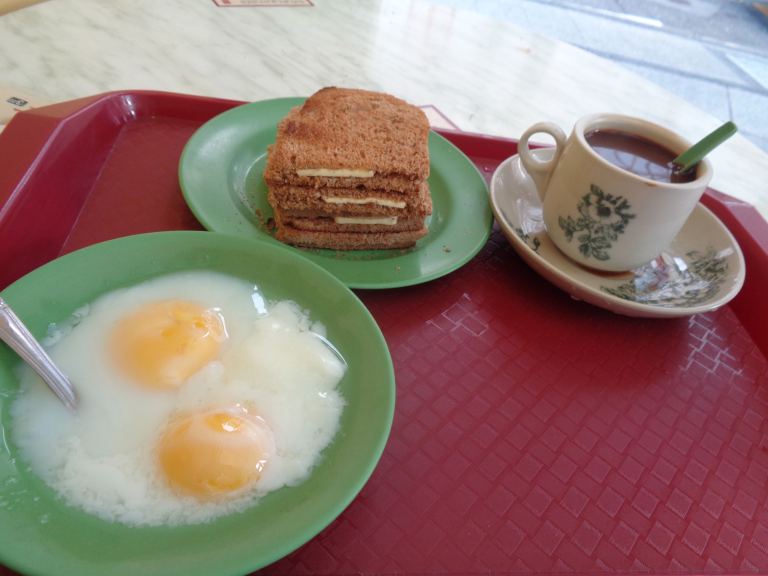
En route to Chinatown, I sopped and had breakfast.  I went to a coffee and toast place.  Or more specifically a Kopi and toast place.  Singapore has its own coffee traditions.  First, they call it kopi.  It is roasted differently.  It is strong coffee served in small portions with sugar or condensed or evaporated milk or many other variations.  “Kopi-O” is coffee with sugar.  “Kopi-C” is coffee with sugar and evaporated milk.  And so on.  The Kopi is served at breakfast with toast.  You can get the toast a myriad of ways, but the traditional way seems to be butter and kaya (some kind of sweet coconut jam), served with soft boiled eggs.  I ordered the breakfast set but didn’t have the eggs because eggs are gross.

Kopi & toast (and eggs)

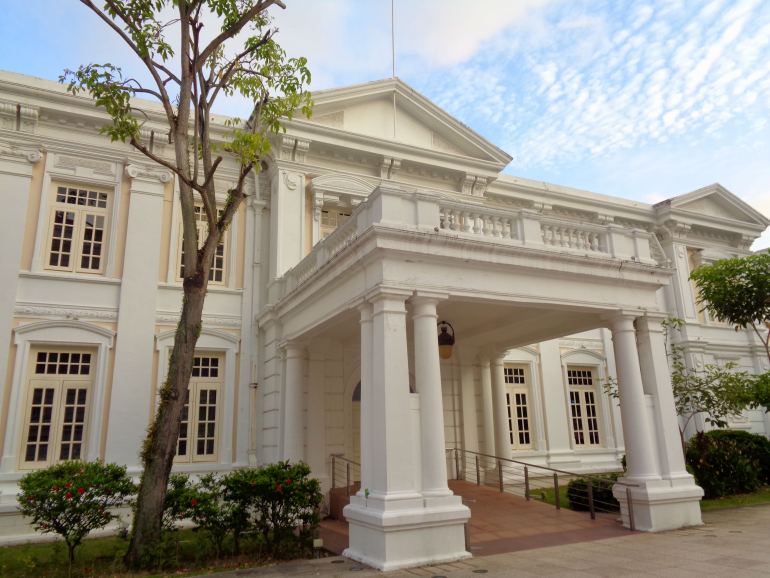
I walked to Chinatown.  I visited the temples, including the Buddha Tooth (replica) Temple (I think it is hilarious that they just openly admit that it’s not an actual relic) and the Hindu Sri Mariamman Temple.  I liked the Hindu temple much more.  The Buddhist one is very new and feels it.  It looked impressive (there’s that word again) but felt a little cheap. 

Buddha tooth replica temple

Chinatown was great for a walk though. The streets are lined with these pretty two-story buildings, painted pastel colors and with wooden shutters.  Lanterns hung in the streets.  And there were lots of appealing cafes and shops to poke around in.  I was also looking for (and found) a cigar shop/lounge but it was closed. 

Feeling peckish, I visited the Chinatown Complex Food Centre, one of Singapore’s famous hawker centres.  A hawker centre is kind of like a food court, but it is partly outdoors, and each food stall is of the highest quality; often with a family making a few dishes for many years to perfection.  There is even a Michelin star hawker centre stall.  And it is cheap.  I had a bowl of some sort of laksa type of vegetarian soup for less than $5 and it was excellent.

Hawker Centre Soup

I spent the late afternoon doing more of the same: walking and poking around the streets. I took shelter at a café for an hour when a torrential downpour made the streets impassible. I had a cigar along the water at a Thai restaurant.  As the sun started to set, I headed out again after a short nap and went to the Gardens by the Bay and did more eating and walking, but I will put that in a separate post. 

Rainbow windows

My first day in Singapore was really good.  Not exciting, but pleasant.  I enjoyed the walking and the sights.  while it is quite modern, it has enough of its own character that I still found it interesting – and impressive.

street art murals

Read More about Impressive Singapore: first impressions
Posted on 16 August 22
1
Posted inAround the World 2022 Asia Bangladesh

Discovering Dhaka, Bangladesh

I like cities, better than nature if I am being honest. Sometimes when I pick a city to visit it is because it has something specific I want to see, but sometimes I am just curious about a city itself. Dhaka, Bangladesh was one of those cities. I had little on a list of ‘sites’ to see in Dhaka; it was just the city itself that appealed.  Everything I read about it suggested it would be either a lively chaos or a miserable cesspool. (Seriously, most people had nothing but negative things to say about it.) Either way, I knew it would be interesting.  I’ll just say now, I loved it. I loved it instantly and throughout. 

Bangladesh’s flag

It started the moment I stepped out of the airport, having flown there from Jeddah, Saudi Arabia. People crowded, shouting, pushing perilous towers of beaten-up luggage, cars bumper-to-bumper, instant heat and smells of people and exhaust and perfume. Terrific.

I got a taxi to take me to my accommodation. Dhaka is notorious for its traffic, and we did spend a little time crawling along, but I didn’t mind because everything was exciting.  The overcrowded buses that looked like they had been through 50 years of bad driving, the tuk tuks, bicycles, rickshaws, and trucks, all jockeying for position. I’m sure that if I lived there, I wouldn’t be so enthusiastic, but as a new arrival, everything seemed new and thrilling.

And then we pulled up to the high gate of my accommodation: the Ambrosia Guest House. I can confidently say I would not stay anywhere else in Dhaka. There are no hostels to speak of and most of the budget hotels look grim. The fancy hotels look generic and are in a dull part of town, but this Guest House is in a perfect location for a walker like me, just off a main road but slightly tucked away with a beautiful garden oasis. I had a big private room, use of the common areas, and enjoyed breakfast each morning with the other guests. In the evenings, I had a cigar in the garden. 

Ambrosia Guest House garden
Ambrosia Guest House

But I didn’t travel to Dhaka to luxuriate in gardens. So out I went.

Street Scene

The streets in Dhaka are wonderful madness. Endless traffic with a parade of colourful rickshaws, creating a cheerful din of handlebar bells. Old, repurposed, red double-decker buses from the UK. The regular city buses, so beaten up but painted with colourful patterns and sometimes with whimsical hearts or birds. And of course, bicycles, tuk tuks, and people on foot, like me, all moving together. It is chaos, but it works. 

Bangladesh buses

Everything is loud, from the voices to the horns and bells, to announcements made over loudspeakers about, presumably, things for sale at the central market. 

Buildings and BRTC Buses

It is colourful. Not just the buses, but the people, many dressed in bright local or traditional clothing, stalls selling fresh flowers, businesses covered in a riot of multicoloured signage that can only come from a lack of regulation.

Nothing is orderly or slow. It is all terrific and exhilarating.

I walked for a bit, stopping for coffees or teas.  I wandered through book stalls and shops at the market and meandered around taking it all in.

I then hailed a rickshaw to take me to the edge of Old Dhaka. That was fun. I discovered later that I paid about 10x more than I should have, but the price I paid was still like $3 cdn, so it was cheap – especially since I was paying for a slightly-built human being to pull me by the power of his own cycling whilst I rode in my sparkly rickshaw seat like a king.

Riding the Rickshaw

I was dropped off at the Dhakeshwari Temple, a candy-coloured Hindu temple. I can’t tell you much about it, but it was busy with worshippers and had altars of slightly fearsome, slightly comedic looking gods.

Dhakeshwari Temple

From there, I wandered towards the Lalbagh Fort. It wasn’t difficult to find. Buildings in Old Dhaka are not that tall and eventually I saw the walls and the tops of the fort ahead of me. The entrance fee was negligible and well worth it.  The fort structures inside are fine.  A bit like the Red Fort in Delhi or the Lahore Fort in Lahore, but much smaller.  The real treat are the grounds, lovely expanses of green with beautiful flowers.  

Lalbagh Fort
The gardens around Lalbagh Fort

It was all locals (and me) inside, everyone enjoying the serenity. It was there though that I discovered the Bangladeshis’ fondness for selfies. I couldn’t go a few feet without being asked to take selfies with people. One person asked me to hold their baby for the photo. (I declined that. I’ve never held a baby in my life and was not to start with a stranger’s child.) Eventually I had to start declining the selfies or I would never get where I was going. People asked me where I was from and, smiling, wished me happy travels in Bangladesh. Both the selfies and friendly greetings happened everywhere. Even people that spoke very little English would manage to ask me where I was from and say, “thank you”.

Selfie! Selfie!

From there I visited the Armenian church, a pretty buttercream and yellow church surrounded by trees. I was let in by the caretaker who unlocked it and was happy to show me around. (All my pictures were lousy, but it is worth visiting.)

I stepped out of the church and was trying to decide which direction to walk next, when a young man approached me. He spoke English and asked me where I was from and if I was lost. I explained I was just looking around and he suggested I walk to the river and told me the way. He gave me his business card and said that if I needed anything, to contact him. That too was not the only time that kind of hospitality happened.

I did walk down to the banks of the Bariganga River. The river is the life of the city, connecting it to the rest of the country. The waterways are filled with passenger ships, cargo ships, and little boats transporting people and goods. It is as energetic as the streets.  I sat on the banks of the river, smoked some cigarillos and watched the action.  I did not go out on a boat that day but did the next.

Banks of the river

After that, I continued to walk the streets of Old Dhaka.  Old Dhaka is, well, the oldest part of the city. The streets are narrow, sometimes not even wide enough for cars.  The buildings are in poor repair and the streets are lined with shops, restaurants, small mosques, and tons of food vendors.  

Old Dhaka
More Old Dhaka

Mysterious fried snacks filled with vegetables or meat, sweets, fresh juices, overly sweet tea, fruits, plates of curries and biryani. I ate some things where I was able to discern that they were vegetarian. I assumed I would get some sort of food poisoning not matter how careful I was, so why not go down enjoying the local food? (Amazingly I did not get sick on this trip.)

Yet More Old Dhaka

I walked back to my hotel, getting there after dark.  

Dusk in Dhaka

On the way back I saw something I had not expected. I was on a busy street with sidewalks and there was a man lying down. I hadn’t seen this yet in Dhaka, so it caught my attention. Plus, the man was lying in an uncomfortable position…with his eyes wide open…and not moving.  I stopped. Also not moving: his chest.  I know what a dead person’s open eyes look like and this was it.  No one else was stopping, so I walked to the corner, where there was a group of policemen. I approached them and tried to say what I had seen, but they didn’t speak English.  I tried to communicate through miming. I pointed, then leaned back with my arms crossed over my chest. Made a slashing movement in front of my throat…but they didn’t seem to understand.  So I carried on.  At that point it wasn’t exactly an emergency situation, and I did what I could.  It was a little jarring to see death in the middle of a city that feels so alive, but you can’t have life without death. You just don’t often see it.

I had only been in Dhaka a half a day but saw so much. I finished the evening in my hotel’s garden with a cigar, reflecting on all of it.

A few practical comments: 

  • As I discussed in a previous post, I did have to get a visa ahead of time, but there was no other hassle entering the country.
  • Dhaka is inexpensive. Like, really cheap.  You can obviously spend more if you want to go to western-style restaurants and cafes, but just walking around, taking local transport, and eating at casual places or on the street, you would struggle to spend $10.
  • This is one of those places where you should have cash. I brought a mix of Euros and US dollars and exchanged them for Bangladeshi Taka as needed. I did try some ATMS just to see if they worked. Some did. Some didn’t. You can’t expect places to take cards unless they are more upscale.
  • I felt completely safe, day and night. It is so busy and there are always people around and they are exceedingly helpful.  No one was rude or leering or threatening in any way. Probably the only risk is tripping or stepping into a hole in the sidewalk.
  • It was really hot and humid. Staying clean was impossible. That said, despite the heat, it felt good. There are so many trees and often a nice breeze, especially near the river. 
  • Most people didn’t speak English but often there would be someone around who would speak it a bit if you really need to communicate. 
  • In case I haven’t made it clear: I thought Dhaka was awesome and was happy to have more days ahead.
Read More about Discovering Dhaka, Bangladesh
Posted on 11 August 22
0
Posted inAsia Iraq Iraqi Kurdistan/Albania trip 2022

Amazing day trip to Akre and Lalish

On my second full day in Iraqi Kurdistan, I left Erbil for the day with the help of a local guide and driver. I don’t like organized stuff and generally do not like group things, but here and there, a guide for a day (if the guide is good, and preferably if I am not with a group) elevates the whole trip. This was such a day.

I had wanted to visit the town of Akre and the religious site of Lalish. Erbil has tons of appealing day trips that are possible, but I narrowed it down to these places. Akre looked pretty and Lalish, fascinating. It is possible to visit these places from Erbil on your own with shared taxis, but it would be very difficult to visit both places in one day. So, I googled and found a guide: Haval Qaraman. I later found out that he is THE guide in the area, having done it the longest and with the best reputation. Most importantly he was tremendous company.

Haval picked me up in the morning and we started on the drive. The scenery was pleasant, if not beautiful. As we approached the mountains it became more lovely. We passed flocks of sheep and Syrian refugee camps, small shrines and rural areas.

The great thing was that Haval gave me all the information I wanted about Iraqi Kurdistan.  He told me about the history, the economy, politics, and about the various wars and invasions and how that affected people like him who live there. He also told me his story about how he grew up in Northern Iraq and how he learned English and set up his tourism business in an area exactly not known for tourism. It is a really good and interesting story, but it is not mine to tell.  Suffice it to say that I learned a lot from him and he answered all of my questions about life in Northern Iraq. And he was great company and had a sense of humour that meshed well with mine. Lots of laughs…and learning. Seriously, what else could I want? (No, he is not paying me to say these nice things.)

Akre

We visited the pretty town of Akre. It is nestled in the mountains north of Erbil and has great views over the valley. If you visit during the new year festival in March, it is the place to be, with people climbing the mountains with torches to celebrate.

Akre

The town was nice to visit. Small. No tourists that I saw.  We walked around the main square and the market. We had tea with locals at a tea shop on the square.

Akre town centre

I insisted on taking my picture with the “I [heart] Akre” sign, even though I hate those signs. I would love someone to tell me where they started. There was a time when I never saw them, and now it seems that I can’t visit a city without a tacky “I [heart] ____” sign. I’m shocked Vancouver doesn’t have one yet. That said….it was Valentine’s Day, so what better time to pose with one of these eyesores? 

I heart Akre on Valentine’s Day

Also in Akre, we visited s shrine of a notable Sufi figure, Sheikh Abdul Aziz Gailani, the son of a founder of an order of Sufism. It was not in the Lonely Planet or the Bradt guides and I would never have found it on my own. Tucked away at the top of a dead-end street, is a building of no note. We left the car and I slipped into a tasteful black Abaya, walked shoeless through glittering gold doors and into a shimmering room of mirrors and colorful Arabic verses, with the casket in the middle.  It was very pretty and came with a lesson on the basics of Sufism. Haval assured me it was ok to take photos.

Sufi Shrine in Akre (that’s me with Haval top left)

From Akre we journeyed West to Lalish.

Me in Akre

Lalish

Lalish is a temple, not a town, and is the holiest site for the people of the Yazidi faith. Not familiar with Yadizism? Neither was I before this trip.

So the Yazidi people practice a religion that is very old, like pre-Zoroastrian old. And it is very specific to people from the region in and around Iraqi Kurdistan. There is some question about to what extent it is just a religion and to what extent it is just an ethnicity. (I am already questioning my use of ‘just.’) Anyway, it is a very niche and ancient religion. Sometimes it is described as an offshoot of Islam, which is totally wrong. It is its own thing and has been persecuted by people of many other faiths for being heathenistic. In short, the Yazidis are monotheistic, but believe that god is in everything, including fire, which has left to some referring to the Yazidis as fire or devil worshippers, which isn’t right either. But they do have some interesting beliefs, like that black snakes are sacred because they saved Noah’s ark from sinking because a black snake plugged a hole. And there is a whole thing about peacocks that is fascinating. Haval told me a lot about the faith and their rituals. It was all so interesting – in fact, I kept exclaiming it – but I don’t want to write all the details of what I learned because I don’t want to deprive someone else of the discovering of learning in the moment, as I did. 

Lalish, Kurdistan

One thing I will say is that in the 2010s, the Yazidi people were the victims of a genocide at the hands of ISIS. The details are horrific, and the community is still grappling with the effects. It is certainly worth reading about. It is incredible that it is as awful as it is, and I was totally unaware. One of the greatest lessons history has taught me is that people are continuously awful to one another, and yet, we can also be kind; and the two truths will carry on.

Apparently there has been a Yazidi temple on the site for over 4000 years, though the buildings that are there are not that old. To enter the site you must remove your shoes. Not just to enter the temples, but the whole site. So, plan accordingly if you visit in winter. The site itself is a collection of shrines and holy places. No one really lives there, but there will always be a few key people on site.  I was lucky enough to meet the woman who carries out all the baptisms and a holy man who carries out the exorcisms. (They don’t use that word, but it is the same idea, and they have a specific room/building where that takes place.) We met him and had tea with his wife. (No, they had not seen the classic horror film.)

Me with various Yadizi people at Lalish. The man on my left is an important member of faith and the woman performs baptisms. Maybe that’s why they were allowed to wear shoes and I wasn’t.

The tombs of the Yazidi are interesting, conical, stone structures that dot the landscape.

Yadizi tomb marker

Inside one of the buildings, which reached far underground, was a series of also very unusual and interesting holy places.  Stone jars of water or oil, bits of colored fabric knotted for wishes and good luck, a stone structure onto which a piece of colored fabric is thrown for good luck, and utter disrespect of you trod on a threshold. Unconnected to the religion, some of these dark, underground rooms had walls covered with ghostly handprints, which made me immediately think of the end of the Blair Witch. A reference understood by no one.

Yadizi religious buildings. (And me with a symbolic black snake.)

I loved the visit.

Back to Erbil and a Detour

On the drive back to Erbil, we stopped at a restaurant for a feast of vegetables, bread, soup, and rice (there was meat too, but I don’t partake). It was quite satisfying. Thankfully, I was allowed to eat in the main room with Haval and the other man, and not relegated to the ‘women and family room’.  Women are forbidden or discouraged from eating in the main room of restaurants, and there is generally a room at the back, sectioned off for women and their families. The back rooms are fine, but they are often windowless and tucked away. Not appealing.

After lunch, we were on a straight shot for Erbil, but made a stop at a trailer parked on the side of the highway with a little tent out front. The trailer is a coffee house operated by a Syrian refugee.  He spends 6 days a week living and selling coffee out of this trailer and one day a week he goes back to the refugee camp to be with his family.  Haval told me he has been doing this for about 8 years while he waits to be able to return to Syria. I found that quite moving. What a lonely and frustrating existence, but what an incredible entrepreneurial spirit; to make the best out of a bad situation.

Roadside coffee in Iraqi Kurdistan

I had Kurdish coffee, which is not coffee at all, but something closer to chicory, but made from roasted terebinth fruits (similar to pistachios?). It was sprinkled with a little chocolate and was excellent.

I was dropped off back at my hotel just as it got dark. It was a thoroughly satisfying day. I felt like a learned so much and experienced and saw things that few do. And none of that would have been possible if I was on my own.

I did pop out that evening for a street falafel and a spin around the square, but then to bed. The next day I had hoped to visit Mosul, but that was not possible, which turned out to be for the best, as the next day was consumed with work. But my final day in Erbil was filled with more city exploration and experience. 

Me at Lalish
Read More about Amazing day trip to Akre and Lalish
Posted on 14 February 22
0
Posted inAsia Myanmar (Burma)

Saying Goodbye to Yangon

I returned to Yangon from Bagan, my trip nearly at an end. I had one and a half remaining days in Yangon before flying to Hong Kong. I had already seen everything I wanted to see in Yangon, so I figured I would just hang out and relax a little before the very long journey home and harsh transition from airport directly to office.  I was happy to be back in Yangon. Bagan was magical and Mandalay was fine, but I really like Yangon. I find it so pleasant just to be there.

I stayed at the Backpacker Bed & Breakfast, which was a nice hostel in the centre. It was exactly what I wanted: Lots of travellers to chat with on a pleasant rooftop and very inexpensive. I met people both leaving and about the enter month long meditation retreats, which only reaffirmed my lack of desire to try such a thing. I met solo travelers and duos of all ages. Mostly women. All really nice. I shared my dorm with three pleasant French girls who spoke very little English but were clean and quiet. All good.

After hanging around for a while I went for a walk through Chinatown. I liked the walk particularly because in Yangon the streets are so enjoyable – full of food vendors, pretty buildings, color, and life – but Chinatown as a destination is sort of underwhelming. 

But I did stumble across some good street markets and enjoyed the walk.

I stopped for a bowl of soup from a street vendor.  I love the street soup in Myanmar. It is fantastic. I had already ordered soup from street vendors there a number of times, so I felt pretty confident. I knew how and what to order, I knew how it would be served (broth and noodles and spices all separate), and I knew roughly what it should cost (about 70c).  I sat there, I smiled at the people sitting next to me, I felt superior to tourists who walked by with the obvious look of curiosity and intimidation on their faces about how to order from these unmarked stalls where English was not spoken (intimidation I had felt a week prior).  I loaded my soup up with chili sauce and powder and began to eat.  I was slurping up the delicious broth and noodles when I slurped too hard apparently because spicy hot broth forced itself into my nasal passages and out my nose.  Suddenly my nose was on fire, my eyes watered uncontrollably and slammed shut. I was blind and my face was on fire.  I fumbled for one of the rolls of toilet paper they had on the counter to use for napkins but dropped it and it rolled down the hill. I fumbled for another, but dropped it in my soup, which it promptly absorbed. I finally had to blow my nose and wipe my face in my scarf. I tried be cool, even as my face still burned from my nasal soup ingestion, but, had I been able to see, I’m sure everyone at the booth was snickering at me as I walked away. Once the pain subsided, I did think it was hilarious.  I was still hungry though so I went to another small street stall a safe distance away and, successfully (and more humbly), had a whole bowl of incident-free shan noodle soup.

I headed back to the big market near the train station, browsed for a bit and then tried a Bumese cigar (not a cheroot, but an actual cigar). It was black and moist and not bad tasting but full of things that I am not sure were tobacco. It had a weird screaming eagle band on it. I didn’t mind it but didn’t bother to bring any back. I smoked it sitting at the ‘No. Coffee in Myanmar’ stand in the market, which did indeed have great coffee as well as a fan. It was a perfect place to avoid the heat and watch market activities.

After that, a bit more walking, and back to my hostel.

One thing that I think is amazing here, and really speaks to the kindness of people, is that most businesses have water pitchers and vessels outside with a tin cup. The purpose? To provide water to people because it is hot and water is vital. No one should have to pay to drink water or suffer from thirst, so they just provide it. I availed myself of this offering many times and was thankful for it.

Back at the hostel I reconnected with a guy I had met earlier in the day; a young fellow from South Africa traveling solo. We decided to check out a rooftop bar that promised to be sort of a club. It had the appropriate setting, music, lights, pricey cover charge, etc, but there was almost no one there. So we just sat and chatted and I had a cigar. Not the party he was hoping for, but I was totally fine with it, not being that keen on clubs to begin with.

The next day was more walking then I decided to see a movie. There was an American horror movie playing called Prodigy and there was air conditioning, so that was good enough for me. Interestingly, they played the national anthem before the movie started and everyone was required to stand in the tiny (maybe 30 seat) theatre. The movie was decent. The popcorn was appalling.

After my movie, I met up with my South African friend and we went to see the world’s largest Buddha, which, as it turns out is not the world’s largest (that is in Myanmar but not Yangon), but it was really big.  We then meandered our way to the Shwedagon Pagoda as my friend wanted to watch the sunset and meditate at the pagoda.  We didn’t make it there for the sunset, but we watched that from a pretty park next to a lake and ate ice cream.

When we got to the pagoda, I said my goodbye – I had been before and wasn’t interested in meditating, plus, I had a 1am flight to Hong Kong to pack for.  I took a taxi back to the hostel.

Myanmar was pretty great. I liked it more than the other countries I have seen in South East Asia. It just had such an easy, friendly vibe, the travel was hassle free, and it was full of beautiful sights. I would even return. But the moment I had little time to reflect because I was on to a day in Hong Kong.

Read More about Saying Goodbye to Yangon
Posted on 23 February 19
0
Posted inAsia Myanmar (Burma)

Bagan on Two Wheels

I had spent my first day in Bagan seeing the main temples on a tuk tuk.  That was a perfect introduction.  I basically saw everything I needed to see, complete with sunrise.  Had that been my only day seeing Bagan it would have been fine. But a second day was perfect.  For my second day I decided to strike out solo on an ebike.

I knew prior to going to Bagan that ebikes were a common way to see the temples, but I couldn’t find any concrete evidence of what an ebike in Myanmar was.  Most people told me it would be a regular bicycle but with a motor that you could turn on to help go up hills. That sounded ok. I ride a bicycle.  But they were wrong. This is what an ebike is in Bagan:

my ebike with its missing mirrors

It is an electric scooter – like an electric Vespa.  It is nothing like a bicycle and everything like a motorcycle or motor scooter.  This may not seem like a big deal, but for me it was. I don’t drive. I’ve never tried it. Never had a license. Never experienced control of a motorized vehicle. I’d never used a key to start anything. I was in a wheelchair briefly after a bad accident and even that was manual and not electric. So the idea of controlling a key operated, electric vehicle on two wheels was crazy.

Of course I tried it.

The guy at my hotel spent an agonizing 10 minutes trying to explain to me how to operate it. It was hard to get a handle on the speed and turns, but I got it eventually, and rented a scooter for the day, which cost the equivalent of about $5 Canadian. Helmets not provided.

The scooter was…amazing.  It went quite fast; up to 80 km/hour, though I stayed at around half that.  The experience was one of the greatest I have had.  I felt so free. I went so fast, zipping along the paved road with cars and other vehicles (ok, they were going faster). I could cover so much ground and go wherever I wanted.  I felt like I finally understood all of those 1950s rock songs about cars. I had found the open road and it felt like home. I started to fantasize about returning to Canada and getting my motorcycle license, joining a gang, and getting a tough nickname…at that point I nearly wiped out, so I decided to focus on the task at hand.

I went up and down the two main roads, stopping where I liked. Whenever I saw a temple in the distance that I wanted to check out, I simply left the road and bounced along the sand or a rocky path. This allowed me to see a lot of smaller temples, many of which were free of visitors. I also visited a small market and some paths around villages.

me applying gold leaf to a Buddha

I went to one temple cluster and a man there was sweeping, which was, at it turns out, his job. Sweeping sand off of temples that sat in the middle of an expanse of sand.  He spoke a little English and showed me a flight of narrow stairs up to the top of one of the temples.  I climbed up and sat in the shade of the stupa, smoking a Burmese cheroot. 

view from the top of the temple

The man came to join me and we chatted a bit. He asked me about Christmas. His daughter was born on Christmas but he didn’t know much about it. I tried to explain about Santa, which sounds so crazy when you really think about it.

I stopped for lunch at a restaurant that was really just a collection of plastic tables and chairs and a bunch of portable cooking equipment. Great food. Unbelievably inexpensive.

lunch spot

I went back to one of the bigger temples I had seen the day before as it had a bunch of stalls selling crafts and textiles.  I bought a scarf and watched a woman with multiple neck-elongating brass rings around her neck weaving fabric.

Eventually I was exhausted and went back to my room for a rest before meeting the Italian man I had met on the boat from Mandalay.  He picked my up on his ebike and we went to New Bagan for dinner but only after finding the perfect temple from which to watch the sunset. He knew there was one perfect spot and we drove around asking people until he found it – it was the same one I had stood on the previous morning to watch the sunrise. I suppose there is some balance to that.

I finished the evening back at my hotel, sitting along the Irrawaddy River, enjoying a cigar until I began to doze.

The next morning I caught a super early flight to Yangon and began slowly making my way home.

Read More about Bagan on Two Wheels
Posted on 22 February 19
0
Posted inAsia Myanmar (Burma)

On the Temple Trail in Bagan

Bagan is the reason most people travel to Myanmar and I was no exception. Over 2000 temples dating back to the 11th C dotted over a small area. It is flat, so in any direction the skyline is punctuated with stupas, some glittering and others stone, rising up to the sky. They are everywhere and the area isn’t particularly built up, so it is easy to feel like you are off on your own on, discovering an ancient civilization.

There are two Bagans: Old and New. The Old Bagan is in the archeological zone and the New Bagan is a small city, where most of the hostels, hotels, and commercial stuff is. I decided to stay in Old Bagan because I liked the idea that I was steps away from the wonders I traveled there to see. I will say though that there are only a handful of hotels in Old Bagan, they are a bit expensive (by Myanmar standards), and there is nothing to do in the evening, so as a solo traveler it may not have been the best choice, but my hotel was so lovely that I didn’t mind.

I stayed at the Bagan Thande Hotel, which is really like a collection of cottages on beautiful treed grounds along the river. The room wasn’t special but the setting was. The night I checked in, I sat at the outdoor bar and restaurant and smoked cigars in the dark, while live music was played. Very nice.

But that first night I also had to make plans for the next day to see the temples. One has options for visiting the temples. You can walk to some, but they are spread out so some sort of conveyance is needed. The options are: taxi, tuk tuk, bicycle, ebike, and horse drawn carts. A taxi would be dull. A horse cart would be slow and bumpy. Bikes would be fun, but hot and exhausting. And I was initially nervous about the ebike, so I went with the tuk tuk. It was a good option. I didn’t really have to decide what to see; the driver just took me on a 10 hour trip around to see all of the best temples.

We started at 5:30am so I could climb up one of the temples to see the sun rise. A lot of other people had the same idea, so there was about 20 of us standing in the dark, cameras ready, watching the sky lighten. People are annoying, but I had some excellent 60s lounge exotica music that i listened to on my headphones, which set the mood. (Ultra Lounge Mondo Exotica to be precise. Cheesy and awesome.) I felt like handing out breath mints to the other sunrise chasers. A lot of bad breath first thing in the morning it seems. But that did nothing to dampen the beauty of watching the sky turn orange and seeing the temples revealed.

Wonderfully, as the sun came up, about 20 hot air balloons rose into the air, adding a certain whimsical aspect.

It was wonderful. But it got better.

The temples are incredible. They are big and small, gold, white, ochre, and stone. Each with Buddhas inside and some with elaborate interior paintings. Some were very busy with tourists and people praying. Others I had all to myself. Some were just off the main, paved road, and others were reached only down sandy and rocky paths.

They are all a bit similar, but I found each so enthralling that I didn’t tire of them. I loved the architecture and the decoration, the incense and offerings. They felt sacred, even when hosting dozens of camera happy visitors. (Me included.)

I’ll let the photos speak for themselves.

We also visited a market in New Bagan…or maybe it was in Nyaung U (a small, nearby town). It was a really good market. Handicrafts, vegetables, candy, meat, and fish. I walked every row and walked away with a traditional tattoo device (basically a long, ornate, metal stabby thing) and a marionette head that is so creepy i’m not sure i can keep it in my home.

I walked down one row and came across an area where men and women were sorting the fermented tea leaves that form the basis for many of the delicious salads in Myanmar. They do eat tea here and it is great when mixed with sesame, ginger, garlic. I said to them how much I liked laphet thoke (pronounced la-pay toe), the main tea leaf salad. Or rather I said “Laphet thoke?” And when they smiled and nodded, I gave a thumbs up. My attempt at making a connection. I didn’t exactly learn much Burmese ahead of time. At that moment, a teenage girl eating a plate of tea leaf salad while working, stood up, brought her plate over to me, and popped her spoonful of tea leaves into my mouth. Now that’s hospitality.

More market wandering and then I was back on the temple trail.

My day was supposed to end with me watching the sun set from a temple but I was exhausted. Plus, I mean, I saw the sun rise. A sun set is basically the same thing in reverse, so I returned to my hotel in the gloaming and fell asleep while smoking a cigar in a chair by the river. An amazing day. The next would bring more temples as I set out on my own.

Read More about On the Temple Trail in Bagan
Posted on 20 February 19
3
Posted inAsia Myanmar (Burma)

Boat to Bagan

As I had already taken the train in Myanmar (from Yangon to Mandalay) I decided to go from Mandalay to Bagan by boat. There are a few options and the prices and vessels are all quite similar. You leave Mandalay at 5:30 am or so and arrive in Bagan about 11 hours later. Many of the trips also involve stopping at a village along the way. I took the Alliance Myanmar boat and that was its itinerary.

The boat ride was pleasant. On the main level were very comfortable seats and air conditioning. On the top level was a bar and covered table seating and an area in the sun with reclining chairs.

It went by quickly. There was the initial excitement of watching the sun rise over the Irrawaddy River, then breakfast.

After that i smoked a cigar and watched dilapidated vessels sail by, as well as small fishing boats and a lot of boats set up to look for gold in the river. People waved at us as we passed.

Near Mandalay and Bagan, the landscape was heavily adorned with stupas and Buddhas. In between it was flat and dry.

The stop at the village was a nice interlude. The village grew peanuts, which they shelled and offered to us raw and boiled. They made hats, which were for sale. Mostly, we were shown around. Everyone was so friendly. I’m guessing (i hope) they get some money from the boat company; we were told not to give money to anyone unless buying something.

Women sorting peanuts

We arrived in Bagan, right on schedule, just as the sun was setting. I took a taxi to my hotel. En route I could see the silhouettes of dozens of temples that I would explore the next day.

Read More about Boat to Bagan
Posted on 18 February 19
0
← Previous 1 2 3 … 5 Next →

About Wandering North

Welcome to Wandering North, where I have been blogging about my travels since 2007.

Dale Raven North

Recent posts

  • Kuwait: Quick and Quiet 2 August 25
  • Ulaanbaatar redeems itself 30 July 25
  • Ulaanbaatar to the Unknown: A Mongolian Day Trip 29 July 25
  • First impressions of Ulaanbaatar 28 July 25
  • Hello Kitty to the Rescue: A Layover in Seoul 28 July 25

Search

Archives

Categories

Theme by Bloompixel. Proudly Powered by WordPress