Skip to content
  • Home
  • About Me
  • Where I’ve Been
  • Destinations
    • Africa
      • Algeria
      • Benin
      • Botswana
      • Burkina Faso
      • Côte d’Ivoire
      • Democratic Republic of the Congo
      • Djibouti
      • Egypt
      • Eritrea
      • Ethiopia
      • Ghana
      • Mauritania
      • Morocco
      • Rwanda
      • Senegal
      • South Sudan
      • Sudan
      • Togo
      • Tunisia
      • Uganda
      • Zambia
      • Zimbabwe
    • Asia
      • Azerbaijan
      • Bangladesh
      • Brunei Darussalam
      • Cambodia
      • China
      • Cyprus
      • Georgia (the country)
      • Hong Kong
      • India
      • Indonesia
      • Iraq
      • Japan
      • Jordan
      • Kazakhstan
      • Kyrgyzstan
      • Laos
      • Myanmar (Burma)
      • Malaysia
      • Nepal
      • Oman
      • Pakistan
      • Philippines
      • Qatar
      • Saudi Arabia
      • Singapore
      • South Korea
      • Taiwan
      • Thailand
      • Turkey
      • United Arab Emirates
      • Uzbekistan
      • Vietnam
    • Europe
      • Albania
      • Andorra
      • Belarus
      • Belgium
      • Bosnia and Herzegovina
      • Bulgaria
      • Croatia
      • Denmark
      • England
      • Estonia
      • Finland
      • France
      • Germany
      • Greece
      • Iceland
      • Ireland
      • Italy
      • Latvia
      • Liechtenstein
      • Lithuania
      • Luxembourg
      • Malta
      • Moldova
      • Monaco
      • Montenegro
      • Netherlands
      • North Macedonia
      • Norway
      • Poland
      • Portugal
      • Romania
      • Russia
      • San Marino
      • Scotland
      • Serbia
      • Slovenia
      • Spain
      • Sweden
      • Switzerland
      • Ukraine
      • United Kingdom
      • Vatican City
    • North America
      • Belize
      • Canada
      • Cuba
      • El Salvador
      • Guatemala
      • Mexico
      • Nicaragua
      • Panama
      • USA
    • South America
      • Argentina
      • Brazil
      • Colombia
      • Ecuador
      • Paraguay
      • Peru
      • Uruguay
      • Venezuela
  • Contact
Menu

Wandering North

Chronicling my travel adventures since 2007

  • Home
  • About Me
  • Where I’ve Been
  • Destinations
    • Africa
      • Algeria
      • Benin
      • Botswana
      • Burkina Faso
      • Côte d’Ivoire
      • Democratic Republic of the Congo
      • Djibouti
      • Egypt
      • Eritrea
      • Ethiopia
      • Ghana
      • Mauritania
      • Morocco
      • Rwanda
      • Senegal
      • South Sudan
      • Sudan
      • Togo
      • Tunisia
      • Uganda
      • Zambia
      • Zimbabwe
    • Asia
      • Azerbaijan
      • Bangladesh
      • Brunei Darussalam
      • Cambodia
      • China
      • Cyprus
      • Georgia (the country)
      • Hong Kong
      • India
      • Indonesia
      • Iraq
      • Japan
      • Jordan
      • Kazakhstan
      • Kyrgyzstan
      • Laos
      • Myanmar (Burma)
      • Malaysia
      • Nepal
      • Oman
      • Pakistan
      • Philippines
      • Qatar
      • Saudi Arabia
      • Singapore
      • South Korea
      • Taiwan
      • Thailand
      • Turkey
      • United Arab Emirates
      • Uzbekistan
      • Vietnam
    • Europe
      • Albania
      • Andorra
      • Belarus
      • Belgium
      • Bosnia and Herzegovina
      • Bulgaria
      • Croatia
      • Denmark
      • England
      • Estonia
      • Finland
      • France
      • Germany
      • Greece
      • Iceland
      • Ireland
      • Italy
      • Latvia
      • Liechtenstein
      • Lithuania
      • Luxembourg
      • Malta
      • Moldova
      • Monaco
      • Montenegro
      • Netherlands
      • North Macedonia
      • Norway
      • Poland
      • Portugal
      • Romania
      • Russia
      • San Marino
      • Scotland
      • Serbia
      • Slovenia
      • Spain
      • Sweden
      • Switzerland
      • Ukraine
      • United Kingdom
      • Vatican City
    • North America
      • Belize
      • Canada
      • Cuba
      • El Salvador
      • Guatemala
      • Mexico
      • Nicaragua
      • Panama
      • USA
    • South America
      • Argentina
      • Brazil
      • Colombia
      • Ecuador
      • Paraguay
      • Peru
      • Uruguay
      • Venezuela
  • Contact

Tag: transportation

Posted inAsia Central Asia 2022 Kazakhstan

Almaty: Green Market / Red Meat

The Green Bazaar

Almaty’s central market is the Green Bazaar, technically Kök Bazaar. I walked there from my hotel. A nice walk. Sights and sounds of Almaty. 

Street art spotted on the way

It opened in 1875 but was rebuilt after an earthquake later that century and then rebuilt multiple times over the decades. The market does not look interesting from the outside. It’s just a big green building. Nondescript. Inside though, it is bustling with everything you could want from a Central Asian market. Piles of colorful fruits and vegetables. Bins of spices. Jars of pickled … everything. Nuts and dried fruits. Locally made honey. Horse meat. And unidentifiable food items.

I took a lot of photos of everything; the familiar and the new. Smiling at vendors and sampling items as they were offered.

The butchery section of any market is always one of my favourites. I just find it fascinating and gruesome. We never see this stuff at home (unless you’re actively involved with the killing and processing of animals for food). And I do love gross stuff, so seeing piles of hearts and stomachs, intestines strung up like morbid party streamers, severed heads staring back…I love it. 

As far as markets go, the Green Bazaar was not gruesome. Pretty tidy actually, but still vastly unlike the markets we have in Canada. There was the section for horse meat (of course, of course). Horse meat is a staple of Central Asia. It doesn’t bother me at all. Meat is meat and I don’t eat any of it.

Horse meat & Organs

My favourite thing about the Green Bazaar though was the dairy section.  They had very local and specific products that I would eat: fresh and fermented camel, cow, and horse milk. I didn’t care for the fermented milks, but the fresh camel milk was excellent. (I think this is more due to the freshness and quality more than the animal of origin.)

Also, they had qurt, which is a fermented and dried milk ball.  It was created many years ago as a portable source for calcium and protein that nomads could carry without risk of spoiling. It comes in many different varieties. I can’t summarize all of the differences, except that some are from different animals, and some have different amounts of salt.   The consistency is like really hard chalk, and it tastes…strong.  Salty and pungent.  I really liked it, a fact that seemed to delight the woman at the stall who let me sample everything.

Qurt
Camel Milk

Excellent Coffee at the Bazaar

The Metro

I went to some different areas of Almaty that day.  Partly just to check out some different neighbourhoods; partly to look for a specific cigar lounge that I never did find.  I walked a lot but also used it as an opportunity to take the metro.

The Almaty metro is not super comprehensive, nor is it very old, but it is nice.  Each stop is a little different in its design and decoration.  One had a stained-glass window of an apple tree (Almaty means ‘city of apples’); another has this 1960s modern style décor.  (Lousy photos, but you get the idea).  They feel quite Soviet but opened in 2011.

My favourite thing about the metro though was that when you buy your fare (super cheap: 80 Tenge, which is about 25 cents Canadian) you get a bright yellow, thick plastic token. It is oddly satisfying – and ended up being my only souvenir.

I spent my evening with cigars and shisha at what became my favourite evening patio.  The next day I would cross the border to Kyrgyzstan by a car and foot combo. 

Read More about Almaty: Green Market / Red Meat
Posted on 6 September 22
0
Posted inAround the World 2022 Asia Singapore

Singapore day 2: Mostly Museums

Singapore. Day two. I probably didn’t need to set my alarm for 5am, but I did. I wanted to make the most of the day. Leaving my hostel, I set out to get a coffee and a bite to eat. Singapore is not an early morning place; at least not where I was staying. Almost nothing was open except for Starbucks, and I wasn’t going to visit an American chain restaurant. I tried to go to a couple of hotel restaurants but was told they were only for guests. I am pretty sure this was not true.

Morning in Singapore

Now is maybe the time to mention that I did not meet a friendly person in Singapore. The people were, at best, cold and polite; and, at worst, rude. I have hardly ever thought that. Vienna, I think, and Hong Kong. Mostly I think people are great.  But not here.  Not in my brief experience. Anyway, I got a coffee and a juice and went on with my day.

This was a day of walking and museums.  I took the metro to the vicinity of Little India and walked from there.

The metro in Singapore is not expansive but suited my needs well enough.  Now is the time to mention that the metro in Singapore is also not friendly. I have never seen so many signs admonishing people for possible behavioral transgressions. There were signs that said no eating, no drinking, no talking, no pets, no durian, no bags on your lap, no sitting if someone else needs the seat, no holding the door, no standing near the door…it was a bit much. I just stood still and tried not to make eye contact.

Little India was a nice place for a wander. It was not as picture perfect as downtown and has candy-colored temples, busy markets, and side streets with street art murals.

Sri Veeramakaliamman Temple

Tan Teng Niah – A Chinese-style Colonial structure

I popped into the hawker centre there – the Tekka Centre – and had a meal from Pakistan (Delhi Lahori). Excellent and cheap.

Tekka Centre (Hawker Centre)

I wandered around some more, aimlessly, taking pictures of all the lovely buildings, street art, and scenes. It was hot though and starting to get to me.

Street Art in Little India

Around Little India

I walked quite a way in the punishing heat and humidity to the Raffles Hotel.  (There’s that name again – as noted in my first Singapore post, he founded the modern colonial Singapore.)  The area around the hotel was not great. A big mall. Big buildings. Busy, wide streets. But the hotel is beautiful.  A low rise, gleaming white colonial era building with palm treed courtyards and Sikh men in white suits and turbans at the door.  It is definitely of another era.

Raffles Hotel and my one and only Singapore Sling

I was there, like so many tourists, to visit the Raffles bar to have a Singapore Sling, as this is the bar where it was invented.  And what a bar!  Dark wood panelling and wicker fans. Well-dressed bartenders. Jazz playing.  You could imagine Humphrey Bogart or Ernest Hemingway there.  Unfortunately, smoking was not allowed.  I had the cocktail, which was excellent.  This was the most expensive thing I did in Singapore.  It was $37 cdn dollars for the standard version.  Worth it for the experience, but one was enough.

I didn’t find Singapore that expensive for the things wanted to do.  Meals were normal to inexpensive and most of the stuff I wanted to see was free – walking the streets and looking at art and architecture.  Price-wise, Singapore was fine – but stick to one Sling.

From the bar I went to the National Museum of Singapore.  It was excellent.  I knew almost nothing about Singapore’s history and this was a great overview.

National Museum

From there I planned to go to the Singapore Art Museum, but it was closed so instead I visited the National Gallery Singapore.  Definitely worth a visit, but also had I skipped it my life wouldn’t be dramatically different. 

Paintings at the National Gallery

After that I went to a fun mini museum: the MINT Museum of Toys.  It’s a small space, several storeys high with just displays of toys. I really enjoyed it. So many things I remember seeing (or in the case of a couple of things: having) and an interesting look at things like horror toys or Beatles toys, or all the diverse modern Barbies.  It was cool.

Museum of Toys

The rest of the day was sort of vague. I wandered, drank coffee, smoked cigars, ate Thai food.  I am really glad I got to visit Singapore.  Two days was fun, but I’m content not to return.

I had a flight home very early in the morning, via Tokyo, back to Vancouver.  Heading back to where I started out when I flew to from Vancouver to Saudi Arabia.  All around the world, visiting Saudi Arabia, Bangladesh, and Singapore.  A great trip.

Read More about Singapore day 2: Mostly Museums
Posted on 17 August 22
0
Posted inAround the World 2022 Asia Bangladesh

Day trip to Sonargaon

On my final day in Dhaka, I was determined to visit Sonargaon. It seemed to me to be best day trip from the capital.  I had originally planned to do it earlier in the week, but it was surprisingly closed so this final day was my last chance.

Sonargaon is an historic, mostly abandoned city and former capital of the Bengal region. It was settled in the 13th century and over time and various rulers and through various wars (I was going to summarise them, but, seriously, it’s a lot) it came to be a major river port city known for literature and learning and commerce. Today it is an area popular for trips outside Dhaka, festivals, and crafts.  There is also the abandoned town of Panam Nagar, which was, by the 19th century, a bustling merchant and administrative centre. It is now a stretch of decaying, beautiful buildings. 

Getting to Sonargaon

When I planned to go to Sonargaon I meticulously figured out the route by bus. It is quite doable by bus on one’s own from Dhaka, provided you start out at the right bus station.  Because I ended up going on a different day – a day on which my flight to Singapore was scheduled in the evening – I was paranoid about going solo arriving back in Dhaka too late and missing my flight, so I hired a car. But if I had not had the flight, I would have made my way there solo, which would have involved getting a bus from the Gulistan bus station in Dhaka and taking a bus to Mograpara to the stop by the side of the road and then walking or taking a rickshaw to the site. Once at Mograpara, it was obvious that the distance from there to the Sonargaon Museum would have been easily walkable (maybe 20-30 mins) and that there are tons of rickshaws and businesses. No worries of being stranded. The only unpredictable part is the traffic in and out of Dhaka, which is highly congested, but it should take about 3 hours to get there. To go by bus would cost only a couple of dollars. To go by private car is a lot more and I missed out on the fun of the public transport, but I also didn’t spend my day rushing and worrying about missing my flight.

tuk tuks

Sonargaon Museum and around

If you google pictures of Sonargaon you will usually see this:

Sonargaon

And it does look exactly that beautiful.  There is a small collection of gorgeous buildings along the water that you can visit (and I did). They are nice inside, but the exteriors and the setting are really the draw.  Around them are waterways with little boats for rent, lush, green picnic areas, and some odd, colorful animal statues.  It is all quite pleasant.

family at Sonargaon

It was very busy with visitors, but not many tourists like me; mostly it was local families and school groups.  Many of whom wanted to introduce themselves and take selfies. 

The Museum at Sonargaon is also worth visiting. It has a great collection of arts and crafts on display (clothing, musical instruments, jewelry, tapestries, etc). My enjoyment of the museum was somewhat hindered by the school kids that were there that just stared at me or asked for pictures.  It was all kind and friendly, but I did feel rather on display. I had to say no to many of the photo requests, but I did agree to take a picture with this one group of kids because they were so nice, but you can see on my face how awkward it all was.  Me and children? Not a natural combination.

Awkward photo No.327

The Abandoned City of Panam Nagar

From the Songaraon Museum area we drove a short distance to Panam Nagar. Panam Nagar was a thriving and prosperous area until the mid 20th century when ethnic tensions between Hindus and Muslims and the Indo-Pakistani war sent the mostly Hindu residents away and left the area abandoned.  What remains is a long road lined by ornate British colonial era buildings slowly crumbling.

Panam Nagar

It is so photogenic, with the bones of the architecture there accentuated by the deterioration and discoloration; it is surrounded by vibrant greenery.

Almost every building had people in front of it taking highly posed shots in colorful clothes.  All locals though. And me.

I did get persuaded to pose with a few families and with one female police officer who approached me, causing momentary alarm, only to be dissipated by a bashful request for a picture.

detained by the tourist police

There isn’t much to do there, but strolling amongst the buildings and under the trees was lovely.

Back to Dhaka and Onwards

We drove back to Dhaka at a crawl in the traffic.  At least I was comfortable and got to take in all of the decorative trucks (not as ornate as those in Pakistan, but vividly painted with scenes of flowers and rural areas) and beat up buses.

trucks and buses

Back in Dhaka, I had time for a cigar in the garden at the Ambrosia Guest House where I was staying before I taxied to the airport for my red eye flight to Singapore.

Bangladesh had been awesome. Dhaka was a delight.  I felt so free and alive.  Especially after the subdued and Jeddah.  Everything was super affordable and the people area amongst the friendliest I have met.  I would love to go back one day and see the rest of the country. Sail the green waterways and take in some small-town life; search for tigers in the jungle.  It says a lot for Bangladesh that I would return.  Maybe someday. This time, I had one more stop on my short round-the-world trip: the not as delightful and very different Singapore.

Read More about Day trip to Sonargaon
Posted on 15 August 22
1
Posted inAround the World 2022 Asia Bangladesh

A Day in Dhaka

For my second day in Dhaka, Bangladesh I had hired a guide. It seemed unnecessary, in a way. On my first day I had seen and experienced so much and satisfies myself that Dhaka is perfectly fine to explore solo, but it turned out to be a great idea. Having a guide met me get a little deeper into Dhaka, to see things I wouldn’t have found on my own, and it was nice to have the company.

I booked the tour through Bangladesh Eco Adventure and had Afridi as my guide. He was great, as was the tour. I was so happy that he didn’t pick me up in a car. We started out on foot from my guesthouse and hopped in a tuk tuk to get to the market during the busy market.

Tuk Tuks

The tuk tuks in Dhaka are a little different. First of all, they call them CNGs, which stands for compressed natural gas.  Unlike the colorful tuk tuks of SE Asia, or Dhaka’s blinged out rickshaw, they are a stately grey. The most notable thing though is that they have cages. When you get in the back there is a metal cage separating you from the driver, and there are cages on the sides, which are locked from the outside. So it is like a little deathtrap. (You can unlock the doors yourself from the inside if you slip your fingers through the cage, so you aren’t entirely confined.) As with tuk tuks everywhere, haggling pre-journey is essential. 

The death trap tuk tuk or CNG

Kawran Bazaar

We snaked and jerked through the traffic to the Kawran Bazaar market. And what a market! So lively and crowded, busy and colorful. Piles of produce, sacks of spices, stalls of house wares, labyrinths of raw meat. It was terrific. Men with huge, flat baskets carried fruits and vegetables, apparently acting as porters or personal shoppers for wealthier residents.

Afridi took me into the dark corridors at the heart of the market, where the lighting is uniformly green, to hide imperfect limes and squash. There were bricks of amber colored sugar and mandalas of tobacco leaves.  Deeper inside were freshly beheaded goats, still leaking blood onto the floor, and blacksmith areas, where young men beat white hot molten metal into knives.

We also walked through the areas where many of the vendors live, at least during market days. Tiny bunks separated with tarps and repurposed rice sacks.  From the roof we got a view over the market.

Alongside the market were train tracks, also busy with less organized commerce.


me, on the wrong side of the tracks in Dhaka

Dhaka University

From the market we caught another tuk tuk to the University, which was an impressible Mughal structure surrounded by a green respite. We walked around the grounds and had a bite to eat (lentils and rice) at the outdoor cafeteria. We mostly looked at the art department where there were rows of busts, sculpted by the students, graded, and then mostly left out amongst the gardens.  Afridi said this is partly to do with the ban on Muslims making art depicting the human form. It was a lovely spot.

Dhaka University

Sculpture at Dhaka University

University lunch spot & mobile libraries
murals around Dhaka University
me in front of a particularly colourful mural at the University

Back to the Old City

We took a tuk tuk to the old city, where I had been the day before, but we stopped for local tea from a street stall and drank it in the courtyard of the policeman’s barracks.

Tea time. Weirdly, served in a “Canada” mug.

old city streets

We visited the famous “Star Mosque”, which is beautiful but was under construction, so I didn’t see it in all of its glory. It is amazing the stunning and small mosques hidden in the ramshackle Old City streets.

A view of the Star Mosque. Not visible are the many stars.

To the River

We then walked to the river’s edge, near where I had been before, but this time, I got to go out on a boat. It was a comfortable, relatively small, flat-bottom boat paddled by a single boatman.  

Me & Afridi & our boatman

We floated along the river past commuter boats and ships. It was heavenly. There was a perfect breeze and was quiet and relaxing.  The boat ride also took us past factories – the sort that make those cheap, disposable clothes and that both provide jobs and subject workers to horrible conditions. Yeah, those.

All along the river people went about their business and enjoyed the weather.  I saw two very little girls standing on the end of a boat, holding up in front of then a small piece of torn cardboard; they repeatedly posed and smiled at it – pretending to take selfies. 

The Ship Yards

We docked on the other side of the river and hopped out to explore the shipyards where enormous commercial ships were being repaired and painted. To look for defects or thin spot in the metal, men pounded on the ships’ hulls with hammers, creating a loud cacophony. 

We also saw people making enormous propellors by digging the mould into the dirt and then pouring molten metal into it. Once cooled, they smoothed off the rough spots.  All of this done without any protective gear of course. Most men wore sandals.

Back on the boat, we went to the other side and had lunch at a local spot near the courthouse where I met several barristers on break. Once I mentioned I was a lawyer the conversation turned to work before I naturally flowed into a chat about Islamic black magic and horror movies.

Wrapping up (and a few more photos)

It was an excellent day that left me exhausted and full.

My first two days in Dhaka had both exceeded my expectations.  Not every place can do that. I went to bed excited for day three, where I had almost nothing planned.

textile printers at the New Market

flower sellers & the ‘Pink Palace’
Read More about A Day in Dhaka
Posted on 13 August 22
0
Posted inAround the World 2022 Asia Bangladesh

Discovering Dhaka, Bangladesh

I like cities, better than nature if I am being honest. Sometimes when I pick a city to visit it is because it has something specific I want to see, but sometimes I am just curious about a city itself. Dhaka, Bangladesh was one of those cities. I had little on a list of ‘sites’ to see in Dhaka; it was just the city itself that appealed.  Everything I read about it suggested it would be either a lively chaos or a miserable cesspool. (Seriously, most people had nothing but negative things to say about it.) Either way, I knew it would be interesting.  I’ll just say now, I loved it. I loved it instantly and throughout. 

Bangladesh’s flag

It started the moment I stepped out of the airport, having flown there from Jeddah, Saudi Arabia. People crowded, shouting, pushing perilous towers of beaten-up luggage, cars bumper-to-bumper, instant heat and smells of people and exhaust and perfume. Terrific.

I got a taxi to take me to my accommodation. Dhaka is notorious for its traffic, and we did spend a little time crawling along, but I didn’t mind because everything was exciting.  The overcrowded buses that looked like they had been through 50 years of bad driving, the tuk tuks, bicycles, rickshaws, and trucks, all jockeying for position. I’m sure that if I lived there, I wouldn’t be so enthusiastic, but as a new arrival, everything seemed new and thrilling.

And then we pulled up to the high gate of my accommodation: the Ambrosia Guest House. I can confidently say I would not stay anywhere else in Dhaka. There are no hostels to speak of and most of the budget hotels look grim. The fancy hotels look generic and are in a dull part of town, but this Guest House is in a perfect location for a walker like me, just off a main road but slightly tucked away with a beautiful garden oasis. I had a big private room, use of the common areas, and enjoyed breakfast each morning with the other guests. In the evenings, I had a cigar in the garden. 

Ambrosia Guest House garden
Ambrosia Guest House

But I didn’t travel to Dhaka to luxuriate in gardens. So out I went.

Street Scene

The streets in Dhaka are wonderful madness. Endless traffic with a parade of colourful rickshaws, creating a cheerful din of handlebar bells. Old, repurposed, red double-decker buses from the UK. The regular city buses, so beaten up but painted with colourful patterns and sometimes with whimsical hearts or birds. And of course, bicycles, tuk tuks, and people on foot, like me, all moving together. It is chaos, but it works. 

Bangladesh buses

Everything is loud, from the voices to the horns and bells, to announcements made over loudspeakers about, presumably, things for sale at the central market. 

Buildings and BRTC Buses

It is colourful. Not just the buses, but the people, many dressed in bright local or traditional clothing, stalls selling fresh flowers, businesses covered in a riot of multicoloured signage that can only come from a lack of regulation.

Nothing is orderly or slow. It is all terrific and exhilarating.

I walked for a bit, stopping for coffees or teas.  I wandered through book stalls and shops at the market and meandered around taking it all in.

I then hailed a rickshaw to take me to the edge of Old Dhaka. That was fun. I discovered later that I paid about 10x more than I should have, but the price I paid was still like $3 cdn, so it was cheap – especially since I was paying for a slightly-built human being to pull me by the power of his own cycling whilst I rode in my sparkly rickshaw seat like a king.

Riding the Rickshaw

I was dropped off at the Dhakeshwari Temple, a candy-coloured Hindu temple. I can’t tell you much about it, but it was busy with worshippers and had altars of slightly fearsome, slightly comedic looking gods.

Dhakeshwari Temple

From there, I wandered towards the Lalbagh Fort. It wasn’t difficult to find. Buildings in Old Dhaka are not that tall and eventually I saw the walls and the tops of the fort ahead of me. The entrance fee was negligible and well worth it.  The fort structures inside are fine.  A bit like the Red Fort in Delhi or the Lahore Fort in Lahore, but much smaller.  The real treat are the grounds, lovely expanses of green with beautiful flowers.  

Lalbagh Fort
The gardens around Lalbagh Fort

It was all locals (and me) inside, everyone enjoying the serenity. It was there though that I discovered the Bangladeshis’ fondness for selfies. I couldn’t go a few feet without being asked to take selfies with people. One person asked me to hold their baby for the photo. (I declined that. I’ve never held a baby in my life and was not to start with a stranger’s child.) Eventually I had to start declining the selfies or I would never get where I was going. People asked me where I was from and, smiling, wished me happy travels in Bangladesh. Both the selfies and friendly greetings happened everywhere. Even people that spoke very little English would manage to ask me where I was from and say, “thank you”.

Selfie! Selfie!

From there I visited the Armenian church, a pretty buttercream and yellow church surrounded by trees. I was let in by the caretaker who unlocked it and was happy to show me around. (All my pictures were lousy, but it is worth visiting.)

I stepped out of the church and was trying to decide which direction to walk next, when a young man approached me. He spoke English and asked me where I was from and if I was lost. I explained I was just looking around and he suggested I walk to the river and told me the way. He gave me his business card and said that if I needed anything, to contact him. That too was not the only time that kind of hospitality happened.

I did walk down to the banks of the Bariganga River. The river is the life of the city, connecting it to the rest of the country. The waterways are filled with passenger ships, cargo ships, and little boats transporting people and goods. It is as energetic as the streets.  I sat on the banks of the river, smoked some cigarillos and watched the action.  I did not go out on a boat that day but did the next.

Banks of the river

After that, I continued to walk the streets of Old Dhaka.  Old Dhaka is, well, the oldest part of the city. The streets are narrow, sometimes not even wide enough for cars.  The buildings are in poor repair and the streets are lined with shops, restaurants, small mosques, and tons of food vendors.  

Old Dhaka
More Old Dhaka

Mysterious fried snacks filled with vegetables or meat, sweets, fresh juices, overly sweet tea, fruits, plates of curries and biryani. I ate some things where I was able to discern that they were vegetarian. I assumed I would get some sort of food poisoning not matter how careful I was, so why not go down enjoying the local food? (Amazingly I did not get sick on this trip.)

Yet More Old Dhaka

I walked back to my hotel, getting there after dark.  

Dusk in Dhaka

On the way back I saw something I had not expected. I was on a busy street with sidewalks and there was a man lying down. I hadn’t seen this yet in Dhaka, so it caught my attention. Plus, the man was lying in an uncomfortable position…with his eyes wide open…and not moving.  I stopped. Also not moving: his chest.  I know what a dead person’s open eyes look like and this was it.  No one else was stopping, so I walked to the corner, where there was a group of policemen. I approached them and tried to say what I had seen, but they didn’t speak English.  I tried to communicate through miming. I pointed, then leaned back with my arms crossed over my chest. Made a slashing movement in front of my throat…but they didn’t seem to understand.  So I carried on.  At that point it wasn’t exactly an emergency situation, and I did what I could.  It was a little jarring to see death in the middle of a city that feels so alive, but you can’t have life without death. You just don’t often see it.

I had only been in Dhaka a half a day but saw so much. I finished the evening in my hotel’s garden with a cigar, reflecting on all of it.

A few practical comments: 

  • As I discussed in a previous post, I did have to get a visa ahead of time, but there was no other hassle entering the country.
  • Dhaka is inexpensive. Like, really cheap.  You can obviously spend more if you want to go to western-style restaurants and cafes, but just walking around, taking local transport, and eating at casual places or on the street, you would struggle to spend $10.
  • This is one of those places where you should have cash. I brought a mix of Euros and US dollars and exchanged them for Bangladeshi Taka as needed. I did try some ATMS just to see if they worked. Some did. Some didn’t. You can’t expect places to take cards unless they are more upscale.
  • I felt completely safe, day and night. It is so busy and there are always people around and they are exceedingly helpful.  No one was rude or leering or threatening in any way. Probably the only risk is tripping or stepping into a hole in the sidewalk.
  • It was really hot and humid. Staying clean was impossible. That said, despite the heat, it felt good. There are so many trees and often a nice breeze, especially near the river. 
  • Most people didn’t speak English but often there would be someone around who would speak it a bit if you really need to communicate. 
  • In case I haven’t made it clear: I thought Dhaka was awesome and was happy to have more days ahead.
Read More about Discovering Dhaka, Bangladesh
Posted on 11 August 22
0
Posted inAround the World 2022 Asia Bangladesh Saudi Arabia Singapore

Planning for a short ’round the world trip

Trying to decide where to travel next is not a science for me. I don’t have a process or a list of criteria. A place will just start to become interesting to me through something I read or saw, and usually it will be a place that is far away geographically and culturally from the last place I went.  So I can’t say why exactly, but I decided I wanted to visit Dhaka, Bangladesh. It had been on my radar for a while. It looked crowded and exciting and intense. I decided to go.

Bangladesh is very far from Vancouver. Multiple stops would be required and when I was doing my flight research, I saw that a number of the flights went through Jeddah, Saudi Arabia, somewhere else I had never been.  I also found that several of the flights back to Vancouver took me through east Asia, and many through Singapore, another new-to-me destination.

This is how my ‘round the world’ flight itinerary was built.  I decided to spend two full days in Jeddah, four full days in Dhaka, and two full days in Singapore: starting in and returning to Vancouver. (Plus making connections in London, Cairo, and Tokyo.)  It seemed like a great opportunity to see three places in one go and circle the globe in one trip. Saying ‘yes’ was an easy decision.

my route

Of course, a trip like that requires a bit of planning.  I worked out the flights (all separate; not a ‘round the world’ ticket) and then needed to sort the visas. The visa for Saudi Arabia was easy to get: an expensive and instantaneous e-visa. The visa for Bangladesh was a different story, being one that required an application to be made by mail or in person with loads of supporting documents and a fee. It also required several follow ups by email and several recitations by email of things already provided in the application. It always amazes me when countries that have very low levels of interest from tourists make it exceedingly difficult to visit. Singapore welcomed me without hassle.

Bangladesh Visa

I booked my accommodations. A proper hotel in Jeddah, a cute guest house in Dhaka, and a capsule hostel in Singapore.

Red Sea Palace Hotel in Jeddah
Ambrosia Guest House in Dhaka
Kinn Capsule Hotel

I devoured guidebooks and blog posts, studied my maps, and tried to memorize some basic phrases (many of which I quickly forgot).

I packed my backpack with two outfits suitable for all three destinations, plus an abaya for Saudi Arabia, and cigars to last the trip.

It came together quickly. I was so excited. All around the world to visit three very different destinations.

I don’t often write planning posts, but this was an ambitious itinerary and I have gotten a lot of questions about how I picked the countries and why I chose them, about the visas and the packing. So there you have it.

Onward to Jeddah, Saudi Arabia.

Read More about Planning for a short ’round the world trip
Posted on 4 August 22
0
Posted inEurope Germany Riga Long Weekend

Munich Layover Part One

Latvia for a long weekend in May

It was the May long weekend, and I had an extra day off.  There was no question that I was going somewhere, but where was the question.  For the May four-day weekend in April I went to Malta, which meant that, for variety, I should have gone somewhere other than Europe, but I just couldn’t stop thinking about Latvia.  I don’t even know what I was thinking except that 1) the only Baltic country I had been to was Estonia (and that was years ago) and 2) they have incredible art nouveau architecture in Riga.  The tipping point in favour of going was when I saw that I could spend a long layover in Munich on either end of the trip, and I hadn’t been to Munich. Flying to Riga for a long weekend from Vancouver isn’t exactly a budget fight for a long weekend, but not terrible and being in Riga is a bargain, so I booked the flight.

Layover in Munich

I was excited to have a layover in Munich – two layovers actually. Six hours each. Long enough to see something of the city.  I arrived at about 1:00 pm and power walked my way through the airport, through immigration, where the officer told me, looking through my nearly full passport “you travel too much”, and to the S-Bahn station.  (As an aside, this was the final trip that I took with that passport, as it was full – 6 years into its 10-year lifespan.  I wear that as a badge of honour.)

The S-1 and the S-8 both go to the city centre of Munich and come every 10 minutes or so. The ride takes about 40 minutes. To save time, I had pre-purchased my train ticket online. (This was not really necessary. I could have bought it from a machine easily, but like I said, it was a 6-hour layover. Every minute counts.)

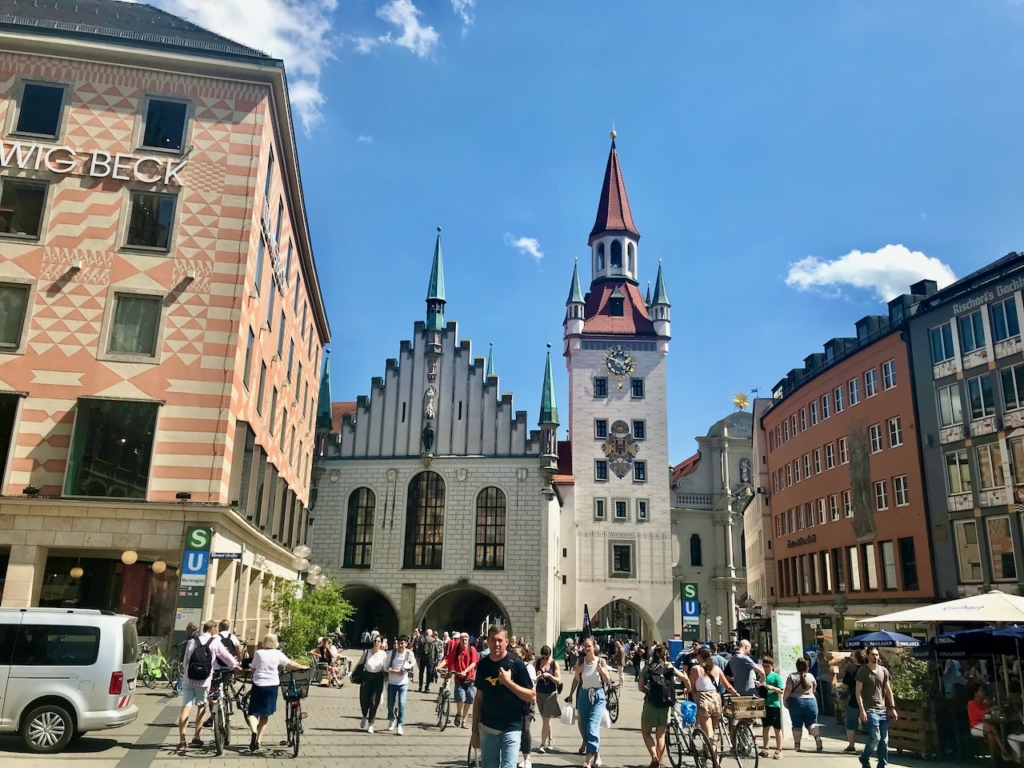
Neues Rathaus at Marianplatz

The Marienplaz Station is the one right in the centre of the old town and coming up the escalator from the station into the sunlight, was a delight. Germany! I was immediately surrounded by beautiful old buildings, street musicians, and throngs of people. It was a hot spring day and even if all I had had time for was a coffee in the square, that would have been satisfying. But I had time for a bit more.

I had done a bit of map review before my flight, so I had a rough plan about where I wanted to walk. I didn’t stray too far from the main square, gawking at the Neues Rathaus (the new town hall) and Alte Rathaus (the old town hall) before walking around the food stalls of the Viktualienmarkt, picking up a perfect sandwich to munch on.

I didn’t linger anywhere too long, but enjoyed wandering around the area, having a coffee, buying a cigar at a little shop, enjoying the architecture, and poking my head into shops and churches.

Alte Rathaus
Viktualienmarkt

With a 6-hour layover, I comfortably had 3 hours in the city, so was never totally relaxed. My pace was brisk and I checked the time a lot, but I had a good time and made mental notes (also some actual notes) about what I would do when I returned in 3 days’ time.

I took the train back to the airport where, thankfully, there were no extraordinary queues, and was back in time to duck into a lounge at the airport before boarding my flight to Riga. Next stop: Latvia.

Read More about Munich Layover Part One
Posted on 21 May 22
0
Posted inAfrica Mauritania Senegal Trip 2021 Senegal

A Day on the Île de Gorée

On my second day in Dakar, I took a day trip to the Île de Gorée, or Goree Island, a tiny island off of the coast of Dakar, just a short ferry ride. (I am going to stick with the English spelling just so I don’t have to keep adding the accents.). Goree Island is small – just over 45 acres – and with a population of less than 2,000 people. It is notable for two things: it’s postcard perfect beauty and its history as a slave trading post. Like the ‘castles’ of Ghana’s Cape Coast, it is another beautiful setting with a grim history. Both are reasons to visit, even if they are uncomfortable bedfellows.

I walked from my hotel to the ferry terminal past some grand buildings from the colonial era.

It is an easy trip to Goree. You might get pressured to take a guide and while that will certainly give you more historical context, it really isn’t necessary. The ferry terminal in Dakar is easy to find and you can buy a ticket there. The ferries leave every 1 -2 hours and the ride back is free.

Goree Island

The harbour of Goree Island

Goree Island was colonized in or about the mid 1400s by the Portuguese, then passed to the Dutch, the Portuguese again, the British, and then the French. It became a trading post for different items, but most notoriously was used as a place to detain enslaved peoples before loading them on to ships and … exporting them.  Today there is a ‘slave house’, which contains the cells used to imprison people before leading them out through a door of no return to an uncertain future.

The ‘slave house’

This is similar to the sights I saw in Ghana in 2019.  And like the trip to the Cape Coast, I found myself struck by how a place with so much horror in its past can be so beautiful. It seems that places with this history should be forever bleak or barren, but it is the opposite. Lush and green, with all of the buildings painted in bright colors. Flowers spilling over the walls, the sea lapping up on the shore, the sky perfectly blue.

It was a delight to wander around, visiting small art galleries and browsing the crafts for sale at the local market. 

It is a real tourist spot. Restaurants full and people splashing in the water. Local women walking around selling pretty fans and jewelry.

My view during lunch

As beautiful as it is, there isn’t too much to do there, but enough to keep one occupied for the day. A fort, a few small museums.

As the afternoon wound up I caught a ferry back to the mainland.

Back in Dakar, I walked around a little more before settling back into the restaurant at the Institut Français for a cigar and dinner.  (The vegetarian offerings there are dismal, but it is such a pleasant environment, having a cigar with my meal in the garden patio, that I could overlook the ‘vegetarian burger’, which was lettuce, tomato, and onions in a bun.)

An evening wander again proved that the streets of Dakar at night are lively, but I was content to spend a little time on the patio of my room before bed.

Read More about A Day on the Île de Gorée
Posted on 7 November 21
0
Posted inAfrica Mauritania Mauritania Senegal Trip 2021

Return to Nouakchott

From Nouadhibou to Nouakchott

It was the morning after my adventure on the Iron Ore Train. I awoke in my hotel in Nouadhibou with no great urgency. I needed to travel to Nouakchott that day and I didn’t know what time the bus left for the ~8 hour journey, but I just couldn’t be bothered to rush. By the time I showered and got downstairs I confirmed the bus had left. Secretly, I was happy. I didn’t feel like crowding into a hot minibus. I wanted comfort, likely as a direct reaction to the rigours of the train and pre train experience (after all, before the ride on the iron ore train I spent one night sleeping rough and two nights sleeping outside without running water or bathing). Desirous of speed and comfort, I inquired as to whether it would be possible to hire a car and driver and by the time I finished my breakfast, there was a car waiting.

The drive was great. My driver took the time to point out the sights. There weren’t many, but we saw the sea and the border crossing to the quasi country of the Western Sahara and a few small towns. Mostly though it was just sand and camels and I had seen a lot of that the day before, so when sleep got the better of me, I let it.

Scenes from the road

About half way into the journey, the driver asked if we could make a stop at his friend’s house in a small town by the roadside. Of course.

We exited the highway into a small town of newish but modest houses, sandy streets, and herds of free roaming goats. We entered a house and were greeted by four guys about to have lunch. We sat on the mats on the floor in an otherwise empty room and out came the tea. Tiny sugary tea cups were passed around and cigarettes were smoked as we chatted. Two of them spoke English, which was a treat for me as I could take a break from struggling with my very basic French.

A large platter of rice covered with pieces of meat and a smaller platter of rice with potatoes and carrots appeared. The driver had called ahead and told them I was a vegetarian. They also gave me water and a yogurt drink to take with me. Another example of startling hospitality to add to those I have experienced over the years in unlikely places.

A surreptitious lunch photo

After lunch we returned to the road and, about 7 hours after we left, we were in Nouakchott.

My remaining days in Nouakchott

I stayed somewhere different this time: the Maison de Jaloua. It is a lovely bed and breakfast in a white two level house on a sandy residential street just off a main road.

My room was a huge private room with my own bathroom and, gloriously, a big bathtub. This was a real bonus as I was still finding iron ore residue from the train on my body.

Maison de Jaloua

The hotel had a pretty garden seating area for meals and, as it turned out, housed one of the better restaurants in the city.

I had it for four nights.

Usually I write about my travel experiences on a day by day basis, but I don’t think this is necessary for my remaining three days in Nouakchott. They were pleasant, but primarily relaxing, days. I had seen ‘the sights’ of Nouakchott on my first visit. This round I just explored nothing in particular by foot and at a leisurely pace.

Lesser scenes from Nouakchott

Each day I went for a long walk in a different direction, seeing what I could find. I had coffee and cigars at local cafés, lingered in air conditioned markets, revisited the main outdoor market, and sought out local artists.

On the art front, that took a bit of digging. There is a gallery/café Gallerie Zeinart, which looks amazing, but it was closed the days I was there. I did find a smaller place, Art Gallé, which was opened and is run by Amy Sow, a local painter and sculptor. It’s small but very cool, with an exhibition space and a café. I chatted for a long time with a young photographer and met Ms Sow. A pleasant respite from the heat and aimless walking.

Art Gallé

I had a covid PCR test, which was required not for my next destination, but to leave the country. The process was simple. At a health centre you arrive before it opens and write your name on a piece of paper found under a rock on the sidewalk outside the gate. When they open they administer the tests in the order of names. It was fast, I got my results in 24 hours, and it was free. This is astonishing as in Canada, where I live, these tests start at $200.

That’s basically what I did in those last days. I was really taken with how peaceful Nouakchott is for a capital city. I can’t say that it is overly interesting or beautiful, but it is calm and pleasant; it feels very safe and the people are great. No hassles. no problems.

street art in Nouakchott

I loved my time in Mauritania. I can’t say that I would recommend it for a casual traveller or a first time trip to West Africa, but for off the beaten path travels, untouched desert vistas, hospitality, and once in a lifetime train travel, it ranks highly.

I left Mauritania with a flight to Dakar, via a day in Casablanca.

Read More about Return to Nouakchott
Posted on 4 November 21
0
Posted inAfrica Mauritania Mauritania Senegal Trip 2021

Nouakchott to Atâr

After a very full day in Nouakchott, I was ready to leave the city and head west to Atâr, a small city that is the gateway to the Adrar region of Mauritania and the Sahara. Atâr is about 6 hours from Nouakchott by mini bus, which is the usual way to get there if you are not driving. Sebastian from the Auberge Triskell drove me and two other guests to the bus stops for various regions. These are mini buses that will be full of people and piled high with baggage. They have approximate times that they leave, but nothing is guaranteed. My bus left about an hour and a half late, which was at least a few hours earlier than I expected.

Through a lot of persistent loitering, I secured the passenger seat in the front, so i had a view of the scenery. (The back windows are all blacked out.)

The landscape became increasingly rocky and then sandy as we moved west.  

I snapped a few pictures from the moving van’s windows. And a few when we made brief stops for people to pray or pee.

Along the way we had various police stops. Nine, to be precise. Each time the driver handed the police a list of the names and identification card numbers of the locals on board and fiches for any foreigners. I don’t know what ‘fiche’ translates to, but it is a photocopy of your passport with various pertinent details written down (contact info, parents’ names, travel info, etc). If you don’t have this ready, you will have to wait while they copy your passport or photograph it and write down all the info. This will delay the trip a lot, and everyone will hate you, so you want to be prepared. I brought 40 of them with me. (You might actually be fine with just a passport photocopy, but I had all the extra information written down as well.) I did notice that each time the driver handed this over, he included a 50UM note with the paperwork. (That’s about $1.60 CDN.)

Six hours after we left, we arrived in Atâr at a busy intersection, complete with people milling about, mobile fruit carts, food being cooked street side, wheelbarrows full of baguettes, and a camel sitting in the street. I liked it instantly.

To be clear, there is nothing to see in Atâr, though a spin on foot around the city centre in pleasant, but it has a pleasant vibe for a short stay.

I took a taxi to the place I was staying at: Inimi. Inimi is a campsite / collection of cabins around a central open area of dirt and one big tree. It is pretty basic, but has (or is meant to have) the key amenities.

I was greeted by the host, who speaks very good French and a few words of English. He was seated on a mat under the tree and invited me to sit and have a plate of rice and then joined me for some Mauritanian tea. (He soon gave me a nickname: Saddam Hussein. This was on account of my cigar smoking and, apparently, when he thinks cigars, he thinks Saddam Hussein.)

Mauritanian tea is Chinese black tea and sugar in what I would say tastes like equal parts, and a few mint leaves, boiled over a fire in a metal tea pot and then poured from pot to thimble sized cups, and then from cup to cup at a great height, over and over again, until the cups are half foam and half tea. Then it is ready to drink. And for those of you who are imagining cups like you might have had in Jordan or Turkey, think again. These cups are even smaller. Not much bigger than a shot. And often it seems that you take the tiniest sip and pass it to the next person. (Yes, even during covid.)

Over that tea I arranged for a driver to take me to Chinguetti the next day.

My room was a cabin. Just a box with a door and two beds, really, though it did have AC when the electricity worked, which it seldom did. Toilet and shower stalls were in a separate  building, with water that ran when there was electricity (ha) to operate the pump. 

I walked into town and looked around the streets and stalls before it got dark. 

I had dinner at an outdoor eatery that had none of the food pictured on their awning (I admit it was naive/hopeful to believe they would). They didn’t even have water, but they prepared a salad of lettuce, cucumbers, tomatoes, and onion and served it with French fries, mayonnaise, and a baguette. At least it was vegetarian. The other thing on the menu was the same meal but with grilled chicken. I picked up some fruits for breakfast.

I walked back to Inimi (maybe 2 km from the town centre) to find that the power was out. That meant it was pitch black and nothing worked. Not super convenient, but I am adaptable. (And it hardly matters that there is no water to flush the toilets when the toilets are just holes in the ground – How’s that for a positive spin?) I had my headlamp (which I never travel without) and instead of sleeping in my boiling hot (and now airless) cabin, I slept on a hard metal bed outside with a mat and my big scarf to cover me, reading until I fell asleep under the stars, which were incredible.

I had pleasant day of travel and a visit to Chinguetti ahead of me.

Read More about Nouakchott to Atâr
Posted on 27 October 21
2
← Previous 1 … 4 5 6 7 Next →

About Wandering North

Welcome to Wandering North, where I have been blogging about my travels since 2007.

Dale Raven North

Recent posts

  • Where to Smoke Cigars in Detroit 7 April 25
  • Toronto Layover: A Mediocre Experience 7 April 25
  • Detroit: A Surprising Weekend in Motor City 7 April 25
  • 24 hours in Belize City 23 March 25
  • Island Life in San Pedro, Belize 22 March 25

Search

Archives

Categories

Theme by Bloompixel. Proudly Powered by WordPress