Skip to content
  • Home
  • About Me
  • Where I’ve Been
  • Destinations
    • Africa
      • Algeria
      • Benin
      • Botswana
      • Burkina Faso
      • Côte d’Ivoire
      • Democratic Republic of the Congo
      • Djibouti
      • Egypt
      • Eritrea
      • Ethiopia
      • Ghana
      • Mauritania
      • Morocco
      • Rwanda
      • Senegal
      • South Sudan
      • Sudan
      • Togo
      • Tunisia
      • Uganda
      • Zambia
      • Zimbabwe
    • Asia
      • Azerbaijan
      • Bangladesh
      • Brunei Darussalam
      • Cambodia
      • China
      • Cyprus
      • Georgia (the country)
      • Hong Kong
      • India
      • Indonesia
      • Iraq
      • Japan
      • Jordan
      • Kazakhstan
      • Kyrgyzstan
      • Laos
      • Myanmar (Burma)
      • Malaysia
      • Nepal
      • Oman
      • Pakistan
      • Philippines
      • Qatar
      • Saudi Arabia
      • Singapore
      • South Korea
      • Taiwan
      • Thailand
      • Turkey
      • United Arab Emirates
      • Uzbekistan
      • Vietnam
    • Europe
      • Albania
      • Andorra
      • Belarus
      • Belgium
      • Bosnia and Herzegovina
      • Bulgaria
      • Croatia
      • Denmark
      • England
      • Estonia
      • Finland
      • France
      • Germany
      • Greece
      • Iceland
      • Ireland
      • Italy
      • Latvia
      • Liechtenstein
      • Lithuania
      • Luxembourg
      • Malta
      • Moldova
      • Monaco
      • Montenegro
      • Netherlands
      • North Macedonia
      • Norway
      • Poland
      • Portugal
      • Romania
      • Russia
      • San Marino
      • Scotland
      • Serbia
      • Slovenia
      • Spain
      • Sweden
      • Switzerland
      • Ukraine
      • United Kingdom
      • Vatican City
    • North America
      • Belize
      • Canada
      • Cuba
      • El Salvador
      • Guatemala
      • Mexico
      • Nicaragua
      • Panama
      • USA
    • South America
      • Argentina
      • Brazil
      • Colombia
      • Ecuador
      • Paraguay
      • Peru
      • Uruguay
      • Venezuela
  • Contact
Menu

Wandering North

Chronicling my travel adventures since 2007

  • Home
  • About Me
  • Where I’ve Been
  • Destinations
    • Africa
      • Algeria
      • Benin
      • Botswana
      • Burkina Faso
      • Côte d’Ivoire
      • Democratic Republic of the Congo
      • Djibouti
      • Egypt
      • Eritrea
      • Ethiopia
      • Ghana
      • Mauritania
      • Morocco
      • Rwanda
      • Senegal
      • South Sudan
      • Sudan
      • Togo
      • Tunisia
      • Uganda
      • Zambia
      • Zimbabwe
    • Asia
      • Azerbaijan
      • Bangladesh
      • Brunei Darussalam
      • Cambodia
      • China
      • Cyprus
      • Georgia (the country)
      • Hong Kong
      • India
      • Indonesia
      • Iraq
      • Japan
      • Jordan
      • Kazakhstan
      • Kyrgyzstan
      • Laos
      • Myanmar (Burma)
      • Malaysia
      • Nepal
      • Oman
      • Pakistan
      • Philippines
      • Qatar
      • Saudi Arabia
      • Singapore
      • South Korea
      • Taiwan
      • Thailand
      • Turkey
      • United Arab Emirates
      • Uzbekistan
      • Vietnam
    • Europe
      • Albania
      • Andorra
      • Belarus
      • Belgium
      • Bosnia and Herzegovina
      • Bulgaria
      • Croatia
      • Denmark
      • England
      • Estonia
      • Finland
      • France
      • Germany
      • Greece
      • Iceland
      • Ireland
      • Italy
      • Latvia
      • Liechtenstein
      • Lithuania
      • Luxembourg
      • Malta
      • Moldova
      • Monaco
      • Montenegro
      • Netherlands
      • North Macedonia
      • Norway
      • Poland
      • Portugal
      • Romania
      • Russia
      • San Marino
      • Scotland
      • Serbia
      • Slovenia
      • Spain
      • Sweden
      • Switzerland
      • Ukraine
      • United Kingdom
      • Vatican City
    • North America
      • Belize
      • Canada
      • Cuba
      • El Salvador
      • Guatemala
      • Mexico
      • Nicaragua
      • Panama
      • USA
    • South America
      • Argentina
      • Brazil
      • Colombia
      • Ecuador
      • Paraguay
      • Peru
      • Uruguay
      • Venezuela
  • Contact

Tag: museum

Posted inAsia Asian capital trip 2023 Philippines

Arriving in Manila

I decided to do a whistle stop trip of a handful of capital cities of closely clustered Asian countries. I was curious about Manila and had long put off a trip to Tokyo. Brunei and Kuala Lumpur fit in nicely. I had 11 days, and I booked my flights meticulously.  The first stop was Manila. A 14-hour direct flight from Vancouver.

I know that most people visit the Philippines for the beaches, and the country does look beautiful, however, I was mostly interested in the city; a city that I had heard nothing good about. In fact, the thing the Manila was most famous for, for me anyway, was karaoke. I had read that the patent holder for the karaoke machine was from Manila and that Manila was karaoke crazy; so much so in fact that there had been a series of murders in Manila based around people singing Frank Sinatra songs in karaoke clubs. When the singer sung the song badly—and usually that song was ‘My Way’—people in the audience became enraged and on several occasions this resulted in murders. I haven’t fact checked this, but there is a Wikipedia page and multiple articles about it. As a Sinatra fan and person with a bit a fascination in all things morbid, I was curious.

I’ll tell you right now that I did not do karaoke when I was in Manila. What I was looking for was that club experience. I imagined some sort of dark room full of inebriated locals singing Sinatra songs and torch ballads. I wanted to try my luck; however, when I got there, yes, there were lots of karaoke bars, but they were all the kind with private rooms where you go with coworkers or family members or friends and sit in a sofa and sing to a small TV screen in privacy. That wasn’t the experience that I wanted. I probably should have looked harder. Next time.

Beyond karaoke murders I don’t really know what I expected from Manila. Sometimes I think that’s the best way to approach a place because there’s no chance that you’ll be disappointed.

I checked into my accommodations: the Stay Malate Hostel at which I had booked a small, dingy, but clean and serviceable room with shared bathrooms and I set off to enjoy and explore the city. It was in Malate, which seems to be to be a perfect place to base oneself. Walkable to the sights and surrounded by an authentic, lively and central neighbourhood.

Stay Malate Hostel

Manilla had a good energy. It was busy and friendly and welcoming and didn’t seem off-putting or dangerous, despite some of the reports that I had read. I think the thing that surprised me most on first appearances was how much it felt like a Latin American country? That assessment may be way off base, but walking around seeing palm trees with coconuts and architecture that wouldn’t have looked out of place in South America, Catholic churches, Spanish sounding names, etc. It just didn’t feel like Southeast Asia.

I was staying in Malate, which is a central area. It was very busy. The streets seemed to have an endless array of what appeared to be strip clubs, karaoke bars, all you can eat meat BBQ joints, and local shops. I devised a sort of a walking tour around that area looked at local monuments and churches and squares; it was all very pleasant, though nothing in particular caught my attention.

The thing that so far was my biggest take away about Manila is the transportation. It was fantastic. There were so many different means of getting around, and all of them excellent. There were buses and taxis, trams and trains, but on top of that there were jeepneys, which as I understand it at one point were modified American World War 2 jeeps that were tricked out to be a form of public transportation. The ones that I saw in the street certainly weren’t that old, but they did still have that look: the front of a Jeep but then a long body and decorated like the chicken buses of Central America with religious pictures and words, art, fringes, velvet lights flashing, and music playing. The back was open with two long benches inside and people just sort of hopped in the back and paid their fare and went on their way. I only rode one once for a short distance. I wasn’t entirely sure what the destination was or how I would know where it was going so one point, I just hopped on one and rode it for a ways down the street in the direction that I was heading and then eventually hopped off. Maybe that’s the way they’re supposed to be used.

There were also two and three wheeled means of public transportation. There were motorcycles that people just rode on the back. There were motorcycles with weird high benches next to them where you sort of sat on an open metal platform next to and higher than the driver of the motorcycle. There were bicycle rickshaws. There were motorcycles with little carts in front that you sat on. And then there was my favorite: the motorcycle sidecar.

I’ve always wanted to ride in a motorcycle sidecar and while this didn’t look exactly like the ones that I had imagined whizzing me around Paris in World War 2, it was pretty outstanding. It was a little rickety motorcycle with sort of a gray semi enclosed seated compartment next to it. Like a little cage. It looked like it might become detached at any moment and I was sitting very low to the ground but it was wonderful to sit inside and have the sights whiz by me and have the air in my face –  a little bit like riding in a tuk tuk, but much dodgier.

From the central area I walked up to Rizal Park which was filled with people. It was Sunday and everyone seemed to be out picnicking or playing sports blowing bubbles and eating cotton candy. It wasn’t really my scene, but it was pleasant for a wander. I looked at the fountains and at the public art that was on the edge of the park.

And then I continued on, determined to walk to the central historic area Intramuros . Walking there was a mistake; too far and dull for a walk on the main road. At any point I should have gotten on one of the many methods of public transportation, but I was stubborn and didn’t realize that it was as far away as it was.

Somehow I overshot my destination and ended up at a small slum next to a river. It wasn’t a big encampment, but it was right across the river from one that was fairly large and equally if not more dingy. Families were living in tents cooking with open fires and selling food and snacks and objects to the other residents of the encampment. It didn’t seem dangerous at all; and it was interesting for a wander except for the fact that I did feel desperately out of place it was clear that I wasn’t supposed to be there. I don’t think people appreciated me gawking at them, so I did a loop and went back the way I came, eventually finding my way to Intramuros.

Intramuros was objectively lovely. It looks very Spanish colonial with perfectly maintained buildings in bright colours and ornamentation, cobblestone streets, gorgeous squares with trees and statues, and impressive churches. It was postcard picture perfect; it was not however particularly exciting. I walked around and I had a cigar. I tried an unusual drink made of soft tofu and brown sugar and had lunch at a cafe that had vegan Filipino food (Delicious), which was the only time that I got to try any sort of local food while I was in the city.

Once I was finished exploring that area I walked back in the direction of my hotel towards the park and through the centre, but I did visit the National Museum of Fine Arts. That was excellent. It was free and full of a range of artworks by local and international artists.

Back in Malate, where my hotel was, I walked around and looked for a place to eat. That wasn’t the easiest, vegetarian-wise. There were lots of delicious local fruits but when it came to actually eating a meal in a restaurant there wasn’t a lot to choose from. I ultimately ended up having dinner at my hostel on the rooftop patio, which suited me just fine. The food there was good and cheap it had a view of this busy streets below and there were there was a handful of elder backpackers there with whom I could chat and share mangoes.

I went out after dark and eventually found a place where I could go and sit and have a juice and smoke a cigar. Smoking in Manila wasn’t the easiest of things. Most restaurants and cafes didn’t allow smoking on the patio and the interiors were entirely smoke free, so over the two days and three nights that I was there, the patio at my hostel became something of a haven. The night scene in my neighbourhood was very lively. It was full of super busy restaurants and bars; everyone seemed to be out until all hours of the morning and there was a lot to look at. I enjoyed it even if I wasn’t out partaking.

Pineapple juice and a Saint Luis Rey robusto.

It was a pleasant first day. I enjoyed myself. I wasn’t blown away by Manila, but I was glad to have seen it. As far as first days go, it was fine – and I can’t write off the fact that I may have been suffering from serious jet lag after my 14 hour direct our flight from Vancouver. I slept very soundly that night and had plans already for day two, which ended up being much more to my liking than day one.

Philippine Pesos
Read More about Arriving in Manila
Posted on 5 March 23
0
Posted inAsia Central Asia 2022 Kyrgyzstan

Two days in Bishkek

Exploring Bishkek

Kyrgyzstan – the country whose name I only learned to spell once I visited it – is a mountainous, sparsely populated country nestled just below Kazakhstan and, likewise, was a part of the Soviet Union until 1991 and before that was usually a part of one empire or another (Russian, Mongolian, etc). Kyrgyzstan’s history though goes back a few thousand years, and its people are traditionally nomadic. Even today, it is mostly a rural country, with only about a third of its people living in cities.

Kyrgyzstan map & flag
Kyrgyzstani Som

I arrived by taxi and foot after crossing the border from Kazakhstan and was deposited at my hostel – the USSR Hostel.  As promised, it was walking distance to everything I wanted to see.  Not counting the day that I did a countryside private tour, I had two days in Bishkek.  That was enough to see and do all that I desired and do so on foot.

Statues & Buildings

I liked Bishkek, more than Almaty. Almaty is the nicer, more European-feeling city, but Bishkek felt more Central Asian.  It was just more interesting. The architecture grander and more imposing. The men often wore their traditional hats.  There were more statues and monuments.  No, not just more; there were a shocking number of statues and monuments.  Especially in Oak Park, where they filled the green space like a chess board dotted with pieces.  There were brightly colored flower beds everywhere.

Man in traditional hat
Statues in Bishkek
Statues in Oak Park, Bishkek

Scenes & Sights

The city was just so interesting to walk in.  But it also was an easy city to visit. Well organized and signposted and all that. So I could wander with ease.

Soldiers, a snack spot, and a statue

Over the two days, I walked around and past all the notable buildings, including the UFO shaped circus building, the imposing museum, and an assortment of ornate buildings of indeterminate use.

The circus building

beautiful buildings, flowers, and Soviet insignia

Behind the National Museum is an excellent Lenin statute. Until recent years he stood in the main square but was moved…for obvious reasons. I like the decision to keep the statue (and not destroy it) but to move it to the museum grounds, to place it in historical context, as opposed to holding him up as an icon. (There is also statue of Karl Marx and Friedrich Engels deep in the park.)

Lenin, Marx, & Engels

A Museum & A Gallery

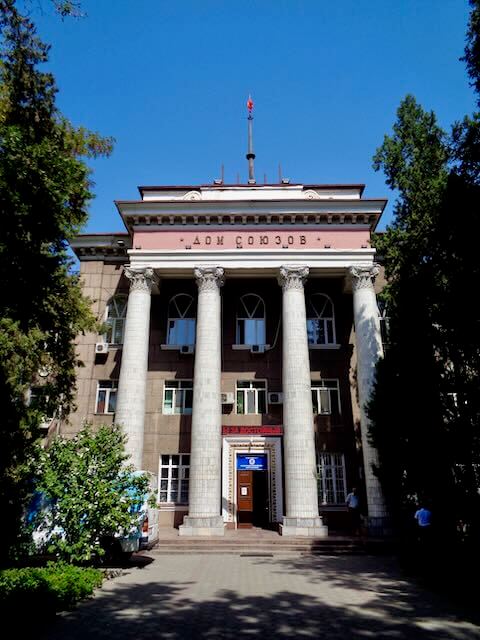
I visited the Museum, which was very good. A beautiful, new building displaying an impressive array of Items from Kyrgyz history.

At the Museum

I wandered to the National Museum of Fine Arts, which I didn’t really enjoy, but was happy to check it out. Interesting art, even if i didn’t like much of it.

Osh Bazaar

I walked to the Osh Bazaar where I was lost in rows and tangles of produce (especially berries), rounds of fresh bread that looked like that I knew from Uzbekistan, slabs of freshly butchered meat, spices, house wears, and hats.  It was a very satisfying market.  I enjoyed some delicious fried dough and potato treat, like a flat piroshki, and tried some balls of Qurt or Qurut or Kurut. (This being the hard dairy balls that can also be used as projectiles if you find yourself in a violent protest but short on rocks. I wrote about this more in my market post from Almaty.)

Bishkek was a very pleasant city for walking, even if it was blisteringly hot when I was there.  It is a city of parks and trees; shade and greenery could almost always be found.  Plus, it has a lot of great cafes.  Cool cafes with tattooed baristas and pleasant patios for sitting with a coffee and a book or laptop. 

cigars & cafés

Got milk?

Milk type and fermented drinks are inescapable in Bishkek. Like, in Almaty, you can buy a variety of different milks from different animals, fresh and fermented at the markets, but in Bishkek, you can buy the milk (or milk adjacent beverages) on the street. On nearly every corner is a woman sitting under an umbrella with 1-3 plastic barrels in front of her, selling drinks by the glass.

The most prominent is the Шоро or Shoro company, which sells milk beverages. They sell maksym (made from fermented barley, wheat, millet and/or corn), chalap (fermented milk, yogurt, and salt), and jarma (a fermented grain mixed with yogurt drink). You can mix maksym and chalap together, which is called aralash. Other stands will sell kymyz, which is fermented horse milk.

Shoro stand

Maksym is the national drink of Kyrgyzstan…it is also the one I liked the least. I also found out after the fact that maksym usually has some form of animal fat in it – maybe butter or maybe other rendered animal fats – so it probably isn’t vegetarian. (oops.)

The other main company that sells their drinks on nearly every corner is the Eneasy company, which sells cold tea and milk/yogurt drinks.

rival stand

All of these things you can buy in the market made in small batches or at roadside stands, but you just can’t escape the sidewalk sellers in Bishkek – and you wouldn’t want to. The milk and yogurt drinks are delicious and cost maybe 15 cents a glass.

me, beating the heat with a refreshing glass of chalap

Impressions

I also noticed that, while it is a Central Asian Muslim country, I saw a surprising number of cool, counterculture-looking young women with visible piercings or tattoos, partially shaved heads, and brightly dyed hair. (Like me as a teen.) I’m not saying I saw a lot of them, but enough that I took note. That’s not something I have noticed in similar places.  Between this observation, the green spaces, and the cafes, I had this reoccurring thought: Is Bishkek the Portland, Oregon of Central Asia?  That might be a weird comparison, but there is something to it.  I liked it anyway.

me in Bishkek

I’m really squishing together my two days in Bishkek, but that’s mostly what I did. The third day I would take to the country for a bit of rural sightseeing.

Read More about Two days in Bishkek
Posted on 9 September 22
0
Posted inAsia Central Asia 2022 Kazakhstan

Glorious Kazakhstan

I had decided to go to Kazakhstan. There wasn’t a particular thing that drew me. I just felt like it was time to go back to Central Asia.  I hadn’t been to any of the ‘stans since my 2011 trip to Uzbekistan. (I had been to Pakistan in 2020, but that seems different.) Plus, in all honesty, there was something appealing about being able to color in such a big landmass on my travel map. Most of the pictures I had seen of Kazakhstan were of its natural beauty. Spectacular vistas of snow-capped mountains, bright blue lakes, and thick, evergreen forests.  It all looks lovely…but it also looks a lot like Canada, so I decided to just visit Almaty. The former capital and largest city. I was light on expectations but brimming with curiosity.  It surprised me but did not disappoint.

the flag and a map of Kazakhstan

Facts

Kazakhstan has spent much of its modern history dominated by Russia. First the empire, then the Soviet Union. Prior to all that it was a country populated by nomadic peoples. Today it is a massive independent country sitting next door to Mongolia and just under Russia. The world’s ninth largest and the largest country with no connection to an ocean. Its capital is named Astana…or Nur-Sultan. It switches back and forth. Kazakhstan is considered one of the most ethnically diverse countries in the world with a mixtures of cultures languages from the region. Kazakh and Russian are the national languages. It is a Muslim country but doesn’t feel particularly religious. It is well off (oil) and its cities are modern, but it still has a close connection to its nomadic and rural heritage. They grow tulips and apples, ride and eat horses, produce formidable boxers and mixed martial art fighters, and men who hunt with massive eagles while wearing large fur hats. (The men; not the birds.)

Kazakhstan is an easy place for Canadians to visit. No visa needed. No bureaucratic cash grab. Just show up, change your Dollars to Tenge and you’re set.

Kazakhstani Tenge

Arrival

I knew right away where I wanted to stay. I eschewed my budget accommodation preferences for a room at the Hotel Kazakhstan; an iconic, Soviet era high-rise with an imposing design. It’s even on some of the currency. (Also, while there are cheap hostels, none of them looked like anything special.) I arrived around midnight and when I awoke, I had a view over the city and to the mountains beyond.

Like all visits to a new city, I spent my first day walking.  The streets of Almaty were pleasant. Lots of trees and inviting cafes. The architecture of the city has some definite highlights, but for the most part is unremarkable. Much of the old buildings were destroyed in an earthquake, but some Soviet apartment blocks and a few pretty buildings remain.

Hotel Kazakhstan & and an impressive statue

Bowler Coffee

Wanderings and Impressions

Almaty surprised me. I guess I was expecting it to be more like Tashkent; a little more ‘exotic’ feeling. Really, it is more European, but with a central Asian twist. People are, for the most part, not dressed in any traditional style and the city operates like an orderly city. I didn’t find it exciting, but it was pleasant and I think it would be a decent place to live for a time.

One of the highlights was The Park of 28 Panfilov Guardsmen (aka Panifilov Park), a short walk from my hotel, it is a green park with the excellent Zenkov Cathedral (aka Ascension Cathedral) in the centre.  The Zenkov Cathedral was built in 1904 and survived the earthquake.  Candy colored and ornate.  The most remarkable thing is that it is built entirely of wood – and without a single nail.  Like Legos or a 3D jigsaw puzzle. 

Zenkov Cathedral – back & front

Zenkov Cathedral interior

Just off to the side of it is the fantastic WWII war memorial.  I’ve seen countless war memorials, but this one is one of the most impressive.  A huge metal sculpture of soldiers bursting forth, roughly in the shape of the USSR.  It has this aggressive power about it. I loved it. 

Fun fact about the 28 Panfilov Guardsmen, it was a story about 28 Red Army soldiers who were killed in battle after destroying 18 German tanks and stopping the advance. It was famous. The were declared heroes. This park was named after them. The thing is…it was just a propaganda story. the Germans did advance, six of the soldiers survived; one of them joined up with the Germans maybe and another surrendered. Still, it is a lovely park.

Soviet insignia are everywhere if you look for them

Kazakh Museum of Folk Musical Instruments

Another park. Flowers were everywhere.

Soviet and Central Asian architecture

A typical building with typical guys

More buildings i liked

Monuments and Mosques

I did pay a visit to the Green Market, which was one of my favourite things in Almaty, but I’ll put that in a separate post.

Museums & Galleries

Between my days in Almaty (I’m condensing a bit here) I visited a few museums. The Museum of Arts of the Republic of Kazakhstan and The Central State Museum of Kazakhstan.

I really liked the history museum.  Lots of artifacts and clothing and weapons from the nomadic tribes that inhabited Kazakhstan.

The art museum was very interesting and worth visiting, though I can’t say that I loved the art.  That said, I liked it for the purpose of seeing the culture and people represented.  Nomadic peoples with huge furry hats and embroidered coats, eagles, and camels.  The 20th C paintings had a lot of depictions of workers and industry.

Kok Tobe

On my second day I took the cable car to Kók Tóbe Park, a small amusement park perched on a hill with excellent views of the city. It has more games than rides, but it is fun to ride the cable car and look around. There are great views of the city and a Beatles statute, and if you want to you can get your picture taken dressed as a Kazakh nomad with a real and massive eagle on your arm.  I was tempted to do the latter, but ultimately did not or you would be seeing that picture now.

Cable Car views

The only ride I went on was the Fast Coaster, which was a small cart on a metal track that races down the side of a mountain at up to 45km. I let go of the speed control and zoomed along.  It didn’t feel entirely safe, but that’s what made it fun.

What could go wrong?

Mountain Views

Evenings

Because I was staying at a proper hotel and not a hostel, I didn’t really meet anyone.  While the local people were friendly, I didn’t have any of those great experiences of meeting and hanging out with anyone.  The language barrier was probably also an issue.  The national languages are Russian and Kazakh.

I spent my evenings in Almaty walking, smoking shisha at patios, drinking pots of local tea, and eating some excellent food.  I am not a foodie, but Almaty had a great selection of restaurants we don’t see a lot of in Vancouver: Georgian, Armenian, Central Asian, Syrian, and Yemeni.  I didn’t eat much Kazakh food because there just aren’t a lot of vegetarian options. I spent two full days in Almaty on the front end of my trip and a third on the back end, where I splurged and went to the opera.  I’ll write about that later.  I was a little sad that I wasn’t seeing more of the country, but I was onward to Kyrgyzstan.

Read More about Glorious Kazakhstan
Posted on 5 September 22
0
Posted inAround the World 2022 Asia Singapore

Singapore day 2: Mostly Museums

Singapore. Day two. I probably didn’t need to set my alarm for 5am, but I did. I wanted to make the most of the day. Leaving my hostel, I set out to get a coffee and a bite to eat. Singapore is not an early morning place; at least not where I was staying. Almost nothing was open except for Starbucks, and I wasn’t going to visit an American chain restaurant. I tried to go to a couple of hotel restaurants but was told they were only for guests. I am pretty sure this was not true.

Morning in Singapore

Now is maybe the time to mention that I did not meet a friendly person in Singapore. The people were, at best, cold and polite; and, at worst, rude. I have hardly ever thought that. Vienna, I think, and Hong Kong. Mostly I think people are great.  But not here.  Not in my brief experience. Anyway, I got a coffee and a juice and went on with my day.

This was a day of walking and museums.  I took the metro to the vicinity of Little India and walked from there.

The metro in Singapore is not expansive but suited my needs well enough.  Now is the time to mention that the metro in Singapore is also not friendly. I have never seen so many signs admonishing people for possible behavioral transgressions. There were signs that said no eating, no drinking, no talking, no pets, no durian, no bags on your lap, no sitting if someone else needs the seat, no holding the door, no standing near the door…it was a bit much. I just stood still and tried not to make eye contact.

Little India was a nice place for a wander. It was not as picture perfect as downtown and has candy-colored temples, busy markets, and side streets with street art murals.

Sri Veeramakaliamman Temple

Tan Teng Niah – A Chinese-style Colonial structure

I popped into the hawker centre there – the Tekka Centre – and had a meal from Pakistan (Delhi Lahori). Excellent and cheap.

Tekka Centre (Hawker Centre)

I wandered around some more, aimlessly, taking pictures of all the lovely buildings, street art, and scenes. It was hot though and starting to get to me.

Street Art in Little India

Around Little India

I walked quite a way in the punishing heat and humidity to the Raffles Hotel.  (There’s that name again – as noted in my first Singapore post, he founded the modern colonial Singapore.)  The area around the hotel was not great. A big mall. Big buildings. Busy, wide streets. But the hotel is beautiful.  A low rise, gleaming white colonial era building with palm treed courtyards and Sikh men in white suits and turbans at the door.  It is definitely of another era.

Raffles Hotel and my one and only Singapore Sling

I was there, like so many tourists, to visit the Raffles bar to have a Singapore Sling, as this is the bar where it was invented.  And what a bar!  Dark wood panelling and wicker fans. Well-dressed bartenders. Jazz playing.  You could imagine Humphrey Bogart or Ernest Hemingway there.  Unfortunately, smoking was not allowed.  I had the cocktail, which was excellent.  This was the most expensive thing I did in Singapore.  It was $37 cdn dollars for the standard version.  Worth it for the experience, but one was enough.

I didn’t find Singapore that expensive for the things wanted to do.  Meals were normal to inexpensive and most of the stuff I wanted to see was free – walking the streets and looking at art and architecture.  Price-wise, Singapore was fine – but stick to one Sling.

From the bar I went to the National Museum of Singapore.  It was excellent.  I knew almost nothing about Singapore’s history and this was a great overview.

National Museum

From there I planned to go to the Singapore Art Museum, but it was closed so instead I visited the National Gallery Singapore.  Definitely worth a visit, but also had I skipped it my life wouldn’t be dramatically different. 

Paintings at the National Gallery

After that I went to a fun mini museum: the MINT Museum of Toys.  It’s a small space, several storeys high with just displays of toys. I really enjoyed it. So many things I remember seeing (or in the case of a couple of things: having) and an interesting look at things like horror toys or Beatles toys, or all the diverse modern Barbies.  It was cool.

Museum of Toys

The rest of the day was sort of vague. I wandered, drank coffee, smoked cigars, ate Thai food.  I am really glad I got to visit Singapore.  Two days was fun, but I’m content not to return.

I had a flight home very early in the morning, via Tokyo, back to Vancouver.  Heading back to where I started out when I flew to from Vancouver to Saudi Arabia.  All around the world, visiting Saudi Arabia, Bangladesh, and Singapore.  A great trip.

Read More about Singapore day 2: Mostly Museums
Posted on 17 August 22
0
Posted inAround the World 2022 Asia Bangladesh

Day trip to Sonargaon

On my final day in Dhaka, I was determined to visit Sonargaon. It seemed to me to be best day trip from the capital.  I had originally planned to do it earlier in the week, but it was surprisingly closed so this final day was my last chance.

Sonargaon is an historic, mostly abandoned city and former capital of the Bengal region. It was settled in the 13th century and over time and various rulers and through various wars (I was going to summarise them, but, seriously, it’s a lot) it came to be a major river port city known for literature and learning and commerce. Today it is an area popular for trips outside Dhaka, festivals, and crafts.  There is also the abandoned town of Panam Nagar, which was, by the 19th century, a bustling merchant and administrative centre. It is now a stretch of decaying, beautiful buildings. 

Getting to Sonargaon

When I planned to go to Sonargaon I meticulously figured out the route by bus. It is quite doable by bus on one’s own from Dhaka, provided you start out at the right bus station.  Because I ended up going on a different day – a day on which my flight to Singapore was scheduled in the evening – I was paranoid about going solo arriving back in Dhaka too late and missing my flight, so I hired a car. But if I had not had the flight, I would have made my way there solo, which would have involved getting a bus from the Gulistan bus station in Dhaka and taking a bus to Mograpara to the stop by the side of the road and then walking or taking a rickshaw to the site. Once at Mograpara, it was obvious that the distance from there to the Sonargaon Museum would have been easily walkable (maybe 20-30 mins) and that there are tons of rickshaws and businesses. No worries of being stranded. The only unpredictable part is the traffic in and out of Dhaka, which is highly congested, but it should take about 3 hours to get there. To go by bus would cost only a couple of dollars. To go by private car is a lot more and I missed out on the fun of the public transport, but I also didn’t spend my day rushing and worrying about missing my flight.

tuk tuks

Sonargaon Museum and around

If you google pictures of Sonargaon you will usually see this:

Sonargaon

And it does look exactly that beautiful.  There is a small collection of gorgeous buildings along the water that you can visit (and I did). They are nice inside, but the exteriors and the setting are really the draw.  Around them are waterways with little boats for rent, lush, green picnic areas, and some odd, colorful animal statues.  It is all quite pleasant.

family at Sonargaon

It was very busy with visitors, but not many tourists like me; mostly it was local families and school groups.  Many of whom wanted to introduce themselves and take selfies. 

The Museum at Sonargaon is also worth visiting. It has a great collection of arts and crafts on display (clothing, musical instruments, jewelry, tapestries, etc). My enjoyment of the museum was somewhat hindered by the school kids that were there that just stared at me or asked for pictures.  It was all kind and friendly, but I did feel rather on display. I had to say no to many of the photo requests, but I did agree to take a picture with this one group of kids because they were so nice, but you can see on my face how awkward it all was.  Me and children? Not a natural combination.

Awkward photo No.327

The Abandoned City of Panam Nagar

From the Songaraon Museum area we drove a short distance to Panam Nagar. Panam Nagar was a thriving and prosperous area until the mid 20th century when ethnic tensions between Hindus and Muslims and the Indo-Pakistani war sent the mostly Hindu residents away and left the area abandoned.  What remains is a long road lined by ornate British colonial era buildings slowly crumbling.

Panam Nagar

It is so photogenic, with the bones of the architecture there accentuated by the deterioration and discoloration; it is surrounded by vibrant greenery.

Almost every building had people in front of it taking highly posed shots in colorful clothes.  All locals though. And me.

I did get persuaded to pose with a few families and with one female police officer who approached me, causing momentary alarm, only to be dissipated by a bashful request for a picture.

detained by the tourist police

There isn’t much to do there, but strolling amongst the buildings and under the trees was lovely.

Back to Dhaka and Onwards

We drove back to Dhaka at a crawl in the traffic.  At least I was comfortable and got to take in all of the decorative trucks (not as ornate as those in Pakistan, but vividly painted with scenes of flowers and rural areas) and beat up buses.

trucks and buses

Back in Dhaka, I had time for a cigar in the garden at the Ambrosia Guest House where I was staying before I taxied to the airport for my red eye flight to Singapore.

Bangladesh had been awesome. Dhaka was a delight.  I felt so free and alive.  Especially after the subdued and Jeddah.  Everything was super affordable and the people area amongst the friendliest I have met.  I would love to go back one day and see the rest of the country. Sail the green waterways and take in some small-town life; search for tigers in the jungle.  It says a lot for Bangladesh that I would return.  Maybe someday. This time, I had one more stop on my short round-the-world trip: the not as delightful and very different Singapore.

Read More about Day trip to Sonargaon
Posted on 15 August 22
1
Posted inAlbania Europe Iraqi Kurdistan/Albania trip 2022

Museum Hopping in Tirana, Albania

Back from my long day trip to North Macedonia, I had about a day and a half left in Tirana.

I think that two days in Tirana is ok, but a bit tight if you want to go to museums and galleries, which I did. What this meant was that on my second day in Tirana, I didn’t have time to lose. My alarm went off early. (Yes, I set an alarm on vacation. I don’t travel half way around the world to sleep.)

I left the Tirana Backpackers Hostel and set off. First thing had to be first however, and I went to get the requisite covid PCR from a place that looked more like a cosmetic surgery office or a Kiehl’s store, with a gaggle of young looking, beautiful women in short dresses and white lab coats. I would get the results later. Negative.

colorful Tirana

I started off at a cafe. Fuelled by espresso I made a bunch of stops. I’m not going to recount all the museums I went to in detail and some of the ones I didn’t go to I missed because they were closed. Tirana has lots; I picked from what was available.

  • National Museum: interesting to get some insight into Albanian history. In poor repair and scruffy, but worth visiting. Educational and I felt like they needed the money.
  • Bunk Art 2: There are two Bunk Art museums. One in Tirana’s centre and one not. Bunk Art 2 is the further out one. I look an easy bus ride, which was fun in its own right.  Bunk Art 2 is excellent. A great history lesson about the long reign of Enver Hoxha and his brutality and paranoia, the latter of which led him to build underground bunker tunnels all over the country – 173,371 to be precise, built obsessively and to Albania’s financial detriment. (Let that sink in: 173,371 underground bunkers in a country slightly smaller than the US state of Maryland.) Bunk Art 2 is a museum built into one of these huge bunkers, very far underground. It is super interesting and also an experience, given that it is a bit claustrophobic and creates atmosphere with music and sounds throughout its rooms and tunnels, but stops short of being too theatrical. Definitely worth a visit.
  • Bunk Art 1: Honestly, Bunk Art 1 was a bit anticlimactic after Bunk Art 2. It is more of the same, but smaller. You can’t beat the location though and if you buy a ticket for Bunk Art 2 No.1 is included.
entrance to Bunk Art 1
cold war bunker and a pretty pink building
  • The House of Leaves: You think I would have been tired at this point by learning about Hoxha’s dictatorship and his tools of surveillance and torture, but I wasn’t. The House of Leaves is a former centre for surveillance and investigation turned museum. Really creepy and interesting. Lots of information and artifacts about secret bugs and cameras, prison and brutality. There is a list posted of favourite torture methods of the regime. I’m still thinking about that.

To cleanse myself of the historical horrors, I walked in the sunshine over to an outdoor food market area and sniffed my way around various treats.

I went for a long walk to nowhere in particular and went for dinner and a cigar at this small outdoor area of international restaurants and cafes.

I had planned to finish the day at Perla Tattoo & Bar for some live music but it was having some guy’s birthday party that night (as best as I understood). It was just as well. I was exhausted. I went back to the hostel and hung out in the chilly courtyard.

The Next Day

I was flying out the next afternoon, which gave me the morning.  I decided to take a leisurely approach.  I had breakfast at the at the café at the Opera house building on the square. I had this very tasty Albanian breakfast dish. A kind of a savory porridge made from a grain and topped with white cheese and crunchy bread.

I had a cigar and walked next door to the bookstore, where there is a good selection of English books. I bought a couple of novellas by celebrated Albanian author Ismail Kadare.

I visited Et`hem Bey Mosque (the mosque on the square), which is uncharacteristically painted with scenes of fruit, trees, and scenery.

buskers (and a dancer!) outside the mosque.

I then went walking in search of street art murals. Tirana has a lot, but they are scattered around.  I found some information online and planned a walking route that would take me to some of them and down some different streets. I stopped for coffee.

Just a few of Tirana’s murals

It was a pleasant way to spend the first half of the day.

I left Tirana feeling like I had done it justice in the time I had. Had my itinerary played out as I planned, I would have spent another 24 hours there, but due to a change of an Albania Air flight, I was instead flying to Belgrade, Serbia.

me in Tirana
Read More about Museum Hopping in Tirana, Albania
Posted on 23 February 22
2
Posted inAfrica Mauritania Senegal Trip 2021 Senegal

A Final Day in Dakar

My final day in Dakar, Senegal was a good one. There is something nice about when you have done the things on your list for a city and then can just freely explore with no expectations and see where it takes you. That was my day. (Truthfully, I did spent about half of the next day in Dakar before flying out, but I didn’t do anything noteworthy.)

I went out before breakfast to get a covid test. It was cheap and relatively efficient, but I got to the clinic very early before there was a big queue. 

Nose freshly swabbed, I had breakfast at the hotel and hit the market. I browsed around and haggled over some west African wax print fabric with the ‘speed bird’ print on it, which was destined to be cushion covers in my office back home. A lot of fabric prints have meanings in different countries in West Africa. The ‘speed bird’ print means various things in different countries, including ‘money comes and money goes’ or something like ‘when the hunter learns to shoot straight, the bird learns to fly without stopping’. That was fun. So many interesting patterns to browse through.

I also bought a painting. I haven’t been buying much in my travels recently. (My home décor is minimalist, and my office is already bursting with odds and ends from my travels.) But in Dakar they had these paintings that are done on the underside of glass and I thought they were quite unique, so I bought a portrait of a regal-looking, older African woman in orange clothes.

I decided I hadn’t had enough markets apparently, so I left the arts and crafts market and went headlong into the more local market, past the shops and stalls selling clothing, fabric, and household items, past the colorful buses, until the market became more of a labyrinth of tarps and tents, with outdoor cooking, and, well, really just a lot more poverty. I didn’t take pictures of that part of the market, because, while very interesting, I really stuck out and didn’t want to seem like a gawker.

Around the edge of that part of the market was the Dakar Grand Mosque, which is quite attractive and has a 67 m tall minaret. I might have been more taken with it, but it is very much in the style of the mosque I had just visited in Casablanca days earlier, but smaller, so appreciated was diminished a little.

From there I walked to the Musée des Civilisations Noires, which is a very modern museum (opened in 2018) designed to celebrate Africa’s contributions to the world. It is pretty great.  There are some detailed displays on the origin of man and African technical and scientific achievements, but the best part was on the upper floors where there was an excellent mix of (primarily west) African traditional masks and works of art with modern art. It was so good. All they are lacking is a café.

Musée des Civilisations Noires

After that I walked rather aimlessly, stopping for a bite to eat and a cigar at a rather posh Lebanese restaurant, and then discovered that there was a decently stocked Cuban cigar store just around the corner from my hotel. I was not out of cigars, but still picked up a few. (I can’t visit a cigar store and not get something.)

On my way back to the hotel for what I felt was a well-deserved nap, I say that there was a concert happening that night at the Institut Français. I bought a ticket. It was the Medicine Man Orchestra. The concert took place at a great outdoor stage – a proper stage and seating, but outside, under the stars with bats and birds overhead.  The Medicine Man Orchestra was a little difficult to describe. On their website they say: “Medicine Man Orchestra (MMO) is a time adventure, swinging between ages, dimensions, cognitive or cartographic geographies. It is a show that takes you to the limits of multiple realities. Advanced audio-visual technologies provide the gift to carry you away as in West Africa, beside venerable griots, as in the fancy european clubs of avant-garde electronic music.” That is kind of apt, actually. There was electronic music, mixed with more traditional music, particularly percussion. There was dance. There were video projections of computer-created landscapes and designs. It was cool. And well attended.

I had a cigar and a juice at the café there and then headed back to my hotel. It was late – for me anyway. I had plans to go to bed.  I was leaving the next day.  On my way back though, I walked past a doorway that had excellent jazz pouring out. Live jazz. I paid cover charge of about $2 and went in. An unremarkable room, but with a jazz quartet playing, people, eating, drinking, and smoking.  Everyone was a bit dressed up and having a good time.  I stayed for a while and had a small cigar and a couple of virgin mojitos.

What else could you want for your last day? It was wonderful, and wrapping it up with a couple of spontaneous concerts was perfect.  It was a great end to a great trip that took me to Mauritania and Senegal (two new to me countries) with short stays in Paris and Casablanca. I flew out, already day dreaming about where I would go next.

Read More about A Final Day in Dakar
Posted on 8 November 21
2
Posted inAfrica Mauritania Senegal Trip 2021 Senegal

Touching Down in Dakar, Senegal

I arrived in Dakar, Senegal in the middle of the night from Casablanca. Not my favourite thing. Arriving at night is so disorienting and robs me of any ability to get a sense of my surroundings. This uneasiness was compounded by the fact that the new international airport for Dakar is about 50 km from the City through complete darkness. During my taxi ride with the two young men who agreed to drive me for a reasonable price I wondered if I was being abducted until my sleepy brain remembered that I have maps.me on my phone and saw that we were indeed on the right path. They were nice guys who played music videos on a screen mounted on the dash and smoked cigarettes.

I got to my hotel sometime around 1am. I was staying at the Hôtel Ganalé; a small hotel in the absolute centre of the city of Dakar (the area called the Dakar-Plateau). As it turned out, I had been upgraded from my regular room to a suite on the roof, complete with my own rooftop patio. It was great, though I didn’t really appreciate it until the light of day.

my little suite and private patio

Senegal was my 70th country, I believe (country counting being an imprecise endeavor). I picked it because it is close to Mauritania and, after my week there, which was amazing, but a bit rough, I thought it would be nice to hang out in relatively urban and modern Dakar. Senegal is in West Africa, bordered by Mali, Mauritania, Guinea, and Guinea-Bissau, with the sliver country of The Gambia entirely within its borders. Senegal is quite frequented by tourists and is known for its music scene, surfing, and, once upon a time, the Paris-Dakar rally. It is a poor country, but in Dakar there is a lot of wealth on display, with the true poverty a bit hidden in certain areas. The official language is French, but most people also (or instead) speak Wolof or one of the other common local languages. 

There was no particular sight that I went to see in Dakar, I just picked it more for the vibe and proximity to Mauritania. It proved to be a good choice.

On my first full day, after a filling breakfast at the hotel, I set off walking. I meandered around the streets. The area around my hotel had a lot going on: cafes, shops, mosques, and the Institut Français. I walked a few blocks to the Musée Théodore-Monod d’art Africain IFAN. Dakar has a lot of museums and galleries, but I picked this one for a start as it was manageable in size and had a good selection of West African traditional art and artifacts. It was great and nice to see West African museum pieces on display in West Africa as opposed to in the museums of the once upon a time colonizing countries. 

IFAN Museum (Musee de l’Ifan)
artifacts at the IFAN

From there I walked the city with less intention, soaking up the lively atmosphere and appealing architecture.

It was hot and humid. I went from a clean and freshly made-up human to a sweaty beast within minutes. Putting on a covid mask whenever I went indoors did not help. But the weather felt good. Healthy. 

Our Lady of Victories Cathedral

I walked down to the sprawling market area where arts and crafts, textiles, clothing, and household wares are sold. I didn’t buy anything that day but enjoyed my browsing and dialogues with the vendors.

I spent some time relaxing with a cigar and bissap juice at the Institut Français, which is just an oasis in the city.

the cafe at the Institut français

The people I met in Dakar were friendly and outgoing. Before I went, most of what I heard from others and read suggested that I would be endlessly hassled while walking around; that I would be bothered by beggars and hounded by touts. It wasn’t quite like that. I don’t recall seeing beggars – or at least none that approached me. I did have men come up to me and speak to me out of curiosity or offering their services as guides, but it wasn’t a hassle. I never felt bothered by it. I certainly never felt unsafe, which was another thing I had been told to expect – that especially at night one should not walk about the city. It seemed fine, with the usual precautions I employ of awareness, confident walking, and sobriety. With all of the restaurants and music venues, what a shame it would be to not go out at night.

That said, my first night, I did spend mostly inside, apart from a dinner out at a Korean restaurant, where my “vegetarian soup” had octopus tentacles lurking in it (particularly disconcerting as I was reading HP Lovecraft at the time).

It was a great first day.

Read More about Touching Down in Dakar, Senegal
Posted on 6 November 21
0
Posted inAfrica Mauritania Mauritania Senegal Trip 2021

Nouakchott, Mauritania

I picked Mauritania for my travels first because of the opportunity to ride atop a train through the Sahara, and second because it is so seldom visited. That always makes me curious about a place. Also, I knew little about it, and what better way to learn about a place than to go there.

A bit about Mauritania

It is a huge country in West Africa, largely covered by the Sahara and is both one of the least populated (~4.6 million people in an area roughly twice the size of Spain) and least visited countries in the world. It is poor, filled with many historically nomadic groups and its capital, Nouakchott, is quite new, only having been founded in the 1960s.

There isn’t much here in terms of tourist sights. It’s primary draws are the desert and the lure of the remote and mysterious. That and the Iron Ore Train (more about that later).

It is a Muslim country. The main language is Arabic (though a specific local version) followed by local languages, like Wolof, then French. English is not common. I can speak enough to French to get by in common situations, though understanding people is often difficult. The few pleasantries in Arabic that I have in my repertoire go a long way.

Mauritania is also a bit troubled, as any visit to Wikipedia will tell you. Aside from the poverty and encroaching militant Islamist groups, primarily around the borders with Algeria and Mali, there have been some acts of violence, including one (very bad one) of which I am aware against a group of tourists in 2007.

Mauritania is (unfortunately) notable for being the last country in the world to outlaw slavery (in 1981) and they only criminalized it in 2007. Despite that, it is a country where slavery still flourishes. Estimates say 10-20% of people live as slaves. There is something of a caste system between people of different ethnic groups. I haven’t quite got a grasp on that. And there are some troubling stories of the treatment of women, including force feeding young women (or girls) to fatten them up to make them more desirable for marriage.

Of course I have not seen these bad things in my travels, unsurprisingly. I am glad for that, but I think it is important to acknowledge that they are there. In my experience so far, everyone has been kind, hospitable, and helpful. I recognize that I will never see the whole picture of a country in a short visit.

Arrival

I arrived in Nouakchott, Mauritania after almost two days of travel, including my long layover in Paris. It was late and I wanted only to get to my hostel and settle in. Mauritania has a visa on arrival process, which is great, though it means often hours at the airport standing in queues. Covid has not approved this situation. Leaving the airplane, I power walked to immigration, grabbed the paperwork and filled it out while standing in line. I was person number two. A small victory. I was soon though the process and had in my passport a new visa with the least flattering picture of myself I have seen on a government document. 

I was picked up at the airport by Sebastian, the proprietor of my accommodations, who also picked up a friend of his; a woman from France who had lived in Mauritania for many years, and her dog.

We arrived at the Auberge Triskell at close to midnight and I spent the next hour or so relaxing and chatting with my hosts in the lovely garden.

Le Auberge Triskell

The Auberge Triskell is super. It has private rooms in the former grand home of a Mauritanian pop singer and on the roof it has tents and bungalows. It was very comfortable and in a great location. Sebastian speaks English and was helpful in assisting with onward travel. And it is very inexpensive.

Also staying at the Auberge was an Italian man in town on business, a Greek fellow travelling solo, and a Math teacher from Paris also travelling solo on a break from school.

The First Day in Nouakchott

My first day in Nouakchott was busy. I saw pretty much everything the city has to offer. I spent it with the Parisian Math teacher. As it turned out, he had the same basic plan I did for sight seeing and he was keen to walk, so we ventured out together.

We started in the centre ville and went to the National Museum of Mauritania. It is a modest museum with artifacts and ethnographic displays. Worth a visit (especially for the modest entrance fee of about $1.50 CDN). We were the only visitors at the time.

National Museum of Mauritania

From there we walked to the Grand Mosque. We were not permitted to enter, but it was indeed grand from the outside. 

The Grande Mosque

Nouakchott is good for walking. Surprising to me it was rather calm; not a chaotic, crowded city like others in West Africa. The traffic is not bad, crossing the street is easy and there are often sidewalks. Sidewalks are one of those things that one thoroughly takes for granted until they are gone. You can’t really go for a leisurely walk when you are dodging traffic at every step. 

The streets are navigated by cars mostly, with a few yellow tuk tuks, donkey carts, and, occasionally, motorcycles.

We wandered over to the Moroccan Mosque, which is very pretty. We were not only allowed to enter but were given a personal tour by some guy who seemed to be in charge. He really seemed more interested in promoting Morocco than Mauritania, but it was a good conversation.

Moroccan Mosque

Our religious visits done, we headed to the market; a sprawling outdoor grid of covered stalls, mobile fruit carts, butchers preparing goat and camel meat, date salesmen, textile vendors and tailors, and women selling peanuts and freshly fried balls of dough, often with meaty centres (I didn’t have the meaty ones but the plain ones were delicious). I love markets so this was a treat.

Market photos

People for the most part here do not want their picture taken. Art one point a man was unhappy when i took a photo of his donkey. So I kept my market photos few and broad. Sometimes though people were keen for it, like this one vegetable vendor who requested a photo. I thought she looked like a queen on a throne of vegetables.

The textile vendors were very visually appealing as they were mostly blue. Most people here have stayed with the traditional Mauritanian dress of long robes and a long scarf, worn around the neck, around the head as a kind of turban, or wrapped around the entire face, with the exception of the eyes as a protection from the sane, which is everywhere. (Only the main streets are paved.) When the fully face covered men add a pair of sunglasses they look just like the Invisible Man trying to blend in.

We ran a few errands. A SIM card for the Math teacher, some fruits to take back to the rooms, and finding a bank machine that would accept our foreign cards – a feat that, when accomplished, resulted in me doing a lively dance, much to the amusement of onlookers.

We walked back to the Auberge for a 20 minute rest, then walked out to the high street to catch a taxi to take us to the sea. On the way we got a bit turned around and asked a family where we needed to go. They were seated on the side of the sandy street, under an awning, cooking up some meat over a fire and cutting up onions to have with the meat and baguettes (as far as I can tell, the only form of bread widely consumed in the country). They gave us directions, but also immediately invited us to join them for their meal. We declined, as we were on a mission, but this is the sort of hospitality that seems to be common here. That sort of thing never ceases to amaze me.

Nouakchott has a busy fishing port with colourful wooden fishing boats similar to those I saw in Ghana. We were there in the afternoon, just in time to watch the hauls and boats being brought in.

It was beautiful and the breeze from the sea felt incredible after the heat of the city centre. We watched the action and the waves and then walked down to the actual beach that people used for recreation – not swimming as the sea is too strong, but exercise and sitting in groups, hanging out. There were also a couple of camels and horses.

On the way back I saw a ghastly form on the sand and immediately yelled out twice “What the fuck is that?!” What is was was the grossest and most interesting sea creature I have ever seen in real life outside of an aquarium. About four feet long, with a beak like face, beady, evil eyes, and a flat, angular body. I learned later that it was a snub-nosed guitar fish, in the ray family. Like something out of a nightmare.

Guitar Fish

We popped into the building where the fish were weighed and sold, and to the outdoor place where they were cut up and gutted, the floor covered with a thick carpet of scales.

We managed to find a car (I am using this term in its loosest sense, as the vehicle barely had the structure of a car, with its rear end dragging on the ground and its doors only partially operational) to take us to the vicinity of the Auberge.

We had a bite to eat at an indoor, air conditioned restaurant near a cluster of embassies. I was delighted to see ashtrays on the tables. 

I spent the rest of the evening, chatting in the garden with Sebasitan and the other guests, making plans, swapping travel tales, and discussing how after living in Mauritania, returning to France seems unappealing. 

I slept well, happy with the day, and with plans to head west in the morning for Atar and adventures in the desert.

Read More about Nouakchott, Mauritania
Posted on 26 October 21
0
Posted inEurope Sweden

A Morning in Malmö

I arrived in Malmö at the train station from Copenhagen, which makes a good first impression, along a scenic waterway and just steps off of pretty Malmö square. Pretty though it was, there wasn’t a whole bunch to do and it was early so a lot of things weren’t open.

So I took a stroll through the historic town centre and Slottsparken (castle park) over to Malmö castle sitting on the edge of the park near a windmill and on a waterway with swans.

The castle itself is only moderately interesting, though I did have a great chat with one of the docents who was full of colourful historic stories of imprisonment, scandal, and witches. The great thing about the castle though is that your ticket also gets you into a gallery, a natural history museum, and an aquarium. I went to the art gallery, which was small, but well curated and had a good collection of Swedish art.

From there I went back to the town and went to a small design museum to take in a textile exhibit, which was ok.

Past colourful buildings and patios of cozily dressed brunchers, I too settled down at a café for a coffee and one Sweden’s famous cinnamon buns.

It was a short visit. Just a few hours. But it was great and so cool just to be able to hop on a train and be in a new country.

I was returning to Copenhagen to finish up my long weekend but I was doing so having seen a bit of Sweden, which was real bonus

Read More about A Morning in Malmö
Posted on 12 October 21
0
← Previous 1 2 3 4 Next →

About Wandering North

Welcome to Wandering North, where I have been blogging about my travels since 2007.

Dale Raven North

Recent posts

  • Where to Smoke Cigars in Detroit 7 April 25
  • Toronto Layover: A Mediocre Experience 7 April 25
  • Detroit: A Surprising Weekend in Motor City 7 April 25
  • 24 hours in Belize City 23 March 25
  • Island Life in San Pedro, Belize 22 March 25

Search

Archives

Categories

Theme by Bloompixel. Proudly Powered by WordPress