Skip to content
  • Home
  • About Me
  • Where I’ve Been
  • Destinations
    • Africa
      • Algeria
      • Benin
      • Botswana
      • Burkina Faso
      • Côte d’Ivoire
      • Democratic Republic of the Congo
      • Djibouti
      • Egypt
      • Eritrea
      • Ethiopia
      • Ghana
      • Mauritania
      • Morocco
      • Rwanda
      • Senegal
      • South Sudan
      • Sudan
      • Togo
      • Tunisia
      • Uganda
      • Zambia
      • Zimbabwe
    • Asia
      • Azerbaijan
      • Bangladesh
      • Brunei Darussalam
      • Cambodia
      • China
      • Cyprus
      • Georgia (the country)
      • Hong Kong
      • India
      • Indonesia
      • Iraq
      • Japan
      • Jordan
      • Kazakhstan
      • Kyrgyzstan
      • Laos
      • Myanmar (Burma)
      • Malaysia
      • Nepal
      • Oman
      • Pakistan
      • Philippines
      • Qatar
      • Saudi Arabia
      • Singapore
      • South Korea
      • Taiwan
      • Thailand
      • Turkey
      • United Arab Emirates
      • Uzbekistan
      • Vietnam
    • Europe
      • Albania
      • Andorra
      • Belarus
      • Belgium
      • Bosnia and Herzegovina
      • Bulgaria
      • Croatia
      • Denmark
      • England
      • Estonia
      • Finland
      • France
      • Germany
      • Greece
      • Iceland
      • Ireland
      • Italy
      • Latvia
      • Liechtenstein
      • Lithuania
      • Luxembourg
      • Malta
      • Moldova
      • Monaco
      • Montenegro
      • Netherlands
      • North Macedonia
      • Norway
      • Poland
      • Portugal
      • Romania
      • Russia
      • San Marino
      • Scotland
      • Serbia
      • Slovenia
      • Spain
      • Sweden
      • Switzerland
      • Ukraine
      • United Kingdom
      • Vatican City
    • North America
      • Belize
      • Canada
      • Cuba
      • El Salvador
      • Guatemala
      • Mexico
      • Nicaragua
      • Panama
      • USA
    • South America
      • Argentina
      • Brazil
      • Colombia
      • Ecuador
      • Paraguay
      • Peru
      • Uruguay
      • Venezuela
  • Contact
Menu

Wandering North

Chronicling my travel adventures since 2007

  • Home
  • About Me
  • Where I’ve Been
  • Destinations
    • Africa
      • Algeria
      • Benin
      • Botswana
      • Burkina Faso
      • Côte d’Ivoire
      • Democratic Republic of the Congo
      • Djibouti
      • Egypt
      • Eritrea
      • Ethiopia
      • Ghana
      • Mauritania
      • Morocco
      • Rwanda
      • Senegal
      • South Sudan
      • Sudan
      • Togo
      • Tunisia
      • Uganda
      • Zambia
      • Zimbabwe
    • Asia
      • Azerbaijan
      • Bangladesh
      • Brunei Darussalam
      • Cambodia
      • China
      • Cyprus
      • Georgia (the country)
      • Hong Kong
      • India
      • Indonesia
      • Iraq
      • Japan
      • Jordan
      • Kazakhstan
      • Kyrgyzstan
      • Laos
      • Myanmar (Burma)
      • Malaysia
      • Nepal
      • Oman
      • Pakistan
      • Philippines
      • Qatar
      • Saudi Arabia
      • Singapore
      • South Korea
      • Taiwan
      • Thailand
      • Turkey
      • United Arab Emirates
      • Uzbekistan
      • Vietnam
    • Europe
      • Albania
      • Andorra
      • Belarus
      • Belgium
      • Bosnia and Herzegovina
      • Bulgaria
      • Croatia
      • Denmark
      • England
      • Estonia
      • Finland
      • France
      • Germany
      • Greece
      • Iceland
      • Ireland
      • Italy
      • Latvia
      • Liechtenstein
      • Lithuania
      • Luxembourg
      • Malta
      • Moldova
      • Monaco
      • Montenegro
      • Netherlands
      • North Macedonia
      • Norway
      • Poland
      • Portugal
      • Romania
      • Russia
      • San Marino
      • Scotland
      • Serbia
      • Slovenia
      • Spain
      • Sweden
      • Switzerland
      • Ukraine
      • United Kingdom
      • Vatican City
    • North America
      • Belize
      • Canada
      • Cuba
      • El Salvador
      • Guatemala
      • Mexico
      • Nicaragua
      • Panama
      • USA
    • South America
      • Argentina
      • Brazil
      • Colombia
      • Ecuador
      • Paraguay
      • Peru
      • Uruguay
      • Venezuela
  • Contact

Tag: cigar

Posted inAfrica South Sudan Sudan-South Sudan trip 2022

A Jaunt to Juba, South Sudan

I knew when I planned my trip to Sudan that would have to add on a trip to South Sudan.  How could I miss a chance to visit the world’s youngest country? So I added a brief trip to Juba after I left Khartoum.

A Bit of Background

South Sudan was a part of Sudan (then the largest country in Africa) until 9 July 2011 when it became an independent nation and the 54th country in Africa.  Those sorts of shifts seldom happen peacefully, and South Sudan is no exception.  In the end, there was a referendum to secede, but that was after decades of fighting for independence. Between the mid 1950s and 2005, the region that became South Sudan went through two civil wars and the unrest continued.  The result was that there was no real infrastructure in the area of South Sudan and when it became its own country that was still the case, with factions on many of its provinces fighting each other.  (As I always say when I try to sum up historical or political events, this is Wandering North, not Poli Sci North, so if you want a proper account of South Sudanese independence and politics, look elsewhere.)

South Sudan is not known for a lot of things, but what it is known for often is poverty.  It is always on the UN list of least developed countries. Today South Sudan does get a share of the money from the oil reserves located in its borders, but it is Sudan that gets the bulk of it.  There is not much else in terms of industry or resources. Most people live in rural areas and on less than a dollar a day.

Life in South Sudan is hard. It has the lowest rate of literacy in the world.  It has poor access to health services, nutritious food, clean water, etc.  The life expectancy is about 55 years, making me a senior citizen.

The other thing South Sudan is known for is violence.  Canada advises not to go there under any circumstances due to risks of violence and armed conflict.  It is regularly on lists of the ‘most dangerous countries’.  But that sort of thing has never stopped me.  So I booked my ticket and applied for my visa.

Canada’s travel warning for South Sudan when I went

Getting In

I did need a visa to go to South Sudan but, remarkably, they have an e-visa system.  You do the paperwork and apply and pay online and get your stamp at the border.  It is very expensive, but not difficult. (As least for me.  I’m Canadian. Other passports may have different experiences.)

I flew from Khartoum to Juba, the capital of South Sudan, on a direct flight.  The border was not a big deal.  A bit intimidating, but no hassles.

Due to the lack of infrastructure in South Sudan, there is no public transport to the airport, so I arranged to have my hotel pick me up, and it was comforting to see my name “Mr. North” on a sign at arrivals.  I got into a nice SUV and was driven, like a dignitary, to my accommodations: the Acacia Village.

Accommodations

South Sudan is poor, but it is not inexpensive to visit.  There are lots of hotels and drivers and some restaurants that cater towards people working for aid organizations and NGOs, like the UN.  But there is no budget traveller level of services.  Of the available accommodations that looked remotely appealing (there are no hostels or cute backpacker spots), Acacia Village was by far the nicest.  It is a lovely spot, just a bit outside of Juba’s city centre, filled with trees and cabins surrounding a pool, and an outdoor bar/restaurant.  The perfect place to spend time in charming comfort.  Visually, it met all my needs.  It was just as pretty as the pictures.  I loved my cabin, taking a morning dip in the pool, and having evening cigars in the courtyard.  But it wasn’t cheap, and it lacked the normal services I thought they should have provided (like daily housekeeping or being able to tell me where to change money). I found that a little annoying.  On my first day I was entirely without cash because they couldn’t (or wouldn’t) tell me where I could exchange some bills.  Nevertheless, it was lovely, and I would stay there again.

Acacia Village grounds
Acacia Village cabin

Wandering Solo in Juba

Day one I had no plans except to see what I could see of Juba on my own.  The challenges here were that walking along in Juba is strongly advised against due to it being unsafe, and I had no local money, and was not about to walk around and ask people where I could change my cash. (Why not just wear a “rob me” t-shirt?)  But I did go out and walk around.

I left the Acacia Village compound. Two sets of gates with armed guards and high walls with razor wire were all that separated me from the outside world.  I was a little intimidated by that, but once I was outside, it felt…fine.   I am not saying it was safe and I was certainly on guard, but during the day, I felt safe. 

the Acacia Village gates (taken the next day from a car)

I attracted a lot of attention as I strolled around, ghostly white and dressed in black. Tattoos peeking out.  I was a curiosity.  But people were nice. Lots of people said hello and asked me how I was. A reasonable mix of smiles and stares.  I can’t blame the people who just stared.  I may have actually been an idiot for walking around on my own. 

A selfie i snapped as i stepped out in to Juba

I think the reason it is considered unsafe on the streets is just that people are so poor.  And there is a real problem with men getting very drunk on dangerous homemade alcohol and going kind of nuts.  Could I even blame someone for wanting to rob me, when they have nothing? Not really, but I didn’t want to take that chance, so I took nothing with me but my cell phone, some cigarillos, and a lighter.

Juba is not an attractive city.  Unlike most capitals, it does not have centuries of being a capital city. It is brand new and wasn’t much of city to begin with.  There are no museums, galleries, or stately capital buildings, or picturesque anything.  Just streets and low rise, quickly constructed buildings. Aside from the few hotels catering to ex-pats, there is really nothing nice or new about it.  But it has an energy.  The streets were busy; lots of people out playing soccer, riding and washing motorcycles, modest shops, and houses. 

The thing that really stood out was how young everyone was.  The average age in South Sudan ins 18.6 years (and the median age is 16.7 years).  Tons of young-looking men were everywhere.  And they looked pretty cool.  Especially the ones that were very into their motorbikes.  Unlike in Sudan, in South Sudan most people are Christian or followers of animist religions, so gone were the modest robes and head scarves; most people here were dressed in a more western style.  Skinny jeans and t-shirt was a common outfit for the young guys in Juba.

motorcyle guys

I wish I had more or better pictures, but photography is not allowed.  There are, I would find out the next day, some places where it is unofficially allowed, but I didn’t know that on day one, so I just snapped a few quick pictures as i strolled. 

shops in Juba
crossroads
soccer match

And that is basically all I did on day one.  I just got a feel for the place and got over the nervousness of wandering solo.

I spent the evening, as planned, at the Acacia Village, with a couple of cigars and dinner. 

Acacia Village restaurant

The next day I had arranged for a driver to allow me to see a little more than I could on my own, which would include the proper ‘sights’ of Juba.

Read More about A Jaunt to Juba, South Sudan
Posted on 20 November 22
0
Posted inAfrica Sudan Sudan-South Sudan trip 2022

Day trip to Naqa and Musawwarat es-Sufra

My next day trip from Khartoum (after visiting the Meroë pyramids) was to go to Naqa and Musawwarat es-Sufra.  As I talked about in the Meroë post, it would be super easy to get to Meroë on your own, but not so with Naqa and Musawwarat es-Sufra.  They are about 30km off the main road and 20km apart, so even if you got yourself to the right spot along the road, you would have to walk quite far into the desert.  So I think it would only be realistic if you brought lots of water and were ok with camping out as needed.  This did not appeal to me, so I got a driver for the day (a nice man named Osman) from my hotel (the aforementioned and incomparable Acropole).

We drove north from Khartoum, stopping for coffee at a roadside shack for some excellent Sudanese spiced coffee. We drove into the desert, stopping at all of the road checks, where my permit to leave the city (the Acropole took care of this), my visa, and my visa registration were all checked repeatedly.

roadside cafe north of Khartoum

We also stopped so that Osman could show me a camel, tied by a rope to a wooden lever, whose job it was to walk in circles.  As he circled, a mortar in the centre would crush sesame seeds into oil and paste.  A camel-powered tahini machine, basically. I did feel bad for the camel, but who really likes their jobs anyway? It was interesting and I met the owner of the operation who had armfuls of cash.  (this may be more a refection of mass inflation than his wealth.)

Sesame grinding camel

Our next stop was Naqa.  But we didn’t go straight to the temple. We had a job to do.  Part of the reason I decided to do this in the way I did was because not only did I want to see these historic sites, but the Acropole – home to so many archaeologists and arranger of all the logistics – needed to deliver food and supplies to a team of archaeologists working at Naqa.  I leapt at the chance to transport the goods.  I had already met and lunched with some archaeologists in Khartoum, but there were ones at work, living in the desert.  I was pretty sure I would become their new best friend as they regaled me with tales of their Indiana Jones lifestyles.  It wasn’t quite like that, but it was very cool.

me at the Naqa archaeologist camp. I am a little too excited

Naqa

First, a bit about the site of Naqa.  Naqa (ٱلـنَّـقْـعَـة) is an ancient city from the Kushitic Kingdom of Meroë.  Although it was, at one time, a huge city, it is now a few temples – but there are archaeologists there excavating and finding new treasures and structures in the shifting sands.  The temples that are there have been listed as UNESCO sites and date to between about 400 years BC to about 400 years AD.  The lost sites were discovered in the early 1800s and since the 1990s they have been excavated on an ongoing basis by a primarily German team.  I met two members of that team including a German woman named Carol who said she has been in Sudan working on excavating these sites since the 1970s.  They were friendly and gave me a small book about the sites, but it was pretty clear they wanted to work and not visit with me, so on I went.

Of the restored temples at Naqa is the Temple of Amun founded by King Natakamani (this the header image for this post), the Temple of Apedemak (aka the Lion Temple), named for a lion-headed god worshipped by the Nubians, and the Roman Kiosk.  They are incredible.  And, again, like the pyramids at Meroë, there was no one else around (except the archaeologists).

Rams at the entrance to the Temple of Amun

Temple of Amun

Views of the Temple of Amun

me at the sarcophagus in the Temple of Amun

Temple of Apedemak (aka the Lion Temple)

The Temple of Apedemak aka The Lion Temple

me at The Temple of Apedemak
me with Osman, a happy guy

The Roman Kiosk

The Roman Kiosk

The Roman Kiosk

Nearby was a well, surrounded by people traveling with donkeys, filling up containers with water.  These are people living in the desert in a nomadic, traditional way and this is their source for water.  Once they retrieved it, they disappeared into the landscape.  I observed from a distance.  I didn’t want to be an annoying tourist with a camera in their faces while they pulled water up from a well.

scenes from a well

Musawwarat es-Sufra

From Naqa we drove to Musawwarat es-Sufra (المصورات الصفراء), a temple complex dating to the 3rd C BC. It had two main sites, the Lion Temple (very well preserved) and the Great Enclosure (this has many impressive elements, but you do have use your imagination a bit to see it as it was).  Both were impressive though.

The Lion Temple

The Lion Temple

The Lion Temple and me

The Great Enclosure

Returning to Khartoum

From there we drove back to Khartoum, giving a ride to two men on foot in the middle of the desert back to the main road. 

desert scenes

By the time we got back to Khartoum it was dark and the traffic was terrible.  There were protests happening in the city (people against the shared military regime and seeking a democratic government) so the bridges were mostly closed.  There wasn’t much to look at – darkness in the desert is just black – but it was pleasant to feel the warm night air and reflect on the incredible antiquities I had seen.  It is amazing to think that there is more there to find.

I returned to the hotel and had a cigar on the patio, chatting with whomever was around (at this point, even though it had only been about 5 days, I was feeling like family).  Another great day in Sudan. The next day (my final one) would be a wander around Tutti Island and a visit to a Sufi ceremony.

me at The Temple of Apedemak
Read More about Day trip to Naqa and Musawwarat es-Sufra
Posted on 18 November 22
0
Posted inAfrica Sudan Sudan-South Sudan trip 2022

Meroë

Meroë was the main reason I decided to visit Sudan. Pictures of pyramids partly submerged in swirling and otherwise empty desert sands. Not another person in sight.  It looked like a dream. And so, on my second day in Khartoum, I made the trip.

My original plan was to take the bus/hitchhike.  You can catch a bus from Khartoum that will take you fairly close to the Meroë pyramids and there is a town (Shendi) not far away.  You can see the pyramids from the highway on the right hand side and it would not be too far to walk to them if the bus drops you off by the roadside. (Take water!) And there are lots of cars that would likely give you a lift to the nearest town to catch a bus back to Khartoum.  Easily do-able as a day trip. That was my plan…until the Sudanese consulate in Ottawa said I needed to have a tour booked to get a tourist visa (and that I could only do this through their one approved tour company) so I booked a driver to take me to Meroë and to get my visa. It wasn’t worth the expense, but it got me there and into the country (and hopefully put a few dollars in a Canadian consulate worker’s pocket) so I can’t complain. Much.

To leave Khartoum, you need special papers authorizing you to travel.  This is on top of the visa and the multiple registrations that must be done with the police in Khartoum.  My tour company arranged the paperwork, and I arranged the multiple copies of my passport and visa that I would be expected to present at the various roadblocks.  On the drive there and back we were stopped multiple times by men in various uniforms (berets, epaulettes askew, medals, brooches, etc) who looked at my passport and paperwork and usually smiled at me. I was extra friendly because I was hoping they wouldn’t notice that the tour company had put the wrong date on the document.  They didn’t.

When we got to Meroë I was basically on my own.  There is a small fee to enter the site (which you should pay, notwithstanding various unscrupulous travelers noting that you can skip by entering from the back).  From there was a walk across the desert to a cluster of pyramids in the dunes.

Sudan has more pyramids than any other country.  They are smaller than the ones in Egypt or the Mayan and Aztec ones I have seen, but they are steep, pointy, and plentiful.  They are also a bit younger; most being built by the Nubians only about 2500-2000 years ago.

The pyramids were used as burial sites for kings and queens.  They have been long since plundered and nothing remains of their contents, but what does remain are excellent carvings – like the sort you would see in Egyptian pyramids.

The thing that is best about the Meroë pyramids though is that you have the place to yourself. I saw one guy on a camel who offered me rides and there were a couple guys at the entrance selling crafts, but at the actual site…it’s all yours. And the setting is spectacular. Rolling dunes of various hues set against a blue sky. The sand is slowly filling up the interior of the pyramids and sweeping up the sides. It’s not hard to imagine them being lost altogether. Conservation is important (which is why you shouldn’t skip out on paying the fee).

It was sometimes a little eerie entering the pyramids and having no one else around. Eerie in a wonderful way. I kept thinking of that old Sesame Street bit where Bert and Ernie are inside an Egyptian pyramid and a mummy comes to life and then does a little dance. I found that eerie too when I was small.

It’s not a large site, so I stayed an hour to two and that was it.  We stopped at Shendi for some water and coffee.

There is a lovely looking tented camp nearby (the only proper place to stay the night) and I have no doubt that it is excellent, but it is also very expensive, and so I went back to Khartoum and spent my evening with friends from the Acropole Hotel – followed by a cigar of course.

It was an excellent day.

If I had it to do over, I would have booked a driver to take me on a day trip to Musawwarat es-Sufra and Naqa, which are not so accessible on one’s own, and I would have gotten myself to Meroë on my own. Instead, I did a second day trip to those sites with a driver on a different day.  Day trips in Sudan are not cheap, but the sites are priceless, so it all balances out in the end.

The next day I would visit the camel market and the market in Omdurman.

Read More about Meroë
Posted on 16 November 22
0
Posted inAfrica Sudan Sudan-South Sudan trip 2022

Visiting Khartoum

As discussed in a previous post, I had finally been able to visit Khartoum. Often I will breeze through a city in a couple of days, but this time I planned to spend nearly a week in Khartoum. I don’t know why, but I just had a feeling like I was going to like it. Plus, there isn’t a lot to do there. Not a lot of formal attractions, so I felt like it might be nice to go there and just hang out and relax.  This idea, of going to Sudan to relax was mystifying to the women seated near me on my flight. Thy were all going for work and would not have gone for any other reason.  Fortunately, I was right.

The Nile running through Khartoum

I loved Khartoum. It had many elements of a more middle eastern / Arabic city, like a little Cairo, but it also felt like a proper more southern African city. That won’t really make much sense unless you have been to both kinds of cities, but it just felt unique. Political instability and excessive soldier presence aside, it has a wonderfully relaxed vibe. I enjoyed several days of visiting the city and two days visiting outside the city to see the pyramids and temples.

I can’t talk about Khartoum and not say how great my hotel was. I stayed at the Acropole, which is a family run hotel, the oldest still in operation. It has a perfect location for walking and all the services and support you could want for doing trips out of the city and dealing with Sudanese bureaucracy. I was drawn to it for two reasons: 1) I read that archaeologists and news reporters stayed there (I had visions of myself hanging out with journalists and swapping stories over whisky; and 2) giant balconies – perfect for my evening cigars.  I really lucked out.  The place was lousy with archaeologists when I was there, and I even got to have lunch with a few of them. (I must have been so annoying; assaulting them with questions like machine gun fire.) The family running the hotel was lovely and, yes, the balconies were perfect for smoking cigars over late night chats. NO swapping stories with BBC correspondents, but with other types of foreign workers and expats. The hotel seems to be a hub for social activities. Perfect for a solo wanderer like me.  It was a bit over my preferred budget but was worth every penny. (I am not being paid to say this; it just was a big part of why my trip was so great. I met so many wonderful people.)

The Acropole Hotel

I arrived late one night and set out early the next morning to see the city.  I can see why many people say one day is good. There wasn’t much to ‘do’. The museums were closed for reasons I could not determine. 

The National Museum (closed)

There are some lovely colonial era, grand buildings to gawk at, but you can’t photograph any of them and there are lots of police (uniformed and not) who will give you trouble if you do.  It is a pity because there are so many government buildings. Some very pretty and some imposing with tanks out front, but all of it is left to my memories.  Well, except…there was this one restaurant I went to that was on the roof of a tall building and gave good views over Khartoum and the Nile, from there you can see many of the buildings that are otherwise off limits, including the courthouse and the library building. 

views over Khartoum and of the Nile

So on two of my days I just walked around the different areas.  I checked out some street art and smoked shisha along the banks of the Nile, under a bridge, where locals gathered to drink coffee, smoke, and get out of the sun.

Smoking shisha by the Nile
under a Nile bridge with cafe boats

I walked around the central souq, and up and down the streets that were mostly pretty quiet. I wandered by mosques and churches, investigated shops, and paid a visit to a tiny art gallery.

art gallery in Khartoum

mosques and churches
central mosque
street scenes in Khartoum

I visited the University, which was pleasant and leafy. Not much to see there unless you go in the afternoon, when I am told there are lots of monkeys out and about.  I saw only students.

One of the best things about walking about Khartoum is there is coffee everywhere.  Not so much as ‘regular’ cafes, but these excellent, roadside improvised cafes under trees.  They are all similarly set up: a woman with small, low-to-the-ground cart where she can boil water and hold a variety of spices, coffee, and sugar will make Sudanese coffee and patrons will sit on little, colorful woven seats and relax and enjoy.  The coffee is like Arabic/Turkish coffee, but with a mix of spices, including lots of ginger. I think there is other stuff in there – cinnamon probably, cardamom maybe – but a big hit of ginger and a good dose of sugar.  You don’t think ginger belongs in coffee? That’s only because you haven’t had it. I drank as much as I could, knowing I wouldn’t be able to anywhere else.  I am still thinking about it.

coffee stand (the best coffee)
Ozone (fancy cafe)
fancy tea shop
fancy tea shop

So two of my days in Khartoum were spent basically that way: just walking and exploring and loving it.

street art
taxis
tuk tuk

Also, on those days, I ended up being very social.  I mentioned the lunch with the archaeologists, but I also connected with a girl I ‘met’ through Instagram.  She is from America but has lived in Sudan for many years. We met up for coffee and then she, a fellow from the hotel, and a guy from Switzerland/Germany/Australia who works part of the year in Central and Eastern Africa.  We went out for shisha and dinner at this excellent Lebanese restaurant next to the Canadian embassy.  One evening with this trio and I was loving Khartoum.  I felt like I got this rare glimpse into what it is like to live there as an expat or a certain type of local, a bit of insight into the political and security situation, and a good amount of local gossip. It was a lot of fun.  (IF any of them read this they will know who they are, but I don’t want to use their names out of respect for their privacy.)

Assaha – Lebanese restaurant and shisha spot

On the next of my aimless wandering days in Khartoum, I and the fellow from the hotel went to the home of another local guy who had this fabulous loft style apartment in a fancy area of town. We went out for Thai food with a girl from Mexico, living in Khartoum.  Again, just another excellent evening.  On my final night I went to a party at that same loft. I have never been so social. It was easy to talk with everyone and everyone was so interesting.

For all of this talk of wandering around in Khartoum and there being nothing specific to do; that’s not entirely true.  Unless / until the museums reopen, there are still a few things worth making a point of going to: the souq at Omdurman, Tutti Island in the Nile, the camel market, the Sufi night, and the Nubian wrestling.  Unfortunately, the wrestling and the Sufis happen on the same evening so you can’t do both.  I opted for the Sufis.  I will post about that and the souq and camel market separately.

A few practical things, since I keep getting asked.

Sudan is an Islamic country and I dressed accordingly. A long flowy skirt to my ankles and some kind of high-necked, long-sleeved top.  I did not have to cover my head. I probably didn’t have to dress so modestly, but I think that is the better way to go. One day I went walking by myself wearing something less modest and I felt a bit uncomfortable.

Few people spoke English.

Cash is king in Sudan.  The rest of the world still has embargoes and sanctions against Sudan, which prevents any foreign credit and bank cards from being used.  This means, bring your money in cash (pristine US dollars is best) and budget accordingly.  Upon exchanging a small amount, you will be given a brick of Sudanese pounds, so exchange as you go.

just your average briefcase of cash

I never felt unsafe. That said, I didn’t spend much time out alone at night.  I don’t think it is a dangerous place, but since the 2021 coup, the cost of living has gone up a lot and that kind of poverty can breed desperation, so why chance it.  Plus, outside of one neighbourhood, Khartoum didn’t seem to have a bustling nightlife.

The people were very friendly and hospitable. 

Khartoum at night

I can’t say enough good things about it.  Almost every week since I was there, I have a dream that I am back. That’s not normal for me and I think it speaks to how much I loved it.

me in Khartoum on a windy rooftop

More to follow about things I did in Khartoum, and excursions to Meroë, Musawwarat es-Sufra, and Naqa.

Read More about Visiting Khartoum
Posted on 14 November 22
0
Posted inAsia Central Asia 2022 Kazakhstan

A Bit of Luxury in Almaty

Crossing back into Kazakhstan from Kyrgyzstan

I had a flight booked from Bishkek back to Almaty. A very short and very inexpensive flight. However, having experienced how quick and easy it is to cross by (shared) taxi and on foot, I decided to skip the airports altogether, ditched the flight and caught a taxi to the Kazakhstan/Kyrgyzstan border.

I walked across, it was quick and almost without hassle.  I say “almost” because the immigration guard for Kazakhstan said insistently that I needed a visa. I just responded “No, I don’t.  I get an automatic 30 day visa at the border.” He shrugged and wordlessly stamped my passport.

the path from one border checkpoint to the next

Back on Kazakh soil, immediately the women who was in the queue behind me started speaking to me in English. She was from Kyrgyzstan but living in Almaty. She wanted to know if I would share a taxi with her. I said “Absolutely.” She found us a car with two other people waiting and did the haggling (getting us a better price than I could have gotten myself. And in moments we were off.  It was a nice drive, with pleasant chats and a stop at a roadside stand for fresh horse milk and balls of qurut. The ride was about $4 CDN and I was in Almaty by 11am.

fresh milk for the road
fuel for the road

Back in Almaty and into the lobby of luxury

Back in Almaty at the bus station, I caught a taxi to my hotel for my final night of this trip.  I usually stay at hostels or budget accommodation, but sometimes I like to have a bit of a splurge on my final night. To have my own room and not share a bathroom with anyone. That is what I was doing that day and…what a splurge.

I stayed one night at the fabulous Rixos Almaty. Definitely, as far as big hotels go, it is the fanciest place I have ever stayed. Like a Grand Budapest Hotel. Gleaming white in the day and illuminated pink at night.  The lobby is a huge atrium with trees and intimidatingly posh-looking cafes – oh, and it has a cigar store and lounge, which was the deciding factor that caused me to book it.

Rixos Almaty

Walking in, I felt like Eddie Murphy in Beverley Hills Cop when he walks into the Beverly Palm Hotel, clearly out of place. I always wear black, and I don’t wear athletic wear, sneakers, or sandals, so I didn’t look super casual, but I had a backpack, and I wasn’t that clean. Everyone else looked very clean and classy. But I had the golden ticket. I had a reservation.

the lobby

My room was…wow. Huge and with a balcony and a giant bed and the biggest bathtub.  Maybe that doesn’t sound like a big deal, but I had just been sharing a single toilet with four men and several cockroaches, so this was a welcome change.

my room (bubble bath pictures not included)

I had a bubble bath, got cleaned up, and headed out. First stop was the cigar lounge for a Partagas Series D No.4.

From there I just went out walking.  It was a glorious day. I had already done all the sightseeing in Almaty that I wanted to do, so I just walked leisurely.  The weather was perfect, and people were out strolling and packing the patios at the sidewalk cafés and restaurants.

just one of many inviting cafes. I went to this one.

I stopped and had multiple coffees and some pomegranate iced tea. 

more coffee at this side street café with outdoor swing seats

I roamed around and snapped pictures of street art murals.  Almaty isn’t super street arty, but there are some nice murals if you look for them. 

murals (The middle one reminds me of Weird Al. No idea who it actually is)

I browsed at an outdoor craft market and just watched the world go by. And then I got to the Opera House; a beautiful and grand yellow structure with fountains. To my luck, there was an opera that night.

Opera House

The show was “Abai”, a newish (2015) Kazakh opera about the life of poet Abai Qunanbaiuly (a Kazakh poet from the late 19th century), and it was starting at 6:00pm.  I bought a single ticket for the centre orchestra, which cost about $10 CDN.

It was a great treat. I was very happy that it was a Kazakh show, and the production was impressive.  Of course, I couldn’t understand a word of it, but I enjoyed the music, staging and costumes.  That said, I did leave at the second intermission – not because it wasn’t good – I had seen enough and wanted to enjoy a dinner on my last night in town.

I walked back to what had become my favourite eating/smoking restaurant patio in Almaty and had some Armenian flat breads filled with herbs and I smoked shisha until late into the night.

Shisha and snacks

It was a perfect end to my time in Kazakhstan and Kyrgyzstan.  In the morning I flew home.  This trip made me even more curious to visit Turkmenistan and Tajikistan and Afghanistan (the three (of seven) ‘stans I have left to visit.  Something to look forward to.

Read More about A Bit of Luxury in Almaty
Posted on 12 September 22
0
Posted inAsia Central Asia 2022 Kyrgyzstan

Two days in Bishkek

Exploring Bishkek

Kyrgyzstan – the country whose name I only learned to spell once I visited it – is a mountainous, sparsely populated country nestled just below Kazakhstan and, likewise, was a part of the Soviet Union until 1991 and before that was usually a part of one empire or another (Russian, Mongolian, etc). Kyrgyzstan’s history though goes back a few thousand years, and its people are traditionally nomadic. Even today, it is mostly a rural country, with only about a third of its people living in cities.

Kyrgyzstan map & flag
Kyrgyzstani Som

I arrived by taxi and foot after crossing the border from Kazakhstan and was deposited at my hostel – the USSR Hostel.  As promised, it was walking distance to everything I wanted to see.  Not counting the day that I did a countryside private tour, I had two days in Bishkek.  That was enough to see and do all that I desired and do so on foot.

Statues & Buildings

I liked Bishkek, more than Almaty. Almaty is the nicer, more European-feeling city, but Bishkek felt more Central Asian.  It was just more interesting. The architecture grander and more imposing. The men often wore their traditional hats.  There were more statues and monuments.  No, not just more; there were a shocking number of statues and monuments.  Especially in Oak Park, where they filled the green space like a chess board dotted with pieces.  There were brightly colored flower beds everywhere.

Man in traditional hat
Statues in Bishkek
Statues in Oak Park, Bishkek

Scenes & Sights

The city was just so interesting to walk in.  But it also was an easy city to visit. Well organized and signposted and all that. So I could wander with ease.

Soldiers, a snack spot, and a statue

Over the two days, I walked around and past all the notable buildings, including the UFO shaped circus building, the imposing museum, and an assortment of ornate buildings of indeterminate use.

The circus building

beautiful buildings, flowers, and Soviet insignia

Behind the National Museum is an excellent Lenin statute. Until recent years he stood in the main square but was moved…for obvious reasons. I like the decision to keep the statue (and not destroy it) but to move it to the museum grounds, to place it in historical context, as opposed to holding him up as an icon. (There is also statue of Karl Marx and Friedrich Engels deep in the park.)

Lenin, Marx, & Engels

A Museum & A Gallery

I visited the Museum, which was very good. A beautiful, new building displaying an impressive array of Items from Kyrgyz history.

At the Museum

I wandered to the National Museum of Fine Arts, which I didn’t really enjoy, but was happy to check it out. Interesting art, even if i didn’t like much of it.

Osh Bazaar

I walked to the Osh Bazaar where I was lost in rows and tangles of produce (especially berries), rounds of fresh bread that looked like that I knew from Uzbekistan, slabs of freshly butchered meat, spices, house wears, and hats.  It was a very satisfying market.  I enjoyed some delicious fried dough and potato treat, like a flat piroshki, and tried some balls of Qurt or Qurut or Kurut. (This being the hard dairy balls that can also be used as projectiles if you find yourself in a violent protest but short on rocks. I wrote about this more in my market post from Almaty.)

Bishkek was a very pleasant city for walking, even if it was blisteringly hot when I was there.  It is a city of parks and trees; shade and greenery could almost always be found.  Plus, it has a lot of great cafes.  Cool cafes with tattooed baristas and pleasant patios for sitting with a coffee and a book or laptop. 

cigars & cafés

Got milk?

Milk type and fermented drinks are inescapable in Bishkek. Like, in Almaty, you can buy a variety of different milks from different animals, fresh and fermented at the markets, but in Bishkek, you can buy the milk (or milk adjacent beverages) on the street. On nearly every corner is a woman sitting under an umbrella with 1-3 plastic barrels in front of her, selling drinks by the glass.

The most prominent is the Шоро or Shoro company, which sells milk beverages. They sell maksym (made from fermented barley, wheat, millet and/or corn), chalap (fermented milk, yogurt, and salt), and jarma (a fermented grain mixed with yogurt drink). You can mix maksym and chalap together, which is called aralash. Other stands will sell kymyz, which is fermented horse milk.

Shoro stand

Maksym is the national drink of Kyrgyzstan…it is also the one I liked the least. I also found out after the fact that maksym usually has some form of animal fat in it – maybe butter or maybe other rendered animal fats – so it probably isn’t vegetarian. (oops.)

The other main company that sells their drinks on nearly every corner is the Eneasy company, which sells cold tea and milk/yogurt drinks.

rival stand

All of these things you can buy in the market made in small batches or at roadside stands, but you just can’t escape the sidewalk sellers in Bishkek – and you wouldn’t want to. The milk and yogurt drinks are delicious and cost maybe 15 cents a glass.

me, beating the heat with a refreshing glass of chalap

Impressions

I also noticed that, while it is a Central Asian Muslim country, I saw a surprising number of cool, counterculture-looking young women with visible piercings or tattoos, partially shaved heads, and brightly dyed hair. (Like me as a teen.) I’m not saying I saw a lot of them, but enough that I took note. That’s not something I have noticed in similar places.  Between this observation, the green spaces, and the cafes, I had this reoccurring thought: Is Bishkek the Portland, Oregon of Central Asia?  That might be a weird comparison, but there is something to it.  I liked it anyway.

me in Bishkek

I’m really squishing together my two days in Bishkek, but that’s mostly what I did. The third day I would take to the country for a bit of rural sightseeing.

Read More about Two days in Bishkek
Posted on 9 September 22
0
Posted inAsia Central Asia 2022 Kazakhstan

Glorious Kazakhstan

I had decided to go to Kazakhstan. There wasn’t a particular thing that drew me. I just felt like it was time to go back to Central Asia.  I hadn’t been to any of the ‘stans since my 2011 trip to Uzbekistan. (I had been to Pakistan in 2020, but that seems different.) Plus, in all honesty, there was something appealing about being able to color in such a big landmass on my travel map. Most of the pictures I had seen of Kazakhstan were of its natural beauty. Spectacular vistas of snow-capped mountains, bright blue lakes, and thick, evergreen forests.  It all looks lovely…but it also looks a lot like Canada, so I decided to just visit Almaty. The former capital and largest city. I was light on expectations but brimming with curiosity.  It surprised me but did not disappoint.

the flag and a map of Kazakhstan

Facts

Kazakhstan has spent much of its modern history dominated by Russia. First the empire, then the Soviet Union. Prior to all that it was a country populated by nomadic peoples. Today it is a massive independent country sitting next door to Mongolia and just under Russia. The world’s ninth largest and the largest country with no connection to an ocean. Its capital is named Astana…or Nur-Sultan. It switches back and forth. Kazakhstan is considered one of the most ethnically diverse countries in the world with a mixtures of cultures languages from the region. Kazakh and Russian are the national languages. It is a Muslim country but doesn’t feel particularly religious. It is well off (oil) and its cities are modern, but it still has a close connection to its nomadic and rural heritage. They grow tulips and apples, ride and eat horses, produce formidable boxers and mixed martial art fighters, and men who hunt with massive eagles while wearing large fur hats. (The men; not the birds.)

Kazakhstan is an easy place for Canadians to visit. No visa needed. No bureaucratic cash grab. Just show up, change your Dollars to Tenge and you’re set.

Kazakhstani Tenge

Arrival

I knew right away where I wanted to stay. I eschewed my budget accommodation preferences for a room at the Hotel Kazakhstan; an iconic, Soviet era high-rise with an imposing design. It’s even on some of the currency. (Also, while there are cheap hostels, none of them looked like anything special.) I arrived around midnight and when I awoke, I had a view over the city and to the mountains beyond.

Like all visits to a new city, I spent my first day walking.  The streets of Almaty were pleasant. Lots of trees and inviting cafes. The architecture of the city has some definite highlights, but for the most part is unremarkable. Much of the old buildings were destroyed in an earthquake, but some Soviet apartment blocks and a few pretty buildings remain.

Hotel Kazakhstan & and an impressive statue

Bowler Coffee

Wanderings and Impressions

Almaty surprised me. I guess I was expecting it to be more like Tashkent; a little more ‘exotic’ feeling. Really, it is more European, but with a central Asian twist. People are, for the most part, not dressed in any traditional style and the city operates like an orderly city. I didn’t find it exciting, but it was pleasant and I think it would be a decent place to live for a time.

One of the highlights was The Park of 28 Panfilov Guardsmen (aka Panifilov Park), a short walk from my hotel, it is a green park with the excellent Zenkov Cathedral (aka Ascension Cathedral) in the centre.  The Zenkov Cathedral was built in 1904 and survived the earthquake.  Candy colored and ornate.  The most remarkable thing is that it is built entirely of wood – and without a single nail.  Like Legos or a 3D jigsaw puzzle. 

Zenkov Cathedral – back & front

Zenkov Cathedral interior

Just off to the side of it is the fantastic WWII war memorial.  I’ve seen countless war memorials, but this one is one of the most impressive.  A huge metal sculpture of soldiers bursting forth, roughly in the shape of the USSR.  It has this aggressive power about it. I loved it. 

Fun fact about the 28 Panfilov Guardsmen, it was a story about 28 Red Army soldiers who were killed in battle after destroying 18 German tanks and stopping the advance. It was famous. The were declared heroes. This park was named after them. The thing is…it was just a propaganda story. the Germans did advance, six of the soldiers survived; one of them joined up with the Germans maybe and another surrendered. Still, it is a lovely park.

Soviet insignia are everywhere if you look for them

Kazakh Museum of Folk Musical Instruments

Another park. Flowers were everywhere.

Soviet and Central Asian architecture

A typical building with typical guys

More buildings i liked

Monuments and Mosques

I did pay a visit to the Green Market, which was one of my favourite things in Almaty, but I’ll put that in a separate post.

Museums & Galleries

Between my days in Almaty (I’m condensing a bit here) I visited a few museums. The Museum of Arts of the Republic of Kazakhstan and The Central State Museum of Kazakhstan.

I really liked the history museum.  Lots of artifacts and clothing and weapons from the nomadic tribes that inhabited Kazakhstan.

The art museum was very interesting and worth visiting, though I can’t say that I loved the art.  That said, I liked it for the purpose of seeing the culture and people represented.  Nomadic peoples with huge furry hats and embroidered coats, eagles, and camels.  The 20th C paintings had a lot of depictions of workers and industry.

Kok Tobe

On my second day I took the cable car to Kók Tóbe Park, a small amusement park perched on a hill with excellent views of the city. It has more games than rides, but it is fun to ride the cable car and look around. There are great views of the city and a Beatles statute, and if you want to you can get your picture taken dressed as a Kazakh nomad with a real and massive eagle on your arm.  I was tempted to do the latter, but ultimately did not or you would be seeing that picture now.

Cable Car views

The only ride I went on was the Fast Coaster, which was a small cart on a metal track that races down the side of a mountain at up to 45km. I let go of the speed control and zoomed along.  It didn’t feel entirely safe, but that’s what made it fun.

What could go wrong?

Mountain Views

Evenings

Because I was staying at a proper hotel and not a hostel, I didn’t really meet anyone.  While the local people were friendly, I didn’t have any of those great experiences of meeting and hanging out with anyone.  The language barrier was probably also an issue.  The national languages are Russian and Kazakh.

I spent my evenings in Almaty walking, smoking shisha at patios, drinking pots of local tea, and eating some excellent food.  I am not a foodie, but Almaty had a great selection of restaurants we don’t see a lot of in Vancouver: Georgian, Armenian, Central Asian, Syrian, and Yemeni.  I didn’t eat much Kazakh food because there just aren’t a lot of vegetarian options. I spent two full days in Almaty on the front end of my trip and a third on the back end, where I splurged and went to the opera.  I’ll write about that later.  I was a little sad that I wasn’t seeing more of the country, but I was onward to Kyrgyzstan.

Read More about Glorious Kazakhstan
Posted on 5 September 22
0
Posted inAround the World 2022 Asia Singapore

Singapore day 2: Mostly Museums

Singapore. Day two. I probably didn’t need to set my alarm for 5am, but I did. I wanted to make the most of the day. Leaving my hostel, I set out to get a coffee and a bite to eat. Singapore is not an early morning place; at least not where I was staying. Almost nothing was open except for Starbucks, and I wasn’t going to visit an American chain restaurant. I tried to go to a couple of hotel restaurants but was told they were only for guests. I am pretty sure this was not true.

Morning in Singapore

Now is maybe the time to mention that I did not meet a friendly person in Singapore. The people were, at best, cold and polite; and, at worst, rude. I have hardly ever thought that. Vienna, I think, and Hong Kong. Mostly I think people are great.  But not here.  Not in my brief experience. Anyway, I got a coffee and a juice and went on with my day.

This was a day of walking and museums.  I took the metro to the vicinity of Little India and walked from there.

The metro in Singapore is not expansive but suited my needs well enough.  Now is the time to mention that the metro in Singapore is also not friendly. I have never seen so many signs admonishing people for possible behavioral transgressions. There were signs that said no eating, no drinking, no talking, no pets, no durian, no bags on your lap, no sitting if someone else needs the seat, no holding the door, no standing near the door…it was a bit much. I just stood still and tried not to make eye contact.

Little India was a nice place for a wander. It was not as picture perfect as downtown and has candy-colored temples, busy markets, and side streets with street art murals.

Sri Veeramakaliamman Temple

Tan Teng Niah – A Chinese-style Colonial structure

I popped into the hawker centre there – the Tekka Centre – and had a meal from Pakistan (Delhi Lahori). Excellent and cheap.

Tekka Centre (Hawker Centre)

I wandered around some more, aimlessly, taking pictures of all the lovely buildings, street art, and scenes. It was hot though and starting to get to me.

Street Art in Little India

Around Little India

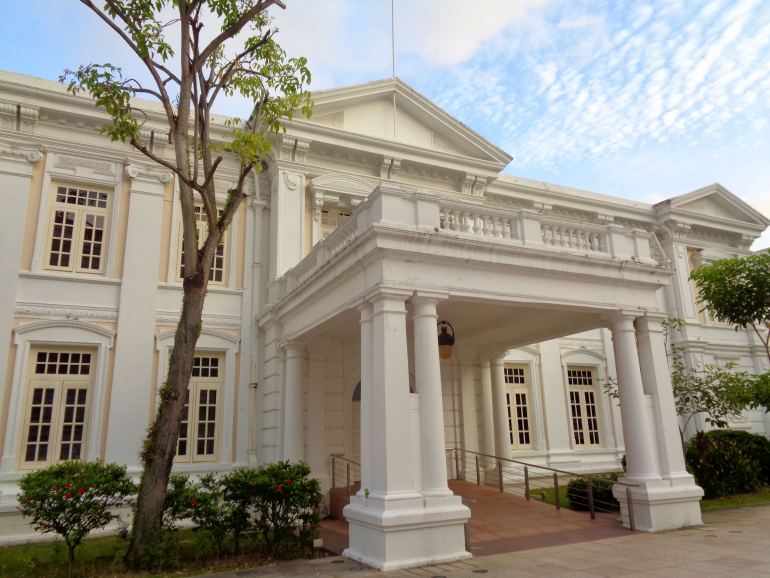
I walked quite a way in the punishing heat and humidity to the Raffles Hotel.  (There’s that name again – as noted in my first Singapore post, he founded the modern colonial Singapore.)  The area around the hotel was not great. A big mall. Big buildings. Busy, wide streets. But the hotel is beautiful.  A low rise, gleaming white colonial era building with palm treed courtyards and Sikh men in white suits and turbans at the door.  It is definitely of another era.

Raffles Hotel and my one and only Singapore Sling

I was there, like so many tourists, to visit the Raffles bar to have a Singapore Sling, as this is the bar where it was invented.  And what a bar!  Dark wood panelling and wicker fans. Well-dressed bartenders. Jazz playing.  You could imagine Humphrey Bogart or Ernest Hemingway there.  Unfortunately, smoking was not allowed.  I had the cocktail, which was excellent.  This was the most expensive thing I did in Singapore.  It was $37 cdn dollars for the standard version.  Worth it for the experience, but one was enough.

I didn’t find Singapore that expensive for the things wanted to do.  Meals were normal to inexpensive and most of the stuff I wanted to see was free – walking the streets and looking at art and architecture.  Price-wise, Singapore was fine – but stick to one Sling.

From the bar I went to the National Museum of Singapore.  It was excellent.  I knew almost nothing about Singapore’s history and this was a great overview.

National Museum

From there I planned to go to the Singapore Art Museum, but it was closed so instead I visited the National Gallery Singapore.  Definitely worth a visit, but also had I skipped it my life wouldn’t be dramatically different. 

Paintings at the National Gallery

After that I went to a fun mini museum: the MINT Museum of Toys.  It’s a small space, several storeys high with just displays of toys. I really enjoyed it. So many things I remember seeing (or in the case of a couple of things: having) and an interesting look at things like horror toys or Beatles toys, or all the diverse modern Barbies.  It was cool.

Museum of Toys

The rest of the day was sort of vague. I wandered, drank coffee, smoked cigars, ate Thai food.  I am really glad I got to visit Singapore.  Two days was fun, but I’m content not to return.

I had a flight home very early in the morning, via Tokyo, back to Vancouver.  Heading back to where I started out when I flew to from Vancouver to Saudi Arabia.  All around the world, visiting Saudi Arabia, Bangladesh, and Singapore.  A great trip.

Read More about Singapore day 2: Mostly Museums
Posted on 17 August 22
0
Posted inAround the World 2022 Asia Singapore

Singapore at Night

I’m sure there is a lot to do in Singapore at night if you want to enjoy some foodie experience or go clubbing or just get drunk with all the foreigners who seem to be there for precisely that purpose. But I didn’t want to do those things. I gobbled up some inexpensive Thai curry and then started walking from the area of my hostel to the Gardens by the Bay.

I walked along the waterside promenade. It reminded me a little of Vancouver; all the waterways and people out walking – except that Singapore had much more appealing looking patios and architecture.

The city looked nice, with all the tall buildings clustered together and lit up. The restaurants were packed and people were out enjoying the evening air. Out too were the buskers. Lots of them on the walking paths, playing music. The thing I found weird though was that all the ones I saw (maybe seven of them) were playing the sappiest, blandest songs I have ever heard. It sucked. Not the voices or talents, but the song choices were the worst kind of music I can imagine. Bland, meandering, vaguely romantic trash. I found this disappointing. I love buskers but give me something with some energy. Some jazz, an electric guitar, an accordion…something. But I was clearly in the minority opinion, based on the crowds appreciatively applauding and throwing money into hats.

As I got over to the area across the water from Merlion Park, where the dome-shaped Apple store is, there were crowds of people waiting. For something. I loitered a bit and then music and colored lights engaged as fountains erupted from the still waters and began one of those choreographed water and light and music shows.  It was very Las Vegas.  A bit corny.  I mean, I’m certainly glad I happened upon it, but I also found myself judging it for its general lameness.

I walked off before the crowds disbursed and carried on to my destination.

The Gardens by the Bay are … a huge garden by the bay.  But they are more than just a garden, they are a proper attraction, with rare flowers and plants and cloud walk platforms.  I’m sure it is lovely in the day, but I went at night when it was quite dark and I could see nothing except for the super tall, tree-like pillars, covered with plants.  Like something from another planet.  I went to see them because they looked so unusual and specific to Singapore.  What I didn’t know is that there is a light and music display that happens every evening.

I immediately rolled my eyes. “Great, another corny display.”  I had already been appalled by the buskers and underwhelmed by the ‘water ballet’, so I braced myself for the bore to come.  But then all of the lights came on and started swirling and sparkling and music swelled.  The songs ranged from classical to traditional, to jazzy and showtune-y; all paying homage to Singapore musical styles.  I wanted to hate it, but I was delighted.  It felt like Disneyland (which I love).  It felt corny in just the right way and was magical and fun.  I can’t explain why I like this and not the water show and I would totally get it someone hated both, but I found some joy in it.

It was a great end to the day.  Singapore does feel, in many ways, artificial and hollow and materialistic, but there are some nice things there.

I walked back to the strip of restaurants and bars along the water near my hostel and ended day one of two for me in Singapore by having a cigar and an iced tea on the patio of a middle eastern restaurant, watching the crowds of tourists getting increasingly inebriated against the backdrop of pretty, colonial buildings and still water. 

Read More about Singapore at Night
Posted on 17 August 22
0
Posted inAround the World 2022 Asia Singapore

Impressive Singapore: first impressions

Singapore is one of those places I had no interest in. I never doubted that it was clean or safe, that it had world class restaurants, a high standard of living, and excellent shopping; I just don’t care about those things. Give me dirty, overcrowded, dodgy, chaotic cities. To be fair to Singapore, because I quickly dismissed it, I didn’t spend any time reading about it. I might not have gone at all, except that on my flight back to Vancouver from Bangladesh, many of the flights had layovers in Singapore. It was my opportunity to see it for myself.

I would spend two full days and two nights in Singapore, which was enough. I saw what I wanted to see in that time – but it was at an exhausting pace. I think stretching it out to three days would be more reasonable.

A teensy bit about Singapore

The micro country of Singapore is an island at the tip of the Malaysian peninsula, just above the Equator.  Singapore was a trading port city back in about the 14th century.  In the early 17th century, the Portuguese destroyed it and then then it remained in relative obscurity until the British colonel and governor Sir Stamford Raffles (his name is everywhere) arrived in 1819 and ‘founded’ it as a new port. Singapore became a British possession in 1824 and it became an important trade location and, later, military base.  It was occupied by the Japanese in WWII and the British lost control to the Japanese in 1942 at the Battle of Singapore. It then fell into more bad times post war with a loss of infrastructure and continued discord in the region as it and other former British colonies moved towards sovereignty.  Singapore was part of Malaysia for a time and then became its own country in 1965.

Today Singapore is very wealthy and multicultural.  Known for being clean, expensive, and modern, having great food, having a ban on buying and selling chewing gum for non-medicinal purposes, having the death penalty for many crimes including drug trafficking, and having caning as a possible punishment for many offenses including voyeurism.  Oh, and it is illegal for men to engage in sex with each other.  Not women though.  Countries are complicated.

First Impressions

I landed at about 5am. Breezed through the airport where, disappointingly, they do not stamp passports, even if you ask.  Twice.  I took a taxi to my hostel. There is no train, there are buses, but I just wanted to get to where I was going with maximum efficiently.  It wasn’t too expensive. I forget exactly how much. Maybe about $30 cdn.

My hostel, KINN Capsule Hotel, was located right in the centre of downtown, in a perfect location near restaurants, the harbour, the subway, a hawker centre – pretty much everything I needed.  The hostel was tidy with clean and comfortable dorms; the kind that are like little pods, closed with a curtain. It was great in many respects, except that it didn’t have a kitchen, just a coffee station and the hang out area was designed in such a way that it seemed like they didn’t want people to hang out.  Anyway, I was there such a short time I just needed a place to sleep.  The hostel was pretty cheap by Singapore standards ~$70/night cdn.

hostel pod

My failure was thinking that I did not need to book a bed the night before I arrived.  (I know better but was trying to save money.)  I got there at 5:30am to drop off my bag.  What I really needed was maybe 2 hours of sleep.  That would have to wait.

As I walked out, the sun was just about to come up and I stopped for a coffee.  Once up, the city was illuminated but still quiet.  People were out jogging and doing tai chi along the waterfront promenade.  The city did look flawlessly clean, and the tall, skinny towers gleamed and reflected in the still waterways.  Lower to the ground were British colonial buildings, with buttercream columns, and pristine white statues of British figures.

waterways

My first impression was that it was a very impressive looking city.  I would not say it is beautiful and it did not excite me, but it did feel impressive and, importantly, it didn’t remind me of any other city.  It wasn’t like Seoul or Singapore, Hong Kong or Taiwan. It seemed more refined, more uptight. Well put together in way that looked great but doesn’t seem like that much fun. That’s why the word that I keep coming back to when I think about it is impressive.

Colonial Buildings

Day one

I spent my first day walking around the central downtown neighbourhood, the waterfront, the harbour, and Chinatown.  I walked along the waterways and to the Merlion Park, which is a scenic view of the water with a large Merlion statue/fountain.  Merlion? Yep. The city’s national icon is a Merlion: half fish, half lion.  It is supposed to be a reference to Singapore’s origins as a fishing village combined with the original name for the city, which translated to ‘lion city’.  I was told that many people hate the Merlion statue.  I liked it.  It’s white and pretty and different. 

Merlion!

From this view you can see over the water to some iconic modern structures.  It is all quite scenic and impressive.  I got a fresh juice and continued to wander.

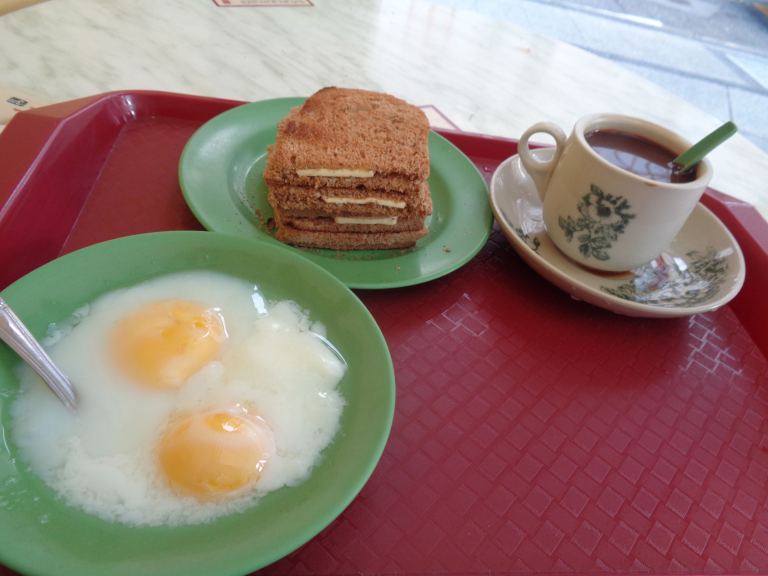
En route to Chinatown, I sopped and had breakfast.  I went to a coffee and toast place.  Or more specifically a Kopi and toast place.  Singapore has its own coffee traditions.  First, they call it kopi.  It is roasted differently.  It is strong coffee served in small portions with sugar or condensed or evaporated milk or many other variations.  “Kopi-O” is coffee with sugar.  “Kopi-C” is coffee with sugar and evaporated milk.  And so on.  The Kopi is served at breakfast with toast.  You can get the toast a myriad of ways, but the traditional way seems to be butter and kaya (some kind of sweet coconut jam), served with soft boiled eggs.  I ordered the breakfast set but didn’t have the eggs because eggs are gross.

Kopi & toast (and eggs)

I walked to Chinatown.  I visited the temples, including the Buddha Tooth (replica) Temple (I think it is hilarious that they just openly admit that it’s not an actual relic) and the Hindu Sri Mariamman Temple.  I liked the Hindu temple much more.  The Buddhist one is very new and feels it.  It looked impressive (there’s that word again) but felt a little cheap. 

Buddha tooth replica temple

Chinatown was great for a walk though. The streets are lined with these pretty two-story buildings, painted pastel colors and with wooden shutters.  Lanterns hung in the streets.  And there were lots of appealing cafes and shops to poke around in.  I was also looking for (and found) a cigar shop/lounge but it was closed. 

Feeling peckish, I visited the Chinatown Complex Food Centre, one of Singapore’s famous hawker centres.  A hawker centre is kind of like a food court, but it is partly outdoors, and each food stall is of the highest quality; often with a family making a few dishes for many years to perfection.  There is even a Michelin star hawker centre stall.  And it is cheap.  I had a bowl of some sort of laksa type of vegetarian soup for less than $5 and it was excellent.

Hawker Centre Soup

I spent the late afternoon doing more of the same: walking and poking around the streets. I took shelter at a café for an hour when a torrential downpour made the streets impassible. I had a cigar along the water at a Thai restaurant.  As the sun started to set, I headed out again after a short nap and went to the Gardens by the Bay and did more eating and walking, but I will put that in a separate post. 

Rainbow windows

My first day in Singapore was really good.  Not exciting, but pleasant.  I enjoyed the walking and the sights.  while it is quite modern, it has enough of its own character that I still found it interesting – and impressive.

street art murals

Read More about Impressive Singapore: first impressions
Posted on 16 August 22
1
← Previous 1 … 8 9 10 … 25 Next →

About Wandering North

Welcome to Wandering North, where I have been blogging about my travels since 2007.

Dale Raven North

Recent posts

  • Where to Smoke Cigars in Detroit 7 April 25
  • Toronto Layover: A Mediocre Experience 7 April 25
  • Detroit: A Surprising Weekend in Motor City 7 April 25
  • 24 hours in Belize City 23 March 25
  • Island Life in San Pedro, Belize 22 March 25

Search

Archives

Categories

Theme by Bloompixel. Proudly Powered by WordPress