Skip to content
  • Home
  • About Me
  • Where I’ve Been
  • Destinations
    • Africa
      • Algeria
      • Benin
      • Botswana
      • Burkina Faso
      • Côte d’Ivoire
      • Democratic Republic of the Congo
      • Djibouti
      • Egypt
      • Eritrea
      • Ethiopia
      • Ghana
      • Mauritania
      • Morocco
      • Rwanda
      • Senegal
      • South Sudan
      • Sudan
      • Togo
      • Tunisia
      • Uganda
      • Zambia
      • Zimbabwe
    • Asia
      • Azerbaijan
      • Bangladesh
      • Brunei Darussalam
      • Cambodia
      • China
      • Cyprus
      • Georgia (the country)
      • Hong Kong
      • India
      • Indonesia
      • Iraq
      • Japan
      • Jordan
      • Kazakhstan
      • Kyrgyzstan
      • Laos
      • Myanmar (Burma)
      • Malaysia
      • Nepal
      • Oman
      • Pakistan
      • Philippines
      • Qatar
      • Saudi Arabia
      • Singapore
      • South Korea
      • Taiwan
      • Thailand
      • Turkey
      • United Arab Emirates
      • Uzbekistan
      • Vietnam
    • Europe
      • Albania
      • Andorra
      • Belarus
      • Belgium
      • Bosnia and Herzegovina
      • Bulgaria
      • Croatia
      • Denmark
      • England
      • Estonia
      • Finland
      • France
      • Germany
      • Greece
      • Iceland
      • Ireland
      • Italy
      • Latvia
      • Liechtenstein
      • Lithuania
      • Luxembourg
      • Malta
      • Moldova
      • Monaco
      • Montenegro
      • Netherlands
      • North Macedonia
      • Norway
      • Poland
      • Portugal
      • Romania
      • Russia
      • San Marino
      • Scotland
      • Serbia
      • Slovenia
      • Spain
      • Sweden
      • Switzerland
      • Ukraine
      • United Kingdom
      • Vatican City
    • North America
      • Belize
      • Canada
      • Cuba
      • El Salvador
      • Guatemala
      • Mexico
      • Nicaragua
      • Panama
      • USA
    • South America
      • Argentina
      • Brazil
      • Colombia
      • Ecuador
      • Paraguay
      • Peru
      • Uruguay
      • Venezuela
  • Contact
Menu

Wandering North

Chronicling my travel adventures since 2007

  • Home
  • About Me
  • Where I’ve Been
  • Destinations
    • Africa
      • Algeria
      • Benin
      • Botswana
      • Burkina Faso
      • Côte d’Ivoire
      • Democratic Republic of the Congo
      • Djibouti
      • Egypt
      • Eritrea
      • Ethiopia
      • Ghana
      • Mauritania
      • Morocco
      • Rwanda
      • Senegal
      • South Sudan
      • Sudan
      • Togo
      • Tunisia
      • Uganda
      • Zambia
      • Zimbabwe
    • Asia
      • Azerbaijan
      • Bangladesh
      • Brunei Darussalam
      • Cambodia
      • China
      • Cyprus
      • Georgia (the country)
      • Hong Kong
      • India
      • Indonesia
      • Iraq
      • Japan
      • Jordan
      • Kazakhstan
      • Kyrgyzstan
      • Laos
      • Myanmar (Burma)
      • Malaysia
      • Nepal
      • Oman
      • Pakistan
      • Philippines
      • Qatar
      • Saudi Arabia
      • Singapore
      • South Korea
      • Taiwan
      • Thailand
      • Turkey
      • United Arab Emirates
      • Uzbekistan
      • Vietnam
    • Europe
      • Albania
      • Andorra
      • Belarus
      • Belgium
      • Bosnia and Herzegovina
      • Bulgaria
      • Croatia
      • Denmark
      • England
      • Estonia
      • Finland
      • France
      • Germany
      • Greece
      • Iceland
      • Ireland
      • Italy
      • Latvia
      • Liechtenstein
      • Lithuania
      • Luxembourg
      • Malta
      • Moldova
      • Monaco
      • Montenegro
      • Netherlands
      • North Macedonia
      • Norway
      • Poland
      • Portugal
      • Romania
      • Russia
      • San Marino
      • Scotland
      • Serbia
      • Slovenia
      • Spain
      • Sweden
      • Switzerland
      • Ukraine
      • United Kingdom
      • Vatican City
    • North America
      • Belize
      • Canada
      • Cuba
      • El Salvador
      • Guatemala
      • Mexico
      • Nicaragua
      • Panama
      • USA
    • South America
      • Argentina
      • Brazil
      • Colombia
      • Ecuador
      • Paraguay
      • Peru
      • Uruguay
      • Venezuela
  • Contact

Tag: Africa

Posted inDjibouti Eritrea-Djibouti trip 2024

Two Great days in Djibouti City

Djibouti was my destination after Eritrea (following my brief and unplanned overnight in Dubai). Djibouti is right below Eritrea and above Somali on the Red Sea and the Gulf of Aden. It is a tiny country, just 23,00 square kilometres with just over a million inhabitants. A former French colony. It is an important shipping country and as a military base, due to its location. The capital and main city is Djibouti City.

The flag and the map. That’s Djibouti on the horn of Africa in green.

Day One – Arrival and Impressions

I flew in from UAE to wonderful views, having a whole row of the plane to myself.

flying from Dubai to Djibouti

I applied for and received my e-visa for Djibouti without issue. I provided my hotel booking and an invitation letter from a tour that I booked – not a tour for the whole stay, but for an overnight trip to remote Lake Abbé – and the visa was issued. No problems at arrival in Djibouti City. I caught a taxi and went to my hotel.

Ras Dika Hotel

I was staying at the Ras Dika Hotel, which is right in the middle of everything. There was noting fancy about it, but it was clean and air conditioned and had a little seating area out front where I could have a cigar and watch the very busy street. The owner is apparently Canadian and the manager is from the Philippines. He was a very nice guy and helpful. I told him I needed to change some money, and we walked me a block away to a corner where older women sat in the street in chairs with large handbags on their laps. The money changers.  He helped me get a good rate for my money. (I changed US dollars.) I had my walking around money and so I was off to explore.

Djiboutian Francs

Shortly after I arrived in Djibouti City I got a text from a friend, and she asked me if it was nice. I really hesitated before responding to that text message because I knew that the person who asked this question would most certainly not think that Djibouti city was nice. They would probably think it was awful. And a lot of people do say Djibouti City is awful. It’s hot. So very hot. It is a bit hectic and lacks infrastructure. Like ATMs, unbroken streets, good public transportation, lovely parks. It does have a beautiful sea front but attempting to walk along it is difficult because of the heat and the path is at one point blocked off causing you to need to take it ridiculously long detour away from the shore. Djibouti city is loud, and might be a little bit scary if you’ve never visited other African cities. But I have visited other African cities, and I thought Djibouti City was OK. I don’t think I’d recommend it to people. There’s not a lot in terms of attractions. Museums and art galleries and whatnot are basically nonexistent. But it does have basic infrastructure. Running water, air conditioning in some businesses, restaurants that look like restaurants, and importantly, sidewalks. Not sidewalks in all places, but sidewalks in areas with lots of vehicles.

The mosque right by my hotel

I always feel like sidewalks or a good test of how well developed a city is. Sidewalks show a level of planning and thought for the citizens that live there. Sidewalks also give a person the ability to walk down the street without constantly having to worry about being run over. Where you can walk down the street without worrying about being run over your mind can turn to happier thoughts and generally leads to a more relaxed state of mind.

Anyway, Djibouti City had those things. And while I wouldn’t describe it as beautiful, I did enjoy my wander around.

Half of the city feels relatively developed and half of the city feels relatively underdeveloped. My hotel was just a few blocks into the more developed area. On my first day in Djibouti that was the side that I visited.

The buildings are not all in good repair, but there are some attractive ones, with Islamic style arches in some designs, some attractive mosques and a couple of nice cafes. There is also the market, which as far as markets go isn’t that picturesque, but it’s lively and authentic and gives you a sense of the place.

On my first day I walked around this neighbourhood taking pictures, stopping for generally substandard coffee, and exploring.

Finally, I felt like I needed a bit of a respite, so I walked from my hotel to that of the Hotel Kempinski, which is on the sea at the end of sort of a peninsula. It was about a 40 minute walk and quite pleasant as a lot of the streets had trees.

sunset and a shameless selfie

I arrived at the gorgeous hotel and made my way to the seaside where there was a bar and restaurant overlooking the ocean. I sat and had a juice and a coffee on the bar side with my cigar, before moving to the fancy Italian restaurant side for dinner and a drink and another cigar. Inside the restaurant it was cool and air conditioned, and outside it was hot, but I wanted to smoke my cigar, and I enjoyed watching the sunset over the sea and the rustling palm trees. It was exactly the relaxing visit that I needed.

I wasn’t sure if it was safe to walk back to my hotel at it was quite dark, so I had the hotel called me a taxi, which wasn’t particularly cheap but I appreciated the convenience.

Just a comment about the cost of Djibouti. It is not cheap. Sure, you could go to some hole-in-the-wall restaurant and have a bite to eat and it won’t be that expensive, but things like taxis and hotels and meals in restaurants that look like restaurants are all quite expensive, as are most of the tours that you can book. It’s sort of place where most people traveling there are doing so on a  business trip, and so the nicer hotels and restaurants can afford to charge inflated rates.

The Final Day

I had four days in Djibouti city, but two of them I spent doing an overnight tour, which I’ll write about separately. On my fourth day, I had to be the airport rather late in the day, so I spent my daytime visiting the other side of Djibouti City, the less developed area.

This was close to my hotel.

I walked a bit more near my hotel and then crossed over. The less developed side was very interesting.  It was a different world from the part I had already seen. This side of the city had no charming colonial buildings no paved streets no sidewalks, and really virtually no basic amenities. The streets were dirt and the houses were built out of corrugated metal and leftover timber. The streets were filled with roaming goats and chickens, people washing their clothes in buckets or cooking their food over fires. There was a market selling basic household supplies and tools. There was not much in the way of restaurants or cafes, but there were little shops selling basic essentials.

neighbourhood goats

I really enjoyed visiting this neighbourhood. Despite how poor it was, it was pretty. Colourful. There wasn’t a lot of litter and the houses were all different bright colours. The sun was shining and it wasn’t hectic or crowded. I definitely stood out. And I wasn’t entirely sure if I was supposed to be there, so I didn’t take a lot of pictures. People stared at me but did not seem unfriendly.

Eventually I walked back towards my hotel. Grabbed bite to eat at an Ethiopian restaurant with a rooftop patio, strolled around a bit more, enjoying the crumbling architecture and hand painted business signs and numerous chat markets and then returned to my hotel to kill time before going to the airport.

At the hotel, the manager introduced me to another guest who had just arrived, coincidentally, another lawyer from British Columbia, Canada who is traveling by himself. This fellow was traveling from Egypt Southward with the idea to keep going until he ran at a time and had to be back at work period the nice guy we sat and chatted while I finished my cigar, at that point I went back to the airport, to fly home via London.

If you haven’t read about my truly excellent overnight visit to Lac Abbé, Djibouti, you can do so here.

Otherwise, this particular trip is nearly at an end. All that remains is a pleasant layover in London which if you care to read about you can do so here.

Read More about Two Great days in Djibouti City
Posted on 8 September 24
0
Posted inDjibouti Eritrea-Djibouti trip 2024

Overnight at Lake Abbé

I enjoyed two days in Djibouti City, but the real draw for me was the countryside. There are a number of excursions that one can do on a tour in Djibouti. You can do long treks, wildlife encounters on the land, whale sharks in the sea, etc. The thing that I wanted to do though was travel inland to Lake Abbé, so I looked for a tour operator to do an overnight visit to that destination.

There were a few offering this service, but the one that I found eventually had the best price and itinerary combination. Africorne Travel, run by a pleasant and professional French guy, Alain, living at least part-time in Djibouti. Sometimes he runs the tours himself and if he is not around then he has a local run it. I was in the latter category.

The Journey

On the day that we left, my guide picked me up in a big 4×4 off road vehicle, driven by a driver whose name I can’t recall. We set out. We stopped at a market to buy some fruit and then drove past some large Chinese infrastructure building roads, and then we were out in the countryside.

The drive was excellent. There are some small towns and villages along the way as you drive to the lake. We stopped at one to have lunch, before continuing on our way. But as we got away from that small town, the land just became barren. Some small rocky hills or sometimes just miles of flat cracked earth. Little to nothing was growing, there was no water to be seen, aside from the odd camel, very little in the way of wildlife. The roads disappeared and we were entirely off road. The temperature was in the mid 40s.  It was desolate.

Small towns before we were off road

my crew: stopping for cigarettes and snacks

What I found amazing, was that in this very inhospitable landscape, there were still small villages. In these small villages people seemed to live of houses that resembled rounded piles of sticks and fabric. There would be one or two shops, that were sort of like cinder block cubes. We stopped at one to pick up some water and cigarettes. But I just kept thinking, why live here? No shade or water, electricity or any conveniences. Surely like would be better in a town or at least somewhere where you cold grow food or fish, but you have to respect the resilience.

village life

I was enjoying the journey, but what was unusual was that we were collecting people along the way. It had started with just three of us, but after our lunch in the small town a man with an orange beard joined us, and for a time another young man joined us. I gather we were giving them rides to other places that we were going. It was fun and I was happy for whatever was going on. I have since then had people ask me if I felt safe as a solo female traveler with all these strange men in the middle of nowhere; and the answer is yes. Without reservation.

The drive should have been about 6 hours not including lunch. So I was counting on it being maybe 7 hours or so. Even as I thought that, I did recognize that things can always go sideways, especially where, as here, there are no roads, but I was keeping my fingers crossed that in about 7 or 8 hours I would be at my destination camping out by the lake.

Unfortunately, things did take a bit of a turn. We got stuck in the mud. It’s funny to say “mud’’ because there was nothing remotely wet or muddy about the ground, but we got stuck in layers of dirt that had formerly been mud I suppose. We all got out of the vehicle and tried to help rocking it back and forth to get us unstuck. That was to no avail. And then we walked out from the vehicle into the landscape looking for large branches that we could use to put under the wheel to make sort of a ramp to drive out on. But the landscape was nothing. It was like the moon. There were no trees, and any bits of wood were just little twigs. Finally, two of the guys decided that they would walk back to the last village that we had passed and ask for help. The last village we passed was a ways back, but I figured that was the only option. (It’s worth mentioning, that in this landscape not only is there no Wi-Fi of course, but also no cell signal. Is the sort of place where you could imagine just dying if you didn’t have the right provisions.)  

While we waited for them to return, I sat on the ground in the shadow of the vehicle and smoked cigarillos whilst being bundled up on a long-sleeved hoodie and brimmed cap. It was roasting, but I wanted to stay out of the sun.

a small setback

I was expecting my travel mates to return with a vehicle with 4-wheel drive and a winch to pull us out of the hole, but what they returned with were three skinny young men in sandals, and with a collective weight of about 300 pounds, and a shovel. How was this going to work?

They got to work, digging a bigger hole and then filling it in with dirt, packing it down and adding more. And then with a bit pushing from all of us, we were out. Two of the guys walked back to the village with the shovel, but one guy joined us for the trip. Now we were six.

help arrives

The new guy took over for the designated driver and it was clear why; he skills to navigate the terrain far exceeded that of the original driver. We drove in and out of deep crevices in the earth where water once flowed, we scaled hills that seemed to be nothing more than piles of boulders. A couple of times we briefly got stuck again, but he freed us quickly.

some of the terrains

Of course, this delay had dramatically extended our journey and by the time we got to Lake Abbé, the sun was setting, but first I got a preliminary view of what I had travelled so far to see.

Lake Abbé

Lake Abbé is salty lake at the border of Ethiopia and Djibouti and is considered to be one of the more inaccessible places on earth. The landscape is flat and then towards the edge of the lake are these craggy natural chimneys and a small, dormant volcano. Because of the late hour I would have to wait until the morning to visit them, but I got some nice views from the camp.

sunset

The camp consisted of some igloo-shaped grass huts with cots inside, a covered patio area, cooking area, and toilets that worked if there was water.

sleeping quarters

I sat on the patio area with my companions. Only two spoke English, but we sat and ate dinner and drank tea, watching the landscape disappear into darkness.  I enjoyed a couple cigars.

On the right, that is me trying to take a selfie and being startled by a flying insect.

Because there is no electricity and nothing for miles, the sky was spectacular with stars and in the distance there was occasional lightening. I went to bed but quickly realized that the huts were like tiny ovens, so I dragged my cot outside and slept soundly under the stars.

purple sky!
sunrise

In the morning, before everyone else got up, my guide and I walked to the lake. The ground was crazy. In places it was hard and cracked with dried salt and in other places you would sink into mud past your ankles. There were fissures in the earth in places where hot water boiled up, producing steam. It was so cool; truly like being on another planet.

We could not get right up to the lake as the mud was too thick, but we got to see a lot.

Back at the camp, we had breakfast and then four of us walked to a different part of the lake, where the water appeared pink – because it was covered in flamingos! I had never seen so many. It was incredible. We couldn’t get too close without scaring them off, so my pictures are a bit lacking In quality resolution, but in person it was beautiful.

Me and the original guide and driver and the substitute driver

We packed up and started the journey to another lake – Lake Assal. On the way we met lots of camels and a small troupe of curious monkeys.

Our group dwindled as we dropped off our add-on travelers and again, we were three.

Lake Assal

Lake Assal is relatively close to the city, but on the other side. (It is easily visitable as a day trip from Djibouti City.) It Is notable for being a hypersaline lake, like the Dead Sea, and also for being the lowest place in Africa. I had had the experience of floating in the Dead Sea and didn’t feel like getting all salt encrusted so I didn’t swim in it, but it was beautiful. Like nothing I had seen before. Blinding white and reflective; like ice. We could walk out quite far on the salt before it turned into a lake, but with the water on top of the sale it became like a mirror.

At the shore were a few young men and boys selling salt and items, like animal skulls, that had been submerged in the lake and were now salt-encrusted artifacts.

this would have looked so cool in my office

We drove back to the city, stopping at a massive gorge and a view of the landscape.

It was an excellent experience and while it was not cheap, it was worth the money.

Back at Djibouti City, I would have another day before heading home via London.

For my post about Djibouti City, click here.

Move on to my layover in London here.

friendly kids in a village in Djibouti

Read More about Overnight at Lake Abbé
Posted on 7 September 24
0
Posted inEritrea Eritrea-Djibouti trip 2024

Escape from Eritrea

This is the tale about how I was briefly stranded in Asmara but was able to get out quickly through some sheer luck, kindness, and quick thinking.

In my previous post I wrote about my arrival in Eritrea and the splendid first day that I had visiting the sites of Asmara. I was poised to spend another two days in the capital enjoying being off the grid and relaxing at cafes and checking out historical architecture. I awoke that second day feeling slightly more rested. I’d slept for about four hours, and I headed out in search of coffee. I had an espresso and was just walking down the Main Street when I ran into my guide from yesterday, Selihom. I said “Hello,” and she almost immediately asked me if I was affected by the flight cancellations. “What flight cancellations?” I asked. She told me that Air Ethiopia had, effective immediately, canceled all flights in and out of Eritrea after some perceived sleight. While Ethiopia and Eritrea aren’t technically at war, they are in sort of an administrative standoff and have been for decades. “Huh,” I thought, “that doesn’t sound good.” But I didn’t immediately panic. Yes, in two days’ time I had a flight out of Eritrea on Air Ethiopia flying to Addis Ababa and then to Djibouti, but that was in two days; “Surely things will get sorted out by then,” I thought.

I went and had a cigar and one of those excellent tiny little macchiatos that they make in Ethiopia and Eritrea and I thought about the situation. It quickly dawned on me that this was actually quite bad. There were only three airlines that fly in and out of Eritrea and Air Ethiopia was the main one. If the flights were grounded I had no way to leave. (Land borders were not an option.) And while sometimes I wouldn’t mind being stranded abroad, Eritrea is not one of those countries. It’s not that isn’t lovely, but it has certain disadvantages: the lack of Internet means working remotely is impossible, the very high price of accommodations makes it impractical, and the fact that they don’t accept credit cards means that my cash would very quickly run out. I realized that I needed to get out of the country right away before any remaining flights filled up with people trying to do the same thing.

Fortunately, I had downloaded an offline map of Asmara ahead of time and consulted it and found three airline offices in the city. The first was Air Ethiopia. That very quickly turned out to be a non-starter. The office was closed and there were about 100 people outside angrily yelling and demanding service. Then there was an Air Emirates and a Fly Dubai office side by side downtown. The Air Emirates office had two very stressed out looking representatives working and a massive queue of people waiting for assistance. These were all people that were affected by the flight cancellations looking to get out of the country. The Fly Dubai office only had one customer service representative but had slightly fewer people in the queue. So I decided to wait there. With me in the queue was a woman living in Tanzania who had come to Asmara on business; she was a conservationist working with the government. She was in the same situation as me. She was very pleasant, and we had a lovely chat while we waited. She travels to Eritrea a lot and confirmed that these flights were going to fill up quickly and once they did there would be no way, easily, out of the country.

When it was my turn, I went up to the representative and said that I was looking for a flight out of the country later that night or the next morning to Dubai or Istanbul or Addis. (I didn’t want to fly back to Cairo because I didn’t have a visa for re-entry.)  From any one of the three cities I would be able to get a flight to Djibouti.

The woman said we have a flight to Dubai tonight at approximately 11:30pm. “Terrific,” I said, “I’ll take it. How much?” “$714 U.S. dollars,” she said.  I froze up for a second and asked hopefully, “Do you take credit cards?”  “No,” she said, “only local cash and US cash.” OK. I had an envelope of cash with me. I pulled it out and started counting out my US money. I started by counting the 50s, then the 20s, then the 10s, by the time I got down to the ones, I realized I wasn’t going to have quite enough. I was $7.00 short – but I had euros. “No euros,” she said, “only U.S. dollars.” I did have the option of leaving and exchanging the euros into local money and coming back, but she wouldn’t hold the flight for me. I tried to bargain with her, but she wasn’t budging and the others behind me waiting to book flights were getting impatient (I imagined).  Thankfully my conservationist friend from Tanzania handed me a crisp US $10.00 bill and allowed me to make the payment. Hallelujah. The woman was booking herself on the same flight to Dubai later that night.

I paid for my flight and headed back to my hotel with $3 in my pocket.

A few pictures i took that day before i got the bad news

I was feeling pretty pleased with myself. I was able to act quickly figure out what I needed to do and get a flight out of the country, all without using the Internet or credit cards. Just old-fashioned map reading quick thinking and cash carrying.

I still had no idea how I was going to get to Djibouti, but I was going to figure that out once I got to Dubai and had the Internet access.

I exchanged €10, which gave me enough to have dinner and get a ride back to the airport.

At my hotel I ordered dinner. Some vegetable pasta. However, when they brought it to me it was meat pasta. I normally wouldn’t care about these things, and I would just send it back and ask for what I ordered, but I was running out of time before I had to go to the airport and there was no time for them to remake the dish. Nor were they willing to give me a refund. It was all very frustrating, but I didn’t have time to argue with them. So I just left my food and my money, hungrily, grabbed my bag and caught a ride back to the airport.

Airport

The airport in Asmara is quite bare bones. There are no lounges. There are a couple of souvenir shops that may or may not be open. Other than that. it’s just benches. Like an old-fashioned bus stop. However, the mood was fun. I saw the faces of many people that I had seen throughout the day at the different airport offices. We were all smiling at each other and happily saying things like “Oh you made it!” and feeling sort of a general camaraderie about having gotten out of a bad situation. I sat with my conservationist friend and chatted until the flight came. Oh, and I had a shot of Eritrean vodka from the small bar/cafe at the airport, which cost me about $1.

Why not?

Once I was on the plane with the wheels were up, I felt a more relaxed. I didn’t get to spend my three glorious days in Asmara, but I got to spend one very enjoyable day of sightseeing and another rather exciting, albeit stressful, day of problem solving. Even though it was a bit stressful in the moment, I knew that later on I would look back on this experience fondly.

Plus, this really reinforced a lot of my travel habits, including: always have cash (more than you need); know your maps, and have a printed or offline one; know how to get around and generally do things without the use of cell phones and Wi-Fi; and be flexible.

As we left Asmara very late and we landed in Dubai at about 6:00am, I had little or no sleep again that night, which made probably five days of having less than four hours of sleep. I would land in Dubai without any fixed plans but knowing that I needed to get to Djibouti in about 36 hours so I would not miss out on the rather pricey overnight tour I had booked to visit Lake Abbé. I was up for the challenge.

Read on here for my overnight Dubai layover and how I managed to get myself to Djibouti.

As a postscript, about a month later, my Air Ethiopian flight was refunded in full. Although I ended up spending far more for my last-minute tickets to Djibouti than I had originally. Air Ethiopian flights eventually did resume to Eritrea, but I wouldn’t count on it.  If I was doing the flight now I would probably pick a more reliable airline.

Wheels up!

Read More about Escape from Eritrea
Posted on 3 September 24
0
Posted inEritrea Eritrea-Djibouti trip 2024

Back in Time in Asmara, Eritrea

When I told people I was going to Eritrea, all but the most die-hard travelers had not heard of it. Fair enough. Although Eritrea is famous for a long-standing conflict with Ethiopia, it is not well known to your average person. Eritrea occupies a sliver of land northeast of Ethiopia, just above Djibouti, and along the Red Sea.

Eritrea has been notoriously difficult to visit. You need a visa and someone on the ground to arrange it for you. At the time I went, you had to go as part of a tour, but the tour needn’t occupy all of your time. You needed a permit to leave Asmara (the capital). There is little to no wifi, no ATMs, credit cards are not accepted, and the country tightly controls the information coming in and out. It is often referred to as the “North Korea of Africa.” Not exactly inviting.

But I was so curious to visit this secretive nation that I planned a trip around it.

I booked a day tour and visa support through an Eritrean travel agency called Adulis Travel. They were very helpful. All I had to do was send them my info and agree to pay them in cash and they took care of my visa, hotel, and tour.

my visa

I planned to spend a few days in Asmara. One day on the tour and then two days to myself being gloriously offline; relaxing at cafes and taking in the architecture.

I arrived from Cairo (written about in my previous post). I arrived after midnight and my guide, Selihom, was waiting for me and thankfully so. With her help, I was able to get my visa in my passport in about 30 minutes.  Others waited for more than an hour. I paid $70US cash for the visa and Selihom dropped me off at my hotel, promising to pick me up in a few hours for my day tour. Sigh. Another night of only a few hours’ sleep.

I stayed at the Crystal Hotel.  There are other and cheaper options, but they are located farther from the centre.  The Crystal Hotel was not cheap, but central and well staffed. My room was huge and devoid of any character.

My room at the Crystal Hotel

My first glimpse of Asmara was that it was completely empty of people and quiet at this time of night. Also, the streets were immaculate. Well-paved and free of trash. It looked quaint and I could not wait to go see it tomorrow.

The street outside my hotel.

The next morning, Selihom picked me up with a driver.  The tour would be a walking / driving affair. It was a good introduction to the city. Of course, were it not for the need to have a tour to get the visa, I would have visited on my own and that would have been fine, but we did see a lot on that first day and I got a good sense of what the place was like. What was allowed, what people’s lives were like, etc. As much as you can in a day.

We visited Medebar market – always a favourite stop of mine. We went to a local scrap area where people were taking discarded items and making them into new things. Old paint cans, scrap metal, barrels et cetera, all became something new.  They told me this is because of their environmental concerns, and I am not saying that is untrue, but it is certainly also because they do not have a lot of money or access to world markets.

Medebar Market and a welder there with a homemade mask

We visited a video store and electronic repair shop. I know, but it was really interesting. Because there is little to no wifi in the country, people are not streaming their media; they are renting it. Ah, nostalgia. The guy fixing the TVs and phones said he could fix everything and did. Again, in a limited economy things must be reused, but it is also a good lesson to those that throw things away and replace them without a second thought.

We walked the streets of the downtown area. This was terrific. Asmara is full of 1940s architecture, and little has been upgraded. It is a UNESCO site for these reasons. Part of what makes it so appealing is that the Italians occupied Eritrea, built terrific theatres and cafes and then left and the country has been more or less frozen in time since then.  Those cinemas and cafes are still in use. The coffees and atmospheres are wonderful. All of Asmara has this suspended in time feeling and in a lovely way. No billboards or flashing signs, people are not on their phones constantly (because no wifi), there are old cars, clean streets, and everything is quite well taken care of. It reminded me a little of Havana before they got wifi.

Cinema Impero
Cinema Roma
Coffee at Cinema Roma

This was the atmosphere I wanted to enjoy for a few days.

The only downside is that Asmara has very strict smoking laws. No smoking indoors or on any patios. Period. And I only found one place (a courtyard at a hotel) that was willing to break the rules. That was a bit of a disappointment.  I had imagined myself on patios with tiny Eritrean/Italian coffees, puffing on a Ramon Allones. Oh well. I still was able to smoke outside my hotel in the evening sitting on a chair they let me borrow.

We continue our tour by visiting the thing I was most excited to see: the Fiat Tagliero Building. The building was designed as a petrol station by Giuseppe Pettazzi and was built in 1938.  It has an art deco/futurist style and is intended to look like an airplane. It is fabulous. It is no longer in use but is very much intact and you can enter and climb up to the roof for a different perspective. It was this building that first made me want to visit Asmara and it did not disappoint.

Fiat Tagliero Building

more views, including me and Selihom

But there was more to come!

We visited the tank graveyard; a pretty field littered with piles of tanks, trucks, and other army vehicles. They remain there as a symbol of Eritrean independence and its victorious struggle against Ethiopia in the war of independence (1961 to 1991). The site is just out in the open but there is a cabal of taxi drivers who monitor the comings and goings and charge a small fee. It was super fun to climb on all the old wrecks and play with the tanks.

Tank Graveyard

Amongst the things frozen in time in Asmara is the bowling alley.  Built in the early 1950s for American using a base nearby, it exudes vintage charm. Vintage photos of long deceased leagues adorn the walls. Translucent red brick detail on the walls and lanes where the balls are returned and the pins reset by hand. By children. Of course, Selihom and I played a round. There was no one else bowling at the time, but the billiards tables next to the lanes were packed.

vintage lanes

We stopped by a cemetery and walked the tombstones and then we had lunch.

cemetery

Traditional Eritrean food is similar to Ethiopian and I had a platter of vegetarian treats served on spongy injera bread.

lunch

We made a final stop, which was up in the mountains for views of the valley and to try a local cactus fruit that is picked and sold by the local kids. Honestly the fruit was only so-so, but I had several of them.

fruits for sale
valley views

It was a marvellous day. I learned a lot of about Eritrea, saw ‘the sites’, and enjoyed Selihom’s company.  And then I was set free.

I went out for dinner – pizza (hey, it was an Italian colony) – and had a walk and a cigar before bed. I couldn’t wait for the next day of wandering around at my own pace and enjoying the city.  Except…that didn’t happen.

Sorry for the cliffhanger, but read on, for the tale of how quickly things can change in Eritrea.

Cafés and Asmara streets at night
Read More about Back in Time in Asmara, Eritrea
Posted on 2 September 24
0
Posted inAlgeria Algiers-Nice-Athens 2024

Museums, Monuments, & Massacres: Day 2 in Algiers

My first day in Algiers had been sunny, but on my second day in Algiers, it was pouring rain. Not a little rainfall, but a heavy, relentless torrent. I was soaked through before I had an opportunity to buy an umbrella. I didn’t realize it until later, but the rain had ruined my passport, washing away the details and colours of my photo until I looked like an apparition. Fortunately, the rain was only a morning problem. By the afternoon, the sun was out, and we began to dry off.

I met my guide Rasha (from Fancy Yellow Algeria) at my hotel, and we embarked on a day tour of Algiers, which was about eight hours. This was the first time, I think, that I have ever had a female guide, which a nice change. We started by retracing my steps from the previous day, but this time, I got to see some extra, hidden places in the casbah.  Mosques and dwellings were revealed to me behind closed doors. We went to a bombed-out building where the photos of Algerian heroes hung.

Too many casbah photos? Well then they shouldn’t make it to photogenic.

The French colonization of Algeria was a theme.

The French were there from about 1830 to July 1962. The French brought more than beautiful buildings and a European café scene; they brought death and destruction. The tales of horrors committed by the French against the Algerians were extreme: rape, torture, burying people alive, throwing them off cliffs, and worse.  This was particularly bad when the Algerians fought for their independence and the French retaliated during the Algerian War (1954-1962).  While travel tends to teach me that that people are basically kind, history teaches me that we have always done terrible things to each other and probably always will.

We climbed up to a rooftop and had coffee whilst overlooking the city and the sea.

After a very nice lunch, we took the subway to the botanical gardens. The subway is limited in terms of how much it covers, but is a proper, functioning metro.

lunch

We walked through the gardens, which were stunning. Interestingly, it formed the location setting for many of the shots from the 1932 movie “Tarzan the Ape Man”. Which was shot mostly in Algiers but many of the jungle scenes specifically in the botanical gardens. The tree and lagoon from the movie are still there.

Botanical Garden Hamma

From the top of the botanical gardens, we took a gondola up to the Museum of Fine Arts. It is one of the largest Fine Arts museums in Africa and has a good collection of European and Algerian art. The museum seemed to be almost empty at the time that we were there which made for a nice experience.

I love a gondola

From the museum we walked over to the monument of Algerian independence, a huge and imposing structure with an eternal flame the countries independence and those who died in the struggle. There is also a small museum just underneath it which isn’t a great museum but it does provide a lot of information about the war and if you enjoy viewing awkward mannequins recreating historical torture, you might really dig it.

We took the subway back downtown and parted ways. It had been an excellent and educational tour. My time in Algiers did feel a little bit rushed, because it was a little bit rushed, but I was happy with what I had seen. I had the evening free to myself. I walked around at night, feeling even more comfortable today than I had the day before and took pictures of buildings and mosques as the call to prayer rang out.

I had done some research on where to smoke cigars. I saw almost no one in Algiers smoking shisha, which was a bit surprising to me, but it just doesn’t really have that scene. I also looked into where I could smoke cigars inside and there seemed to be no real answer. I found one blog for many years ago that referenced a restaurant where smoking was allowed but I couldn’t find it anymore. However, I did find a peculiar restaurant that had both smoking and non-smoking sections and I decided to go there.  It was called the Brasserie des Facultés and was a watering hole/bistro across from the university. And they do in fact have a smoking section. I was delighted. The place felt wonderfully 1970s. I ordered some dinner and enjoyed a Romeo y Julieta along with it. How civilized. 

sneaking a selfie during dinner

Dinner, like my lunch in Algiers, was bland.  Couscous or noodles with vegetables served in a tagine. Not offensive, just bland, I longed for spicy sauces.

But good food was just around the corner as I was about to leave for France. Algeria deserves more of my time, and I definitely plan to go back to visit the desert vistas of the South, but for now this is all I would see. The next morning, the third day after I arrived in Algiers, I was on the 6:15 AM flight to Nice.

more, random Algiers photos
Read More about Museums, Monuments, & Massacres: Day 2 in Algiers
Posted on 12 February 24
0
Posted inAfrica Algeria Algiers-Nice-Athens 2024

Alighting in Algiers

I wanted to visit Algeria. The largest country in Africa, sitting on the north coast between Morocco and Tunisia, stretching from the Sea to the Sahel. It seems to have it all: stunning desert vistas, a vibrant capital, rich cultural traditions, ancient ruins…I was smitten. I particularly wanted to visit the south, with its isolated, ancient desert cities. I’ll tell you now that I did not get to the south. I still plan to visit, but it didn’t happen this time.

Logistics

Algeria is one of those countries that has been very difficult to visit. Visas required with invitation letters and mandatory tours, consulates that don’t respond, and expensive fees. This have been getting better in the past few years, but when I went it was still not super easy. To go, I needed a visa, which required sending my passport to Ottawa with an application, fees, my bank account statement, a letter from my employer, an itinerary, and an invitation from a tour company. I’ve never done a multi day tour and wasn’t interested in it, but I had heard that it might be possible to travel independently after I took a tour. I understand this is now possible; then it was not – or so I was told. There were a lot of competing stories at the time. The tour company said I could only get a visa for the length of my tour. I did ask how much a tour would be if it included a few days in the south, but it was prohibitively expensive. So I reached a compromise: I would only visit Algiers (this time) and worked out a short visit (so it wasn’t too costly) that gave me some time on my own as well as with a guide.

I had heard so many horror stories from people who sent their passport into the Algerian consulate in Ottawa and never got the visa, or that it took months; I don’t know how I got so lucky, but I mailed in my application on a Monday and had my passport back, with the visa, by Friday of the same week.

My Algerian Visa

The arrangement I had was with the Fancy Yellow tour company. They arranged to pick me up at the airport and drive me back to the airport and I had a half day tour on my second day.

Overnight in Paris

I flew from Vancouver to Paris, where I spent the night; arriving late and leaving early. I stayed at the hotel Libertel Gare Du Nord Suede, which was cheap and serviceable, and went for a late night was around the area, just to stretch my legs and soak up something of being in Paris. I got a sandwich and had a small cigar in the chilly February air before going to sleep.

Arrival

The next morning, I flew to Algiers. No hassles at the airport. I had my visa. It was about 12:45. I met my driver, changed some money, and drove to the ABC Hotel. What it lacked in charm or character it made up for in being in a central location and being clean and functional with a nice free breakfast and helpful staff.

Algerian Dinars

Hotel ABC

I immediately went out to explore.

Algiers

I walked all around the central part of Algiers, taking in the streets and walking past landmarks and impressive buildings. Algiers is lovely. Like a cleaner Paris in some areas. Gleaming white buildings with decorative balconies, flower sellers, tree-lined streets, statues, and squares. It was lovely and felt safe and, while I was dressed quite modestly anyway (all in black with a loose knee-length dress, sweater, blazer, scarf, tights, and combat boots), I didn’t feel like that was strictly necessary. Certainly there was no need to cover my head or wear an abaya.

National Theatre

Post Office

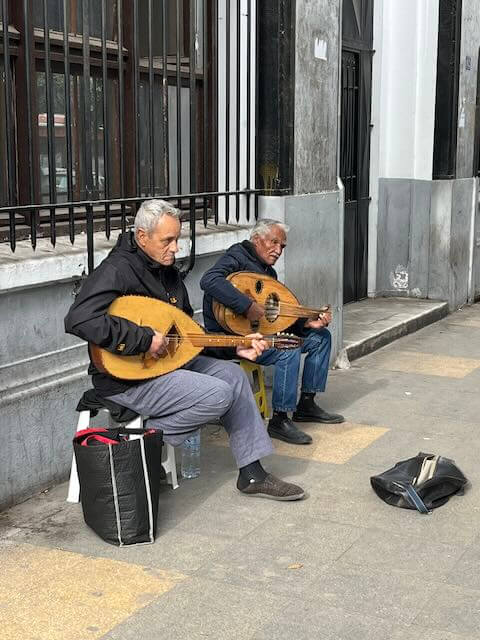
I took photos of the stunning mosques (they didn’t seem to be open for interior visits). I got a Mhajeb, also known as Mahdjoub (a delicious flatbread/crepe-like thing stuffed with, in this case, different greens) being sold from a window. A few men on the streets played the Algerian mandole for donations.

Ketchaoua Mosque

lunch

Most people in Algiers spoke Arabic, with some French, and Berber, with the written language of Tifinagh, a written form of Berber appearing on many signs. Tifinagh is a very intriguing looking language; almost like a language that would be engraved on some alien artifact.

Tifinagh script

Language barriers notwithstanding, it seemed like an easy place to visit. But I hadn’t been to the Casbah yet. The Casbah was the most appealing part of Algiers. An historic quarter of the city, rising up a hill, with the buildings mostly dating back to the 17th and 18th centuries. It is a UNESCO heritage site, but due to years of conflict, colonization, and neglect, parts of it are in very poor repair. Readings about the Casbah, most reports say it is dangerous; that tourists should not visit it without a guide. I didn’t let that stop me, and had no issues wandering the narrow, crooked alleys. I was a bit shy about taking pictures that day, not wanting to attract any hostility. (I made up for it the next day.)

Had this been my only visit to the Casbah, I would have been quite happy, but I admit that I had a better visit the next day with my guide, as there was so much history I didn’t know and areas I had missed.

But it was a perfect wander, and I finished it off with a coffee and a cigar on the excellent patio of Le Tantonville Grande Café d’Alger. Dating back to 1883, it has history and a perfect patio for people watching as you sip your coffee.  It was, apparently popular with French bohemians, artists, writers, and philosophers, including Camus and Sartre. I felt rather sophisticated.

Cafe Tantonville

I went back to my room just after dark. It had been a long journey. I thoroughly enjoyed my first day in Algiers, but I will say that the city felt a bit quiet. It wasn’t busy or bustling, and just felt subdued. There is nothing wring with that, but I felt like it lacked excitement, but it made up for it in history and looks.

The next day I would have a guided tour and see much more of the city.

Read More about Alighting in Algiers
Posted on 11 February 24
0
Posted inAfrica Zambia Zimbabwe-Zambia 2023

Last Stop: Lusaka

I had arrived in Lusaka in the afternoon of Saturday, arriving by car from Livingstone. I set out immediately to explore what I could of the city. I had read a lot of things about Lusaka that suggested that it might not be particularly safe after dark, so I wanted to get in the sightseeing that I could while I could on that first day. I set off from my hostel – Lusaka Backpackers – to explore.

Lusaka doesn’t seem to have an overwhelming abundance of intriguing touristic sites, but I always say that there’s something worth exploring in every city.

me, out for a wander.

Unfortunately I had missed the closure of the museum, which I had really wanted to see, and it would be closed the next day as well, but I walked to it so that I could see the freedom statue out in front.

National Museum of Zambia and the Freedom Statue, marking Zambia’s independence.

I walked around a busy street catching some glimpses of mosques and a few interesting buildings. But I didn’t have a lot of time before the sun went down. I walked through sort of a residential neighbourhood filled with flowering bushes and trees and made my way to a cute cafe set in a garden (The Garden Café & Buddha Bar), which I recommend as a pleasant oasis.

I had a bite to eat and a cigar and ended up chatting with the owner for over an hour. He is from Zambia originally but had moved away to England and moved back. It was fascinating to hear his theories about why, he felt, Zambia is so culturally diverse and safe. His theory was that tribes from lots of different warring countries around Zambia had all fled to Zambia to escape conflicts and as a result, the country was full of people who were diverse and peace loving. I don’t know if that is true, but I certainly cannot contradict it; nor would I wish to.

I walked back to my hostel just as it was getting dark. I don’t know if it was safe or not to be out after dark, but I was also fairly tired so I spent an evening hanging out at my hostel before going to bed.

Murals in Lusaka

The next morning, I got up early, determined to make the most of what I could that day. I had to leave for the airport around 4:00 that afternoon. Again I went out exploring. A lot of things were closed in Lusaka on a Sunday, but it was pleasant to walk the quiet and colourful streets.

I visited several cafes, but I had breakfast at this wonderful restaurant called Meraki Café, which is not a far walk from my hostel. (I think there is more than one location; the one I went to, which is so pretty, is on Chaholi Roasd). It looked like it was lovely inside, but I never made it past the wonderful outdoor garden seating. I had an excellent breakfast and a morning cigar. It was the sort of place that if you weren’t looking for it you wouldn’t stumble across it because it was tucked away on a residential street. I got the sense in my short time in Lusaka that a lot of places were like that, just hidden away, which makes it difficult to see a lot on a short trip, but I did what I could.

Breakfast at Meraki Café

I took the bus to the African Sunday crafts market, which was worth the journey. Lots of masks and paintings and other sorts of crafts being sold. It was a little outside of the centre, so I took a bus. I walked around and looked at the offerings, which were lovely, but how many things can one buy? After a bit of haggling, I walked away with a mask for my office.

Sunday Crafts Market

At this point it was time for me to head back to the hostel and get organized to go to the airport. My trip to Zambia and Zimbabwe was at an end — or just about, as I had a long layover in London ahead of me.

Read More about Last Stop: Lusaka
Posted on 12 November 23
0
Posted inAfrica Zambia Zimbabwe-Zambia 2023

The Road to Lusaka

I had done what I set out to do in Livingstone, including visiting the Devil’s Pool, and my trip was drawing to a close. I decided to fly home from Lusaka, rather than return to Harare. Why not see a new city, even if only for a day or so? I needed to figure out how to travel from Livingstone to Lusaka.

Lusaka is the capital of Zambia and is not too far away from Livingstone. You can fly, but most of the flights were routed through Johannesburg, making it a needlessly long journey. There is also the bus, which is cheap and seems to run on schedule from a big, new bus station in Livingstone and takes about seven hours. Or you can drive. I was set to take the bus, but I met this nice taxi driver in Livingstone – let’s call him Max (not his real name) and I liked him so much that I asked if he would drive me. He wanted to visit some of his kids in Lusaka, so we worked out a deal and he drove me the whole way. It was faster than the bus (giving me more time in Lusaka) and we got to make stops.

Changing Money & Getting a Snack (not very good, as it turned out)

The drive was pleasant. Max had a comfortable car, and I enjoyed chatting with him about his life and family. We drove though small towns or cities along the way (Zimba, Koloma, Choma, Batoka, Pembo, Chisekesi, Menze, and more), stopping for snacks and coffee. About halfway through the journey I finally asked Max about the music he was playing, as we had been listening to the same CD on repeat. (I didn’t know what it was, but I make a small video and ‘Shazaamed’ it later.) It was an Irish boy band called ‘Westlife’ that I had never heard of. It just seemed an odd choice for a Zambian man in his mid 40s. Monga said he didn’t know who the band was. He had just bought the car used and the CD was in the player and, as the car menus were all in Japanese, he hadn’t yet figured out how to change the music. So, Westlife was the soundtrack to the journey.

Me and “Max”

En route it was wonderful to see some of the landscapes as well as catching fleeting glimpses of daily life.

views from the road

We arrived in Lusaka about midday. The traffic in the city was awful. We crawled along once we reached the city limits, but I go my first glimpses of Lusaka. A busy, not terribly attractive place.

first glimpse of Lusaka

I checked into my hostel, Lusaka Backpackers, which was a nice little place. I had a private cabin-type of room, which, unfortunately, I shared with many small cockroaches, so I slept with the lights on both nights, but it was well located and I could walk to the museum and other central locations, so it was ok.

Lusaka Backpackers Hostel

More about Lusaka in the next post as I explore Zambia’s capital.

Read More about The Road to Lusaka
Posted on 11 November 23
0
Posted inAfrica Zambia Zimbabwe-Zambia 2023

Zambian Zebras in Livingstone

Coming from the border with Zimbabwe, my taxi driver dropped me off at my accommodations: The Ravine Lodge. I was still on a high from having seen zebras by the roadside and I was excited to explore a new country: Zambia.

The Ravine Lodge was comfortable. I had a nice private room in a bungalow around a grassy courtyard. I would have no hesitation recommending the hotel as it was a good price and just a short walk into the city centre. That said, that short walk into the city centre felt like a long walk during the day because it was so hot and felt long at night because it was so dark and I was concerned about what creatures might be roaming around.

The Ravine Lodge

But I didn’t come to sit in my hotel

walking in Livingstone

I walked into the city centre. I liked Livingstone; it is small and there is not a lot to do there apart from animal and river activities. The central crafts market (the Mukuni Park Curio Market) is open most days. It is small enough so as not to be overwhelming and has an excellent assortment of local handicrafts. I eventually bought a mask and chatted with some of the vendors. There is a small museum in town, which is worth visiting if you have a bit of extra time but is okay to skip if you don’t. I made my way through the city stopping at various cafes along the way enjoy some air conditioning and a bit of coffee. It was an easy place to visit. People spoke English and are used to tourists; and it felt safe.

cellphone booths

downtown Livingstone

crafts market

My time in Livingston really had two purposes: number one was to visit the Devil’s Pool at the Victoria Falls; and number two, was to do a microlight flight over the falls. Once I had done those two things in the two days that I had in Livingstone, I was going to head to Lusaka. Things didn’t go quite according to plan. The Devil’s Pool was amazing and I have written about that separately, but the microlight flight never happened. I had pre-booked a flight with this company and prepaid them what I think was about $200 US, but on the day that I was to do it they said the weather wasn’t cooperative and they wanted to reschedule for the next day. I said that was fine. However, the next day came and they said the weather still wasn’t good. And since I was leaving the next day, it meant I never got the chance to do the microlight over the falls. What was more frustrating was that they refused to refund my money on to my credit card so that was a bit of a loss (yes I’m aware I should have done a charge back on the credit card but I just couldn’t bring myself to do it). My fault. So I spent my two days in Livingstone just kind of wandering around and taking it easy.

An excellent café, the museum, and a church

While I didn’t have the microlight flight over the falls, I had something that might have been even better. On that second day when I realized the microlight flight wasn’t going to happen, I thought about what I could do. There is no end to the amount of activities that you can do at Victoria Falls, but I had already done the Devil’s Pool and I had already visited the falls from the Zimbabwean side and I just didn’t feel that excited about going kayaking or bungee jumping or any of those things. So I decided to go to a very fancy hotel for drinks and a cigar.  I think this idea came from someone who commented on a post I made on Instagram about the fact that my if I was looking for something to do I should have tea ta the Royal Livingstone Hotel. I wish I could remember who that was because I would thank them.

I took a taxi to the Royal Livingston hotel, which is south of the Livingstone town centre. It is a big luxury hotel set along the banks of the Zambezi river with a view of the spray coming up from the falls. It is absolutely stunning. A graceful mansion set on manicured grounds surrounded by forest and facing the river. I could never afford to stay here, but I could afford to go there for a drink. They have restaurants and bars including one appropriately called the Traveller’s Bar, and they have a sundowner bar that is al fresco and set right along the banks of the river. I thought “what a great place to go finish out the day and have a cigar.” The real draw however was that, allegedly, because there are no fences around the hotel, animals will just wander into the grounds to nibble on the grass by the river. I didn’t know if this was true but I thought it was worth visiting to find out.

As my taxi pulled up to the hotel, a giraffe ambled by in front of the car. This is only the second time I had seen a giraffe in the wild and the first time I wasn’t expecting it. Similar to when I saw the two zebras by the roadside the previous day, I started to exclaim and giggle with wonderment. I managed to get a short video, of which this is a still:

oh, hello there.

I walked through the lobby of the Royal Livingstone Hotel (trying to look like I belonged there) and back outside to the river. As I stepped out onto the grass I saw zebras. Maybe a dozen zebras, including a baby or two, just on the grass in the shade. I became overwhelmed with emotion; it was maybe one of the most beautiful things I’ve ever seen and I hadn’t been expecting it to look anything like this. I felt emotion well up in my throat and my eyes were tearing up. It was a wonderful feeling.

As I walked to the bar, which was really just a wooden platform with seating under the trees, the bartender greeted me and asked me how I was doing, and I burst into tears. Not sad tears, just overwhelmed with emotion tears. Sometimes when things are wonderful I will tear up, but it isn’t very often that I actually start to cry. I was trying to explain to the bartender why I was crying: simply that it was so beautiful and the zebras were so amazing and unexpected, but as I was saying this I was still crying, a scenario I found ridiculous, which made me laugh. So then I was there crying and laughing and trying to explain myself to this bartender who only really wanted to know what I wanted to drink. A bit embarrassing, but mostly just a great moment.

me, after I had composed myself

Fortunately, there was another tourist there, a doctor from Vancouver Island of all places, and he offered to take my pictures in front of the zebras. I am so happy that he did because I think this has become maybe my favourite picture of myself in my travels. Cigar in hand, all dressed in black, and somewhere amazing. It really is a good encapsulation of me.

I sat at the bar and had a cocktail and watch the sunset into the river, chatting with the Canadians seated nearby. In the distance I could see and hear hippos in the river. A zebra or two walked in front of us just as the sun was setting. It was really amazing. I could have stayed there forever, but eventually it got dark and there was nothing to see.

river views
river view + sunset
river view + sunset + zebra!

At this point I decided to settle in at the Traveler’s Bar, or more particularly, on the patio of the Traveler’s Bar, for a bit of dinner and another cigar.

the Livingstone Hotel

I had a bite to eat and was just about to order a cocktail when a man and a woman walked past me heading into the restaurant. The man was holding a box that contained a bottle of Scotch and an opaque Ziploc bag that I knew probably had cigars inside. I was smoking a cigar and as he walked past, he stopped and looked at me and I at him and I said “Are those cigars you have in that bag?” And he responded “I’m just wondering if we should come and join you.” I suggested that they should absolutely join me, and they did. The man and his girlfriend were locals and I found out during the conversation that the man was a member of the Zambian government. (I don’t know if I’m supposed to say who he was so I won’t.) Three of his other friends joined us and we sat and had cigars and drinks until late into the evening. It was such a great experience. His friends were all well-to-do Zambians; One a designer of banks, another owned a winery and game reserve, another one was some kind of a technology business guy. The girlfriend was, like me, a lawyer.

At one point, my governmental friend pulled out a Zimbabwean cigar – a Mosi-Oa-Tunya. This was a cigar that I had been looking for when I was in Zimbabwe but was unable to find it. I had sent an e-mail to the company, but they had not responded. When I commented on it, my friend gave me the cigar and called up the owner of the Zimbabwean cigar company and put me on the phone with him to arrange getting me some of those cigars. I always say that cigars are such a great social lubricant. If you’re a cigar smoker and you meet another cigar smoker not only do you have cigars to talk about, but it is understood that there is a fraternity of sorts and you are both members and that it is not only acceptable but encouraged to share your time and conversation with each other. Having that cigar on that patio allowed me to have one of the more memorable evenings on my trip, connecting with interesting local people over cigars

And as we sat there, the animal parade didn’t stop. Zebras continued to walk past us in the darkness.

It was an incredible evening in a perfect way to wrap up my time in Livingstone. The next day I would head for the capital of Zambia: Lusaka.

Read More about Zambian Zebras in Livingstone
Posted on 11 November 23
0
Posted inAfrica Zambia Zimbabwe-Zambia 2023

A Dip in the Devil’s Pool

I had arrived in Zambia from Zimbabwe ready for more adventure. My trip to Zimbabwe and Zambia was epic because it contained so many big and exciting experiences in addition to the already great experiences of seeing the cities: Victoria Falls, Chobe National Park, and finally: the Devil’s Pool.  There was no way I was going to go to Livingstone, Zambia and not sit atop one of the world’s great waterfalls. Did it sound scary? Yes, but that is part of the fun.

What is the Devil’s Pool? It is a natural rock formation at the top of Victoria Falls on the Zambian side that, during the drier season, you can sit in and look over and down the top of the falls as water rushes by. Try it in the wet season and it will be your final water-slide.

There were a lot of companies offering the experience, but I ended up booking with Livingstone Island.

I had to be at the launch site by 6:50am, which meant taking a taxi from my hotel. There were about 10 of us who quickly got to know each other, partly because we were all a bit trepidatious as we signed our liability waivers in case of death. While I think it is natural to be nervous, the whole experience is quite safe and very professional. We were given a briefing before taking a boat across one part of the river, passing hippos on the way.

Sounds good
the river with and without hippos

We then stopped the boat and got out onto a rocky bit on the middle of the river and ‘swam’ across the next part of the river. I say ‘swam’, because it isn’t really swimming. There is a rope going across the river to help guide you, as the current is rushing perpendicular to you. If you are tall, as I am, your feet can touch the bottom most of the way. So it is sort of half swimming, half walking/pulling yourself across.

crossing the river with rope guides

The setting is beautiful. If you go in the morning, you are almost guaranteed to see a rainbow created by the spray of the falls.

Then we got out onto another rock and descended into the Devil’s Pool, which really is right at the top and edge of the falls. Everyone goes in and takes turns peering over the edge.

Sitting the pool is lovely and very relaxing, even though there were tiny fish nibbling us and I was convinced that someone would jump over the edge at the shock of it.

Before you get into the Devil’s Pool, you give your phones or cameras to one of the guides and when it is your turn, he will take a series of photos and videos of you peering over the edge of the falls, while another of the guides holds on to your ankles to prevent you from being swept over. If ever a guide deserved a good tip, it’s these guys.

Looking over the edge of the falls is unbelievable.  It is loud and dramatic and the drop is so far down. It was exhilarating. I actually did it twice; once at the beginning and once at the end. The second time was better because my photo was not being taken, so I wasn’t thinking about the camera and could just focus on the sheer excitement (or terror) of looking down the falls.  

I found the photo part a bit awkward. I wanted a picture, but I wasn’t sure what to do. A lot of people did ‘thumbs up’ or peace signs, but that’s not really me. I wasn’t really comfortable enough for a ‘superman flying’ pose.  So I just sat and lay there and tried not to look ridiculous. I think I look silly in most of the photos, but here are two.

And then we headed back where we had a fancy breakfast under a gazebo tent by the river.  We all chatted and bonded over the unique experience.

leaving the falls behind

view of a different part of the falls and a plaque for Dr. Livingstone

fancy oatmeal

A few tips:

  • While not necessary, I was glad I had water shoes with me as the rocks can be slippery and sharp.
  • Don’t wear a loose t-shirt out of modesty, as the force of the water when you are looking over the falls will push it all up around your neck. Wear a regular bathing suit or other tight-fitting bathing costume.
  • Sunscreen. Always.
  • I didn’t have one at the time, but I wished I had had a go pro or similar waterproof device, as it would have been nice to take photos and videos while sitting in the Devil’s Pool as everyone else took their turns.

It is super touristy, but it is also amazing and the guides were so good, there is nothing to worry about. I was returned to my hotel early in the morning to enjoy the rest of the day in Livingstone, which included a terrific zebra and cigar encounter.

Read More about A Dip in the Devil’s Pool
Posted on 10 November 23
0
1 2 … 9 Next →

About Wandering North

Welcome to Wandering North, where I have been blogging about my travels since 2007.

Dale Raven North

Recent posts

  • Where to Smoke Cigars in Detroit 7 April 25
  • Toronto Layover: A Mediocre Experience 7 April 25
  • Detroit: A Surprising Weekend in Motor City 7 April 25
  • 24 hours in Belize City 23 March 25
  • Island Life in San Pedro, Belize 22 March 25

Search

Archives

Categories

Theme by Bloompixel. Proudly Powered by WordPress