Skip to content
  • Home
  • About Me
  • Where I’ve Been
  • Destinations
    • Africa
      • Algeria
      • Benin
      • Botswana
      • Burkina Faso
      • Côte d’Ivoire
      • Democratic Republic of the Congo
      • Djibouti
      • Egypt
      • Eritrea
      • Ethiopia
      • Ghana
      • Mauritania
      • Morocco
      • Rwanda
      • Senegal
      • South Sudan
      • Sudan
      • Togo
      • Tunisia
      • Uganda
      • Zambia
      • Zimbabwe
    • Asia
      • Azerbaijan
      • Bangladesh
      • Brunei Darussalam
      • Cambodia
      • China
      • Cyprus
      • Georgia (the country)
      • Hong Kong
      • India
      • Indonesia
      • Iraq
      • Japan
      • Jordan
      • Kazakhstan
      • Kyrgyzstan
      • Laos
      • Myanmar (Burma)
      • Malaysia
      • Nepal
      • Oman
      • Pakistan
      • Philippines
      • Qatar
      • Saudi Arabia
      • Singapore
      • South Korea
      • Taiwan
      • Thailand
      • Turkey
      • United Arab Emirates
      • Uzbekistan
      • Vietnam
    • Europe
      • Albania
      • Andorra
      • Belarus
      • Belgium
      • Bosnia and Herzegovina
      • Bulgaria
      • Croatia
      • Denmark
      • England
      • Estonia
      • Finland
      • France
      • Germany
      • Greece
      • Iceland
      • Ireland
      • Italy
      • Latvia
      • Liechtenstein
      • Lithuania
      • Luxembourg
      • Malta
      • Moldova
      • Monaco
      • Montenegro
      • Netherlands
      • North Macedonia
      • Norway
      • Poland
      • Portugal
      • Romania
      • Russia
      • San Marino
      • Scotland
      • Serbia
      • Slovenia
      • Spain
      • Sweden
      • Switzerland
      • Ukraine
      • United Kingdom
      • Vatican City
    • North America
      • Belize
      • Canada
      • Cuba
      • El Salvador
      • Guatemala
      • Mexico
      • Nicaragua
      • Panama
      • USA
    • South America
      • Argentina
      • Brazil
      • Colombia
      • Ecuador
      • Paraguay
      • Peru
      • Uruguay
      • Venezuela
  • Contact
Menu

Wandering North

Chronicling my travel adventures since 2007

  • Home
  • About Me
  • Where I’ve Been
  • Destinations
    • Africa
      • Algeria
      • Benin
      • Botswana
      • Burkina Faso
      • Côte d’Ivoire
      • Democratic Republic of the Congo
      • Djibouti
      • Egypt
      • Eritrea
      • Ethiopia
      • Ghana
      • Mauritania
      • Morocco
      • Rwanda
      • Senegal
      • South Sudan
      • Sudan
      • Togo
      • Tunisia
      • Uganda
      • Zambia
      • Zimbabwe
    • Asia
      • Azerbaijan
      • Bangladesh
      • Brunei Darussalam
      • Cambodia
      • China
      • Cyprus
      • Georgia (the country)
      • Hong Kong
      • India
      • Indonesia
      • Iraq
      • Japan
      • Jordan
      • Kazakhstan
      • Kyrgyzstan
      • Laos
      • Myanmar (Burma)
      • Malaysia
      • Nepal
      • Oman
      • Pakistan
      • Philippines
      • Qatar
      • Saudi Arabia
      • Singapore
      • South Korea
      • Taiwan
      • Thailand
      • Turkey
      • United Arab Emirates
      • Uzbekistan
      • Vietnam
    • Europe
      • Albania
      • Andorra
      • Belarus
      • Belgium
      • Bosnia and Herzegovina
      • Bulgaria
      • Croatia
      • Denmark
      • England
      • Estonia
      • Finland
      • France
      • Germany
      • Greece
      • Iceland
      • Ireland
      • Italy
      • Latvia
      • Liechtenstein
      • Lithuania
      • Luxembourg
      • Malta
      • Moldova
      • Monaco
      • Montenegro
      • Netherlands
      • North Macedonia
      • Norway
      • Poland
      • Portugal
      • Romania
      • Russia
      • San Marino
      • Scotland
      • Serbia
      • Slovenia
      • Spain
      • Sweden
      • Switzerland
      • Ukraine
      • United Kingdom
      • Vatican City
    • North America
      • Belize
      • Canada
      • Cuba
      • El Salvador
      • Guatemala
      • Mexico
      • Nicaragua
      • Panama
      • USA
    • South America
      • Argentina
      • Brazil
      • Colombia
      • Ecuador
      • Paraguay
      • Peru
      • Uruguay
      • Venezuela
  • Contact

Category: Bosnia and Herzegovina

3 Articles
Posted inBalkans Trip 2023 Bosnia and Herzegovina Europe Montenegro

Bus from Sarjevo to Podgorica

I decided to take the bus from Sarajevo, Bosnia and Herzegovina to Podgorica, Montenegro. I was flying home from Podgorica, Montenegro so I needed to get there, and the bus was the cheapest and best option. I might have flown, but none of the flights were direct or cheap. I am happy I took the bus. It was easy, cheap, and very fast.  Train was not an option.

I bought my bus ticket from the bus station on the morning I was leaving. It cost about $30 CDN. It was supposed to be about a seven-hour journey, but it ended up taking less than six. The bus was a basic minibus. Comfortable, but totally full, so I was glad I arrived early enough to get a ticket. Not everyone was so lucky.

The journey was pleasant. We made two to three short stops (in Foča and Nikšić); enough to use the washroom and buy water.

The scenery was stunning. Mountain villages to bright blue lakes to steep mountain passages.  I listened to music and enjoyed the journey.

At the border, we crossed at the Hum border crossing, they took our passports and stamped them. No questions. And we were in Montenegro. A new country to explore.

Sooner than expected we arrived in Podgorica, at a small, brutalist, concrete bus station.  I walked to my hotel, ready to see what the capital of Montenegro had to offer.

Read More about Bus from Sarjevo to Podgorica
Posted on 9 September 23
2
Posted inBalkans Trip 2023 Bosnia and Herzegovina Europe

Day Trip to Mostar

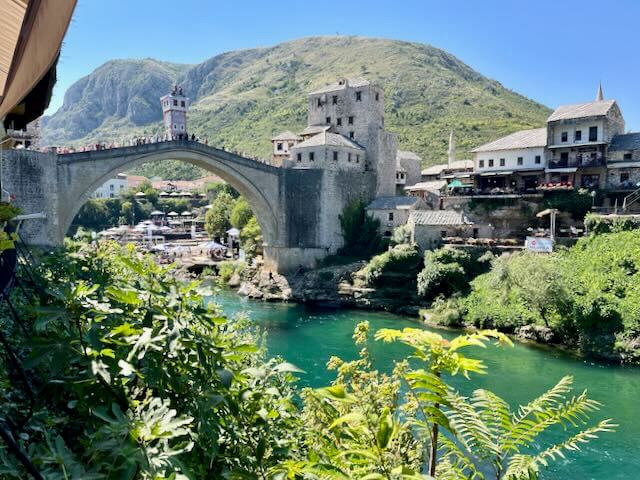
Following my busy first day in Sarajevo, on my next day in Bosnia and Herzegovina I went to Mostar. I wanted to see a little bit of the countryside and also, I wasn’t going to leave the country without seeing the famous bridge. Mostar is a small city about 130 kilometres away from Sarajevo and is famous for having a beautiful Ottoman era bridge: Stari Most, which, not so creatively, means “old bridge”. This also gave me a great opportunity to take the train.

Train from Sarajevo to Mostar

To get to Mostar is easy; you can drive, take the train, or take the bus. There are lots of train and bus schedules per day and they take roughly the same amount of time. But I wanted to take the train. The first train in the morning was 7:15am so I left my hostel early and walked to the train station in Sarajevo. (I probably should have just taken a tram to the station, which would have been faster as there is a stop right there, but it was a pleasant time for a walk.) The 1949 train station is this interesting communist era functionalist structure, concrete with high ceilings and Olympic murals. And best of all, people were smoking inside. I went to the ticket office and queued up in front of a man who sold tickets and stamped papers with a demeanour that I would also describe as communist era and functionalist. It really felt like I was transported to another time.

Train Station Sarajevo Exterior
Train Station Sarajevo Interior

The ticket was 22 Bosnian Marks round-trip. That’s about $16.00 Canadian.

ticket office
round trip ticket

The trip takes just under 2 hours and it is utterly delightful. The most gorgeous scenery passes: small villages, green hills, and lakes and rivers. And the seats are quite comfortable. I visited the gleaming dining car and got coffee, which was fine. (Don’t count on much in the way of snacks.)

the Talgo Train
on board

views from the journey

We arrived at the train station in Mostar.  From the train station, it is a short walk to the historic part of the city and the bridge. The newer part of the city is perfectly fine but not completely charming. The best thing that I saw on the way to the historic centre was a building of indeterminate former use that had fallen into disrepair and covered in graffiti.

Mostar Train Station
abandoned building

Into the heart of Mostar

The historic centre of Mostar is what I was there to see (along with everyone else). Cobble-stoned alleys and shops, pretty buildings, restaurants, a bridge, and a river (Neretva River). The streets with shops are extremely touristy but very nice to walk. The closer you get to the bridge, the thicker the tourists get, crowding around to take perfect shots of themselves standing in front of the bridge. I can’t really blame them; it is gorgeous, and if I had been traveling with someone who wanted to take my picture maybe I would have done that too.

But before I was ready to delve into the throngs around the bridge, I wanted coffee. There are several cute little cafes perched on the cliffs high above the river that offer excellent views. I picked what appeared to be the cutest of them. It was set back just behind a little market where local vendors were selling liqueurs and honey. I went to the cafe and sat facing the bridge smoking a cigarillo, drinking Bosnian coffee and eating a Hurmašice, a Bosnian cake soaked in spice syrup.

honey and spirits for sale

Café, coffee, and cake

Stari Most

I finished my snack and walked closer to the bridge. It was built by the Ottomans in about the 15th century, but then was destroyed during the Bosnian War in the 1990s it was finally rebuilt in the early 2000s. It’s become incredibly famous and is one of those sites that people share and pin and dream about visiting. And it is beautiful. It is a very attractive bridge in a very attractive setting. What I didn’t realize until I went there was how stunning the surroundings are. It is not really just the bridge, it’s the river and the surrounding green hills dotted by mosque minarets and charming little streets. It is absolutely lovely.

Neretva River
Neretva River and Mosques

Mostar river views

I crossed the bridge and wandered around the other side and continued poking around, but at that point I was kind of done. I came to see the bridge and to wander around and I did that. I had no desire to spend more time. It was just so busy with tourists, and I can’t blame them (I am also a tourist), but I also didn’t want to be stuck in their crowds any longer. My train to return to Sarajevo was supposed to leave at about 3:00pm, but I didn’t feel like staying that long, so I stopped and had a final lunch overlooking the bridge, where I watched people preparing to dive off it into the river below, and then I found a bus station.

Mostar

Mostar views.

on the other side of the bridge
Lunch with a view. There was nothing vegetarian on the menu, so they made me a plate of delicious roasted veggies.

Busing back to Sarajevo

There are numerous buses a day that go in between Mostar in Sarajevo I picked one that was leaving at about 1:00pm and bought a ticket. I don’t remember how much it was, but it was cheap. The views were just as lovely as the train trip had been. And I was back in Sarajevo by about 3:00pm, which gave me the opportunity to spend the rest of the day enjoying more of that city. I’ve written about that in the previous post here. Was Mostar worth visiting? Absolutely. Not just for the destination but also for the wonderful train ride to get there, but I didn’t need to spend more than a few hours there. I’d rather spend my time in Sarajevo than gazing at bridges and fighting crowds.  Plus, this was my final full day in Bosnia and Herzegovina.  The next day I was going to bus to Montenegro.

Read More about Day Trip to Mostar
Posted on 8 September 23
0
Posted inBalkans Trip 2023 Bosnia and Herzegovina Europe

At the crossroads in Sarajevo

I flew to Sarajevo from Zagreb. Sarajevo wasn’t supposed to be the highlight of my Balkans trip that year, but it ended up being just that.

flag of Bosnia and Herzegovina
Sebilj in Sarajevo (Ottoman wooden fountain)

Arrival in Sarajevo

Sarajevo is the capital of Bosnia and Herzegovina, the country that has been many things. I will not even attempt to describe the history of the geography of this part of the world and the many conflicts that led to it being what it is today, but in a nutshell, when Yugoslavia broke up in 1992, following the collapse of the Soviet Union, it was divided up into a series of states including the Socialist Republic of Bosnia and Herzegovina. When that Republic had a referendum to decide whether it should further subdivide, the Bosnian War broke out. A localized conflict between Bosniaks, Serbs, and Croats which became an international armed conflict complete with war crimes and genocide. It was probably inevitable. A perfect storm of conflict that dealt with history, culture, geography, and religion. It is probably still the thing that most people think of when they think of Bosnia and Herzegovina.

I arrived very late at night in Sarajevo and was picked up at the airport by a guy and a gal who run a tour company in the city (Meet Bosnia Tours).  My hostel had arranged for them to pick me up because there wasn’t proper transportation at that late hour.  I later looked them up and saw that the guy had given Bill Clinton a walking tour of Sarajevo, complete with pictures on the website. I decided that I would do their free walking tour the next morning.

I was staying at the Franz Ferdinand Hostel. It was cheap and centrally located and really felt more like an apartment than a hostel. I had a private room with a small bathroom and a shared kitchen in a hallway where there was a timeline of the events of World War One marked on the floor. My room was near the Battle of the Marne.

Franz Ferdinand Hostel

Morning walk

The next morning, after a good night’s sleep, and thankfully not dreaming about over half a million dead European soldiers, I went out into the city. Sarajevo is so intriguing. Divided by the Miljacka River, it is also divided between East and West. Sarajevo was the administrative seat of both the Ottoman Empire and the Austro-Hungarian Empire, and it displays its divided past proudly. One side of the city feels a bit like Turkey, with mosques and narrow streets cafes selling Turkish coffee and baklava with carpets and shisha. The other side has churches, ornate buildings, cafes selling Viennese style coffee and cakes, and more western European style streets.  It quite literally feels like the best of both worlds.

scenes in a divided Sarajevo

The first order of business, of course, was coffee. Bosnia has its own coffee, Bosnian coffee, which is very similar to Turkish coffee (for the reasons just described), but the preparation is a little bit different.

Bosnian Coffee

I had a coffee (delicious) and wandered around the square, visited a church, and started to explore the streets. I walked along the river, which is very picturesque with numerous bridges old and new. I crossed to the other side. And meandered around residential streets. Rough looking but well cared for buildings, flowers, a bit of street art. There were some curious statues of circus performers strung across the river. I stopped to browse booksellers setting up along the river before making my way to the appointed spot for my free walking tour.

Sacred Heart Cathedral
Festina Lente bridge
circus sculptures over the river

A tour through history

I haven’t done one of these free walking tours in a long time. I think they are excellent opportunities to learn a little bit about a city and the history and pay only whatever you think is appropriate for a tip, but often the schedules don’t suit me, or I’d rather just explore on my own. But the history of Sarajevo is so complicated, and the current state of things is still contentious, and I really hoped to learn something from the tour, so I joined. I’m glad I did. I got all the information that I could have wanted, including about how there are still tensions in Bosnia and Herzegovina. Some people would prefer the country to fracture further into newer smaller countries, and ethnic and religious differences are still a source of strife. The only downside of the tour was that it was enormous. There were about 30 people, and while I made a point of always being up at the front of the group, it was a bit too large and could have been a little bit faster paced with a smaller group; but it was free, friendly, and informative.

Armed with my new knowledge, I really appreciated the city even more. I notice the bullet holes that cover so many of the buildings. Some have been completely repaired, others simply plastered over so you can so you can still see where they landed, and some have been left as reminders of the not-so-distant past. There are places, like in front of the cathedral, where bullet holes and mortar shell damage is marked by red paint as a reminder of those who died on that spot. It is one of those places where the war is so recent that when you walk around you realize that everyone that nearly everyone you see either lived through or fought in the war or has parents who did. So the scars, like the bullet holes, were still fresh.

bullet holes and markers of death at the base of the Sacred Heart Cathedral

There are, as I understand it, several very good museums in the city about the war and the genocide and those experiences. Unfortunately, because I was only there for a short time, just two days (and one spent visiting Mostar) made the choice to skip the museums. If I were going back, they would be top of my list.

In terms of historical sites, I think my favourite spot was seeing the place where Gavrilo Princip stood when he assassinated Archduke French Ferdinand on 28 June 1914. In case you don’t already know, I like history. I even have a degree in it (which doesn’t mean that I know a lot it just means that at one point I studied it a bit) and the First World War is my favourite war. I know it’s weird to have a favourite war, but for a variety of reasons that I’m not going to go into in this post, I’m fascinated by World War One. To see the spot where 19-year-old Gavrilo Princip the Archduke Franz Ferdinand (and his wife), was amazing. This is the act that set into motion the First World War the end of the empires of Europe, and really the start of the modern 20th century. As a cynical friend said to me “if it hadn’t that act, it would be something else that started the war.”  That’s true, but it wasn’t something else; it was this, and the spot itself is fascinating.

There’s a small marker which is very politically neutral. This might seem surprising given that it is a marker of an assassin and murderer, but as the tour guide explained to us Gavrilo Princip’s legacy in the country is divided. Some people view him as a hero and others as a terrorist or anarchist. So the marker does not refer to the moral quality of his act, it simply notes that this is where it happened.

the assassination happened at the foot of this bridge (the Latin Bridge), at the corner of the pink building
Gavrilo Princip marker

More walking and sights

I spent most of my time in Sarajevo doing what I always do walking around taking insights looking at interesting buildings and historical spots, drinking coffee and smoking when I can. The coffee in Sarajevo was great the food, for vegetarian it wasn’t so great, and at this point I was entirely sick of burek, the ubiquitous Balkan greasy cheese pies.

I had a cigar and coffee and the excellent Cafe Divan, hidden away in a pretty courtyard, thick with smoke.

Café Divan

I visited the Gazi Husrev-beg Mosque, and wandered the streets.

Gazi Husrev-beg Mosque

Abandoned bobsled hike

One thing I was excited to do in Sarajevo was to explore the bobsled track on Trebević Mountain.  In 1984 Sarajevo hosted the Olympics, and as part of that, they built a bobsled track on the mountain. Due to years of neglect, and probably the war, the bobsled track has fallen into ruin. Just across the river you can walk and follow the signs to the cable car and for a small fee it will whisk you up the mountain.  (The cable car, originally built in the 1950s, was completely destroyed during the war, but was rebuilt in 2017-2018.) The ride is 9 minutes long, whisking you 500 meters up, and when you finish you are 1164 meters high on Mount Trebević, with excellent views of the city.

near the stairs leading to the gondola
gondola
me on Mount Trebević

From the gondola, you can go hiking on the mountain or follow the signs to the bobsled track, which is what I did. Almost immediately I ran into another girl (Canadian and traveling solo), and we decided to walk along and then hike back up the track together. I was thankful for the company.

The bobsled track is excellent, particularly if you love abandoned places and graffiti, which I do. It winds through the mountain and is completely covered in graffiti. In places it is intact, in other places it is broken. Effectively, you walk to the bottom of it and you have to hike back up to the top which seems a bit punishing in the heat, but it’s not too long and it is certainly a good exercise. Apart from a couple other people we passed, we were entirely alone on the track, which gave it a bit of a delightfully eerie feel.

Zlatna Ribica

Following way descent from the mountain, and parting ways with my short-term companion, I made my way to one of the best bars I’ve ever been to. Zlatna Ribica. (Goldfish.) In the centre of Sarajevo but, it’s not something that you would likely stumble across if you were just walking around as it is a bit tucked away. It is a delightful tiny bar, warm with browns and golds cluttered with objects and antiques. It feels like the sort of place that you might go to have your fortune told by a mysterious old woman. There was soft jazz music playing and a cool goth girl serving drinks when she wasn’t knitting and smoking cigarettes. I asked for the menu, and she brought me a deck of cards. Each card had written on it in sharpie a drink. There were two people in there smoking cigarettes which was amazing to me, because, while smoking on patios in Sarajevo was certainly allowed, I hadn’t seen anyone smoking inside. I asked the girl if it would be possible for me to smoke a cigar inside and she simply shrugged and said in deadpan heavily accented English “Why would it not be ok?”  And that’s when it became my favourite bar. I had previously wondered where to smoke cigars in Sarajevo? I had found my spot. I sat in there and smoked a cigar and had a drink and listened to the music and was the happiest I had been all day. And it was a good day to start with.

Goldfish Bar & cigar

Wrapping up Sarajevo

I had three nights and two days in Sarajevo, which probably would have been enough time to really do it justice, except that on my second day I wanted to visit Mostar, and did, so everything that I’m describing in this post is what I did on day one. The following morning, I went almost immediately to Mostar, and I got back in the afternoon and spent my final evening in Sarajevo wandering the streets, eating local food (I found some vegetarian dumpling dish), smoking shisha, and trying to cure a recently onset cold with local apricot and honey brandies. This was before taking a bus to Montenegro.

I just loved Sarajevo. Just a wonderful combination of cultures in a historically fascinating place. I could definitely go back.

Read More about At the crossroads in Sarajevo
Posted on 8 September 23
0

About Wandering North

Welcome to Wandering North, where I have been blogging about my travels since 2007.

Dale Raven North

Recent posts

  • Where to Smoke Cigars in Detroit 7 April 25
  • Toronto Layover: A Mediocre Experience 7 April 25
  • Detroit: A Surprising Weekend in Motor City 7 April 25
  • 24 hours in Belize City 23 March 25
  • Island Life in San Pedro, Belize 22 March 25

Search

Archives

Categories

Theme by Bloompixel. Proudly Powered by WordPress